

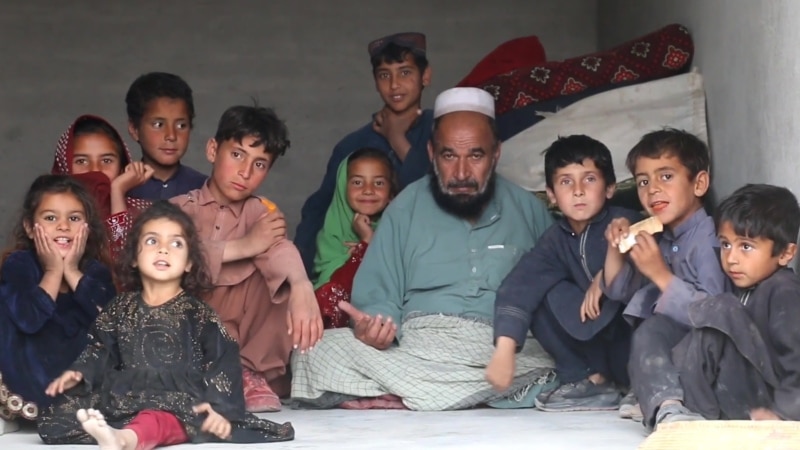
Forty-year-old Hazrat Salam had never spent more than three days apart from his family. Now, after nearly two months away from home, his only wish is for the Pakistan-Afghanistan border to reopen so he can return to work at the crossing and be reunited with his family.
A resident of Landi Kotal, a British-era cantonment town overlooking the strategic Torkham border crossing in Pakistan’s Khyber tribal district, Salam earned a living transporting modest quantities of goods across the border, making multiple crossings a day.
But because the border is closed, he is now forced to travel in search of work nearly 200 kilometers to the city of Rawalpindi in Pakistan’s Punjab Province, leaving his ailing wife and three children at home.
On October 12, 2025, Pakistan closed nearly a dozen formal and informal land crossings with Afghanistan following the eruption of deadly clashes between the two neighbors a few days earlier. The fighting lasted for several days and resulted in casualties and material losses on both sides.
The prolonged closure has brought cross-border trade to a standstill, leaving tens of thousands of people on both sides without work. It has also disrupted commercial activity and strained longstanding family and social ties across the border.
“For 20 years, I would leave for work after having breakfast with my family and return home before dusk to have dinner with them, earning a handsome amount each day,” Salam told RFE/RL. “But the border closure has forced me to travel as far as 200 kilometers from my hometown in search of work.”
Mostly Pashtun tribes live on either side of the British-era Durand Line, drawn in 1893, that demarcates the border between the countries. Successive Afghan governments, including the so-called pro-Pakistan mujahedin administration of the late 1980s and the Taliban, have refused to formally recognize the Durand Line as a permanent international border with Pakistan, thus making it a perpetual bone of contention between the two neighbors.
Islamabad accuses Kabul of harboring Tehrik-e Taliban Pakistan (TTP) militants who carry out attacks inside Pakistan, a charge the Taliban authorities deny. Pakistani forces have carried out multiple strikes on regions in Afghanistan this year, reportedly killing and injuring over 1,000 civilians and straining already-tense relations between the neighboring countries.
One such attack on the Pakistani military in October last year prompted Pakistan to launch air strikes inside Afghanistan. The Taliban retaliated by targeting Pakistani border posts, triggering several days of deadly clashes.
Since then, all major border crossings have remained closed, marking the longest-ever border closure between the two neighboring countries.
Just this week, Pakistan carried out a round of air strikes on October 1 on two Afghan provinces near the border based on “credible evidence” of militant activity in the area, killing 10 civilians, according to the UN Assistance Mission in Afghanistan.
Following the strikes on the Kunar and Helmand provinces, Pakistani authorities claimed that 22 militants had been killed, while the UN Assistance Mission in Afghanistan (UNAMA) confirmed that 10 civilians were killed in the attack, including women and children.
In a recent report, UNAMA said 1,100 civilians have been killed and injured in Afghanistan from cross-border violence so far this year.
Trade At A Standstill
The closure has affected not only bilateral trade involving huge consignments and millions of dollars, but also thousands of laborers, truckers, restaurant owners, retailers, farmers, auto mechanics, cab drivers, and others whose daily wages were dependent on cross-border movement.
Hakeem Khan, 30, a resident of Landi Kotal town, had to close his restaurant and lay off all 11 employees as hopes of the border reopening dwindled.
Khan’s father, and before him his grandfather, had run the restaurant, which he said had provided the family with a respectable monthly income. But now, after laying off his workers, Khan has had to seek a manual labor job for himself.
“We’ve had to borrow money from relatives and friends to pay rent for the restaurant and our family expenses,” Khan told RFE/RL.
Trade and business activity has been suspended for a year at all five major border crossings — Torkham, Chaman-Spin Boldak, Ghulam Khan, Kharlachi, and Angoor Adda — affecting millions of people.
Niamat Pashtun, a resident of the Chaman district of Pakistan’s Balochistan Province, used to cross the border weekly at Chaman-Spin Boldak to trade goods, earning an average of 15,000 rupees ($156) a day. Pashtun now says his daily earnings have fallen to less than 2,000 rupees ($21), which isn’t enough to support his family of nine.
The sprawling border town of Chaman joins the Spin Boldak district in Afghanistan’s southern Kandahar Province. Just across the border lies the Wesh Bazaar in Spin Boldak, long a major attraction for Pakistani traders, mostly from Chaman, who buy imported goods such as mobile phones, household items, and auto parts and resell them back in Pakistan for a profit.
Pashtun was running an auto parts and computer business. Since the border closed, he moved his business to Quetta, the capital of Balochistan. But he told RFE/RL that the security situation in the restive province has affected business there.
“Now, my family is dependent on the remittances that my brother sends from South Africa,” he said.
Communities Torn Apart
For decades, trade activity and community ties were a lifeline for millions of people living along the border. But the closure has rendered tens of thousands of people jobless and Pashtun communities, many of which span the border and would frequently go back and forth for family occasions, rent apart.
Pakistani authorities introduced gradual restrictions since 2001, when US/NATO forces invaded Afghanistan following the September 11 attacks on the United States. As the so-called war on terrorism continued, Pakistan erected a barbed wire along the border in 2017, saying it would keep out militants.
Since the Taliban seized Kabul in August 2021, violence surged in Pakistan with increasing attacks from the Tehrik-e Taliban Pakistan (TTP) stoking tension between Pakistan and its erstwhile allies, Taliban.
The TTP has ideological ties to the Afghan Taliban, and its members hosted much of the Taliban and Al-Qaeda leadership following 9/11 in its Waziristan sanctuary, just across the border in Pakistan.
For Islamabad, the yearlong border closure is seen as a pressure tactic to force the Taliban to take action against the TTP. But for the family split down the border, it has affected every part of their lives.
Safarash Khan, 25, says family is the most important thing in life. “It has been a year since we last saw our close relatives who live across the border in Pakistan,” said Khan, a resident of the town of Torkham in Afghanistan’s Nangarhar Province.
Border communities would often travel and meet for marriages, funerals, and Eid festivals. In addition, thousands of Afghans regularly visited Pakistan for medical treatment.
Khan told RFE/RL that his auto parts business at the Torkham border earned him an average 15,000 rupees a day. “Now we’ve had to close our business because we couldn’t pay the mechanics and laborers whom we used to employee on a daily basis.”
In Pakistan, the border closure has affected the agriculture, livestock, and construction industries as well as its exports of honey, rice, sugar, and maize to Afghanistan. On the Afghan side, growers and exporters of fresh produce faced plummeting demand and prices, and thousands of tons of fruit and vegetables had to be destroyed after loaded trucks waited in vain at the border last fall.
According to customs officials, bilateral trade has dropped in recent years, as the value of Afghan goods transiting the border dropped from $6.7 billion in 2023 to $367 million in 2026. In the 2024-25 financial year, a total of 42,959 shipping containers crossed from Afghanistan to Pakistan; so far, in the 2025-26 financial year, that figure is only 11,592 containers.
According to Pakistan’s Business Recorder newspaper, before October 25, Pakistan exported roughly 20 percent of its poultry production to Afghanistan. Since then, that figure has dropped to virtually zero.
Ziaul Haq Sarhadi, a former deputy head of the Pak-Afghan Joint Chamber of Commerce and Industry, said the yearlong border closure has deprived Pakistani traders of approximately $1 billion in exports to Afghanistan.
He added that it also disrupted Pakistan’s exports to Central Asian countries that rely on Afghanistan as the shortest and least expensive land route. In addition, Pakistan has seen an increase in the prices of Central Asian cotton and legumes, which were previously imported through Afghanistan.
Sarhadi says Afghanistan’s exports to India through Pakistan’s Wagah border crossing have also suffered losses of roughly $200 million in the past 12 months.
Pakistan’s Karachi Port, in Sindh Province, has long been a key hub for Afghan transit trade. According to Pakistan’s Dawn newspaper, between 40,000 and 45,000 containers used to transit to Afghanistan through the port each year, generating roughly $160 million annually for Pakistan.
Sarhadi says the border closure has deprived Pakistan of that revenue, as well.
