


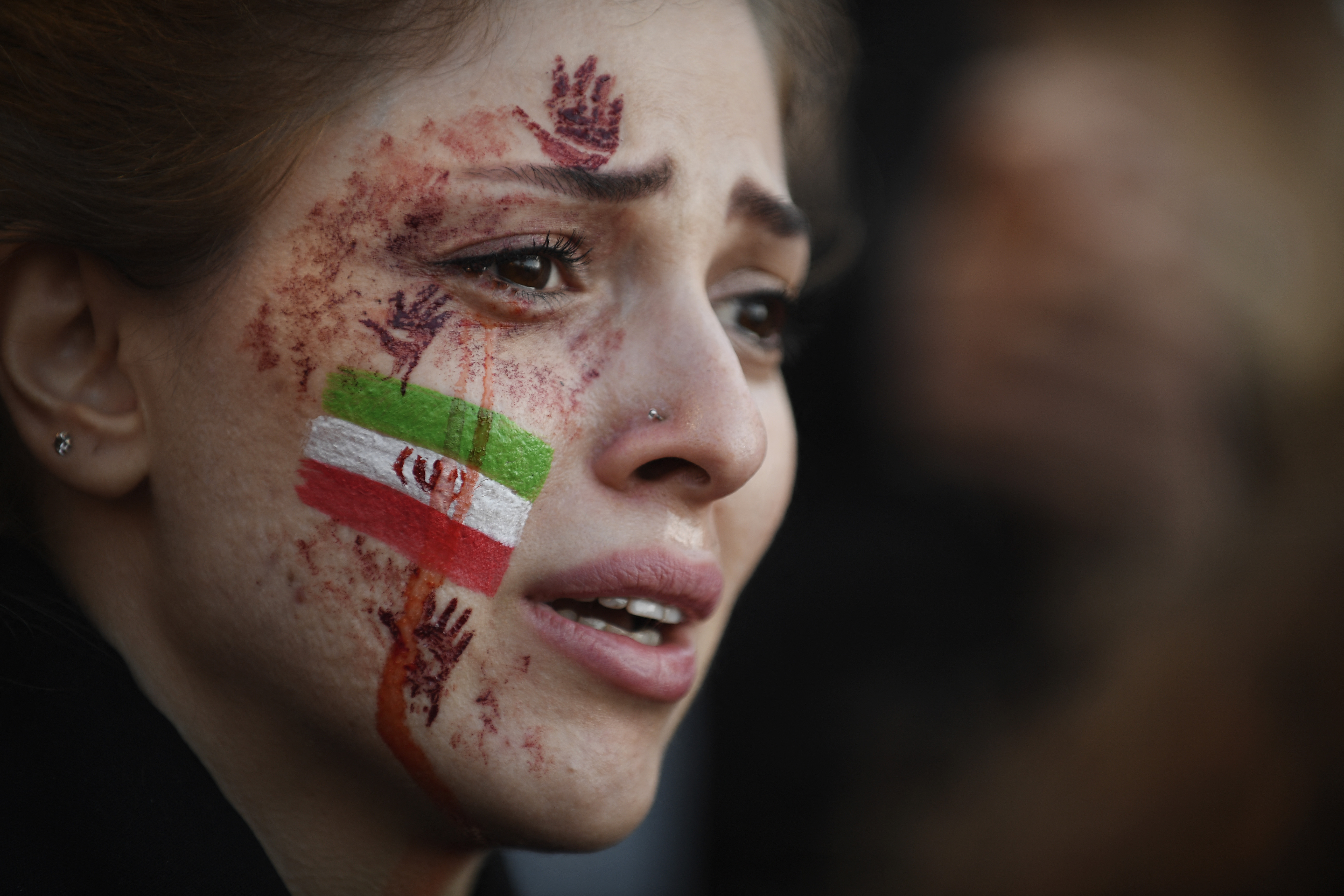
A demonstrator with an Iranian flag and red hands painted on her face attends a rally in support of Iranian protests, in Paris on October 9, 2022, following the death of Iranian woman Mahsa Amini in Iran.
Afp Or Licensors
Many human rights organisations, women’s rights activists and some diplomats, including in the UN, are using the term gender apartheid to describe the current situation of women and girls in Afghanistan and Iran. Swissinfo looks at what it means and the campaign to get it recognised as an international crime.

What constitutes gender apartheid?
Gender apartheid is not yet recognised as a crime against humanity, although gender persecution is. Apartheid is recognised, but only on the grounds of race, since it was defined in the context of South Africa. The Rome Statute of the International Criminal Court (ICC) defines apartheid as inhumane acts “committed in the context of an institutionalized regime of systematic oppression and domination by one racial group over any other racial group or groups and committed with the intention of maintaining that regime”.
According to Richard Bennett, the United Nations Special Rapporteur on human rights in Afghanistan, if the word racial were replaced with gender, this definition would apply to the situation of women and girls in Afghanistan under the Taliban. Activists are also applying the term gender apartheid to the situation of women and girls in Iran.
“First, it requires the existence of an institutionalised regime of systematic oppression and domination, and second, it is a crime of special intent,” explains Sareta Ashraph, an international criminal lawyer specialising on gender crimes and faculty member of the Geneva Academy of International Humanitarian Law and Human Rights. “It requires the perpetrator, when committing an inhumane act, do so with the intent of maintaining that regime of systematic oppression and domination – in the case of gender apartheid, one gender group over another gender group or groups.”
More
More
Inside Geneva: what now for women in Afghanistan?
What is the difference between gender persecution and gender apartheid?
UN Special Rapporteur Bennett has described the situation of women and girls in Afghanistan as the crime against humanity of gender persecution, since that is recognised under international law. The International Criminal Court in 2025 issued arrest warrants for two top Taliban leaders for gender persecution. Bennett says we “should not underestimate the crime against humanity of gender persecution”. But for this there needs to be an identified victim and an identified perpetrator. “It’s not a crime by a state, but by individuals, whereas gender apartheid would also look at the actions, policies and laws of a state,” he told Swissinfo.
Does gender apartheid apply only to women and girls?
Gender apartheid couldpotentially also applyto other groups targeted on grounds of their gender identity. In Afghanistan, according to Bennett, it applies to the LGBTI community as well, “which is severely threatened and discriminated against”. It could apply to the gay community in other countries such as Uganda, where the government has introduced draconian lawsExternal link against the LGBTI community, including a death sentence for some homosexual acts.
Who is supporting the campaign to get gender apartheid recognised?
The push to get gender apartheid recognised is spearheaded by the End Gender ApartheidExternal link campaign, led by Afghan and Iranian women’s rights defenders, as well as international lawyers and experts. Prominent international human rights organisations such as Amnesty International and Human Rights Watch also support it. The term has been used by top UN officials, including UN High Commissioner for Human Rights Volker Türk. Around ten countries were said to support the campaign at the end of 2025.
More
More
Inside Geneva: Are we throwing away international law?
How can this be done?
There are two ways – both lengthy – that gender apartheid could be recognised as an international crime. One is to amend the Rome Statute of the International Criminal Court, but this is not currently on the table. The other is to include it in a new UN Convention on Crimes against Humanity, which is currently under discussion in New York.
What are the prospects?
Discussions have been ongoing in New York for years on a new Crimes against Humanity ConventionExternal link. However, they received new impetus in November 2024 when member states agreed it was necessary and set some dates. A new round of talks is due in 2026. According to Azadah Raz Mohammad, an exiled Afghan lawyer and legal advisor at the End Gender ApartheidExternal link campaign, the campaign to get gender apartheid included is currently supported by at least 11 statesExternal link, and she hopes more will come on board in 2026. None are “openly resisting”, she says, but admits that “the issue of gender is once again coming under attack internationally”. International lawyer Ashraph expressed this concern too, pointing particularly to US government funding cuts under US President Donald Trump to NGOs working on gender justice.
If gender apartheid is included in the new Convention, Bennett says this will also put expectations on other states and non-state actors such as businesses “not to support a regime where there are allegations of gender apartheid”. But, he stresses, there is a long way to go, because the earliest the treaty might be adopted is 2029, and then there have to be sufficient ratifications by states before it comes into force.
New UN Conventions always take time, but Mohammad is hopeful that this one will be adopted by 2029 or 2030. “There are at least a few gendered crimes that will be codified under the treaty,” she told Swissinfo. “These are forced marriage, slavery, and then gender apartheid is probably the most debated, the hardest. Maybe heavy lifting is needed to pursue it, but we are completely getting ready for that.”
Edited by Virginie Mangin/ts


