


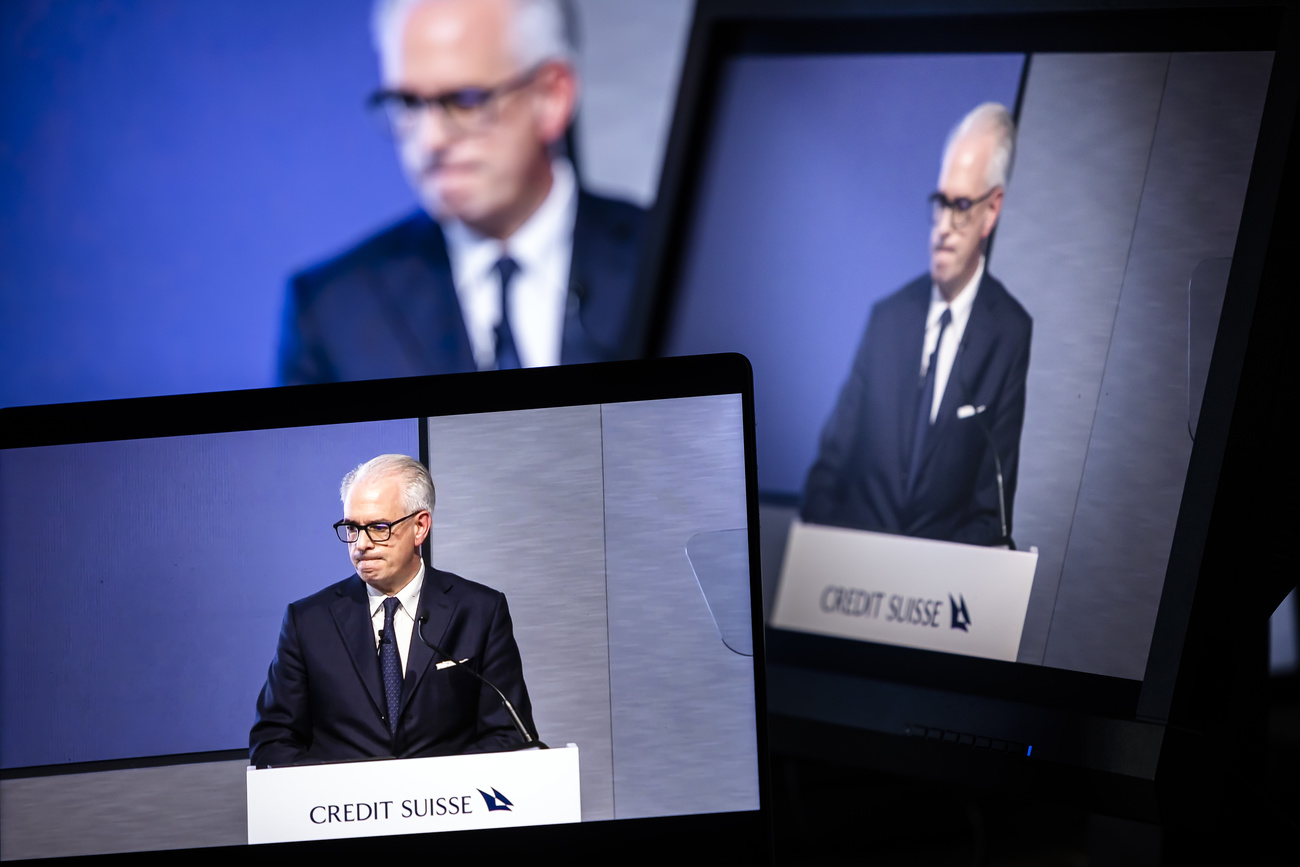
The former chair of Credit Suisse, Urs Rohner, denies the Swiss finance ministry’s findings.
Keystone-SDA
The former chair of Credit Suisse bank has been fined CHF25,000 ($30,000) for allegedly making false statements to Swiss regulators during a probe into surveillance of staff.
The Swiss finance ministry imposed the suspended fine on Urs Rohner, who served for a decade as chair of the now defunct bank.
Rohner is alleged to have committed a criminal offence. This is according to the Swiss finance ministry in a non-final penalty decision dated October 20.
The ministry has sentenced Rohner, aged 66, who served as Credit Suisse chair from 2011 to 2021, to 144 daily fines of CHF690 each, suspended, and a fine of CHF24,840 for intentionally providing false information. The offence carries a maximum sentence of three years’ imprisonment.
More
More
Where did it all go wrong for Credit Suisse?
The reason for the ruling, which SRF Investigativ, a unit of Swiss public broadcaster SRF, and the online magazine Republik have seen, relates to the events surrounding the Credit Suisse surveillance scandal. In 2019, it emerged that the bank had arranged for former and current employees to be monitored, including the former head of international wealth management, Iqbal Khan.
Rohner withheld information
In June 2025, the finance ministry opened criminal proceedings against Rohner. Shortly after the surveillance scandal came to light, the Swiss Financial Market Supervisory Authority (FINMA) had put various questions to the bank.
It wanted to know how many surveillance contracts the bank had awarded to external firms in the previous three years and how many substantiated complaints it had received internally regarding former CEO Tidjane Thiam.
In its reply to FINMA, Credit Suisse repeated what it had already stated publicly: that Khan’s surveillance had been an “isolated incident”.
Citing investigations by the law firm Homburger, the bank reported two further cases. In 2016, it had arranged for a former employee of Thiam to be monitored following threatening emails. In the same year, there were plans to monitor a “non-employee third party outside Switzerland”.
More

More
Credit Suisse punished for corruption and spy cases
What the bank failed to disclose at the time was that this person was the ex-husband of CEO Thiam’s partner.
Rohner signed the reply dated October 25, 2019, which in the view of the finance ministry, constituted a criminal offence. This is because the FINMA investigation later revealed that between 2016 and 2019, seven surveillance operations had been planned or carried out within the bank, and external firms had been engaged in four of these cases.
Furthermore, a few days after the affair came to light, a former senior executive had complained to Rohner about Thiam and expressed suspicions of surveillance.
According to the ruling, the bank did not mention this report to the supervisory authority, even though it had enquired about substantiated complaints regarding Thiam.
Failure to investigate leads
The finance ministry acknowledges in Rohner’s favour that there was no evidence to suggest he had “specific knowledge” of the further planned or enacted surveillance operations or investigations. However, there were “sufficient indications” pointing in this direction.
More

More
Who’s to blame for the demise of Credit Suisse?
These included an invoice from a security firm for around CHF150,000 for the surveillance of Khan, which, according to the ruling, included costs for a further surveillance operation.
Although Rohner expressed surprise at the amount in an email, he did not arrange for this invoice amount to be investigated further. “In doing so, he acted in a manner contrary to the duty of care,” said the finance ministry, which largely attributes Rohner’s actions to negligence.
However, in two instances – including the planned surveillance of the ex-husband of Thiam’s partner – the ministry accuses Rohner of having acted intentionally. “The accused deliberately decided (…) to conceal the fact that the CEO was the main subject of the planned surveillance,” the ruling states.
Rohner is said to have had a motive to “play down the extent of the surveillance as much as possible”. Such behaviour on the part of the chair of a systemically important bank was “unjustifiable” – particularly in a case that threatened the reputation of the entire financial market.
The finance ministry has given Rohner “a poor assessment”, says Monika Roth, an expert in financial market law and compliance.
She analysed the penalty order for SRF Investigativ, a unit of Swiss public broadcaster SRF, and says: “As chairman of the board of directors and as the addressee of the FINMA letter, Urs Rohner should have passed on the whole truth and all necessary information in full.”
“And he should have done so impartially and objectively. But he did not do so. He responded selectively, disregarded his duty and acted carelessly and superficially.”
Rohner rejects allegations
Rohner has not answered detailed questions from SRF Investigativ, citing the ongoing proceedings. In a written statement, he states that he rejects all allegations “in their entirety and emphatically”.
He states that during his tenure he never provided “knowingly or wilfully false information” to FINMA or other authorities. On the contrary, in autumn 2019 he went to great lengths to review all the available facts “within the short time available at the time” and to ensure that the bank answered the questions correctly and in full.
Rohner has not accepted the 81-page ruling and has requested a judicial review. The statement adds that Rohner is “convinced that the allegations are unfounded” and that he is “confident… that they will not stand up to judicial scrutiny”.
The case will therefore next be heard by the Federal Criminal Court in Bellinzona. Urs Rohner is presumed innocent.
During the proceedings, Rohner maintained that he had relied on the law firm’s assessment that the report made by the senior staff member regarding Thiam did not constitute a substantiated complaint. In the case of the ex-husband of Thiam’s partner, Rohner argued, among other things, that it was a private matter.
The finance ministry disputes this: the matter became a company affair when Thiam commissioned the bank to carry out the surveillance and the bank initially covered the costs.
Monika Roth shares this view: “His argument is a completely implausible defence. He knew that what he was telling FINMA was not true.”


