


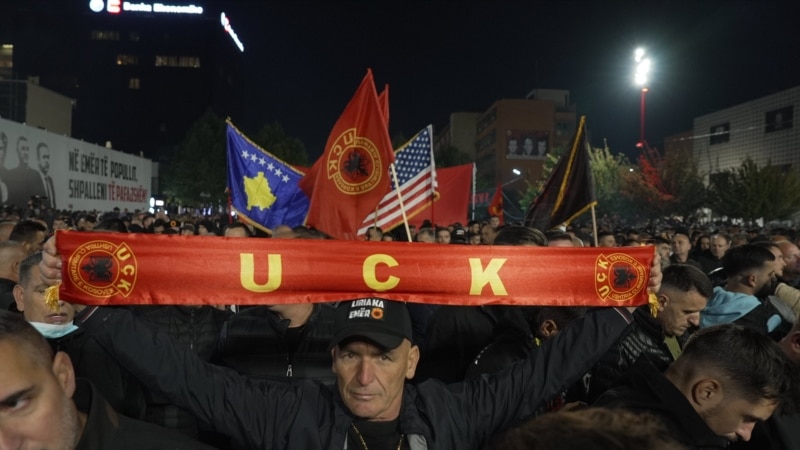
The European Union has expressed “deep concern” over Kosovo’s adoption of legislation that seeks to narrow the jurisdiction of a Hague-based war crimes court, saying the changes violate the country’s international obligations toward the bloc.
The amendments, approved by parliament on October 6, target the Kosovo Specialist Chambers, which last month convicted former President Hashim Thaci and three other former Kosovo Liberation Army leaders of war crimes.
In a response to RFE/RL on October 7, an EU spokesperson said the legislation “goes against Kosovo’s international obligations toward the EU.”
“Their current mandate and independence must be fully respected,” the spokesperson said. “The Kosovo Specialist Chambers are rendering justice, based on the principle of individual criminal responsibility.”
Perparim Gruda, a lawmaker from the opposition Democratic Party of Kosovo (PDK), which initiated the amendments, rejected the EU’s assessment.
“I can assure the EU that we are not violating any international obligation with this law,” he told a news conference.
Gruda said he had not personally seen the EU statement. He cited European Commission President Ursula von der Leyen’s recent remarks in Pristina, which he characterized as affirming Kosovo’s right to amend the law.
RFE/RL contacted Kosovo’s government about the EU’s criticism but had received no response by publication.
During the bill’s first reading on October 5, Prime Minister Albin Kurti said his Vetevendosje party considered the changes rushed and had little time to analyze them but would support them nonetheless.
The Kosovo Specialist Chambers declined to comment directly on the legislation.
“The Specialist Chambers is fully focused on implementing its mandate to ensure fair, impartial, and secure judicial proceedings, and to ensure the protection of witnesses and victims,” it told RFE/RL on October 7.
The amendments’ adoption was part of a last-minute agreement between the PDK and Vetevendosje that also paved the way for Justina Shiroka Pula’s election as president on October 7.
The legislation would restrict the court’s jurisdiction to offenses directly linked to organ-trafficking allegations outlined in a 2011 Council of Europe Parliamentary Assembly report.
It would also limit jurisdiction to crimes allegedly committed in Kosovo between July 1, 1999, and December 31, 2000, excluding the earlier period beginning in January 1998.
Cases outside that remit would be transferred to Kosovo’s regular courts. The amendments also envisage serving sentences in Kosovo and eligibility for presidential pardons.
The PDK introduced the initiative five days after the September 16 verdict. Thaci and Jakup Krasniqi each received 25-year sentences, Kadri Veseli 18 years, and Rexhep Selimi 13 years.
All four were convicted of war crimes and acquitted of crimes against humanity. Organ-trafficking allegations were not part of their indictment. The verdict is not final, and defense teams have announced appeals.
Parliament’s approval does not itself overturn those judgments or mean those convicted will be released.
Gruda also said the final amendment sought to reserve constitutional review of the legislation for Kosovo’s Constitutional Court in Pristina, excluding the Specialist Chambers’ constitutional chamber in The Hague.
Legal experts have warned that changes to the court’s mandate could raise constitutional issues and conflict with international obligations.
The EU stressed that the court operates within Kosovo’s legal system and is enshrined in its constitution. It urged Kosovo to ensure accountability and justice for victims from all communities.
In an exchange of letters in April 2014 between Kosovo’s then-president, Atifete Jahjaga, and then-EU foreign policy chief Catherine Ashton, Kosovo made a series of commitments concerning the Specialist Chambers.
The exchange formed the basis of the agreement that paved the way for the institution widely known in Kosovo as the Special Court.
Among those commitments was an obligation to consult the EU on any proposed legislative changes affecting the court’s mandate or judicial proceedings arising from investigations by the Special Investigative Task Force (SITF).
Kosovo also committed to allowing the Specialist Chambers and the Specialist Prosecutor’s Office to continue their work until the relevant investigations and proceedings were completed.
Still, the bloc also welcomed Shiroka Pula’s election, expressing hope for renewed institutional stability.
“While the EU is available to continue supporting Kosovo, our partnership implies not only shared interests but also shared responsibility,” the spokesperson said.


