


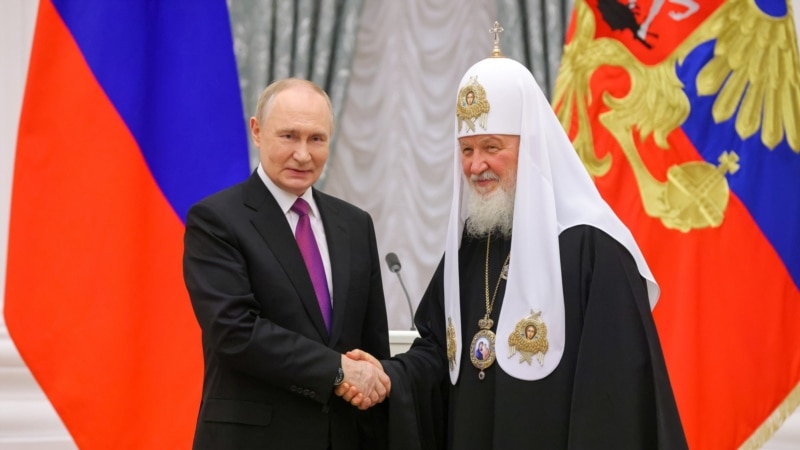
The European Union will not impose sanctions on the head of the Russian Orthodox Church and the chief of Russia’s largest private oil company, after Bulgaria vetoed the proposal.
Patriarch Kirill, a vocal support of President Vladimir Putin and public backer of the war on Ukraine, had been expected to be included in the latest round of financial penalties that the 27-member bloc was considering.
Kirill “consistently justified and supported Russia’s aggressive war against Ukraine,” calling it “sacred,” according to the sanctions proposal seen by RFE/RL.
However, according to EU officials with direct knowledge of the negotiations, the latest draft, which is expected to agreed upon in the coming days, removes Kirill from the 42-person list.
Another prominent Russian figure whose name has also been removed from the final draft: Vagit Alekperov, head of Lukoil, Russia’s largest private oil company.
Brussels has long pushed to include Kirill under the sanctions it began imposing on Russia starting in the weeks after the start of Moscow’s all-out war on Ukraine in February 2022.
But that effort was consistently blocked by the previous Hungarian government under Prime Minister Viktor Orban, on grounds that the EU should not target religious figures.
Orban and his party were voted out of office earlier this year, removing a major thorn in the side for the EU where its Russia policy was concerned.
According to EU officials who were granted anonymity to speak freely on the subject, Bulgaria has now voiced similar concerns to Orban.
Like Orban, Bulgarian Prime Minister Rumen Radev, who took office after elections in May, is seen as friendly towards Russia.
Radev’s representatives could not be immediately reached for comment.
News of the exclusion of Kirill from the final sanctions draft was first reported by Ukrainskaya Pravda.
The exclusion of Alekperov from the list was motivated in part by Lukoil’s considerable market presence in Bulgaria, EU officials told RFE/RL.
EU foreign ministers will discuss the EU sanctions package when they meet in Brussels on July 13 with a view to giving EU ambassadors instructions to agree on it before the end of the week.
Other prominent Russian officials who are expected to remain on the final list of sanctioned individuals include Arkady Dvorkovich, a former deputy prime minister who is now the head of the International Chess Federation, and Russia’s sports minister, Mikhail Degtyarev.
Other key proposals in the final sanctions package that have been watered down include restrictions on imports of Russian fish, which countries such as Germany, Poland, and Portugal still to use in food processing.
An automatic entry ban on all Russian ex-combatants seeking visas to enter the bloc has been removed, and an oil price cap on Russian crude is set to be frozen at $44 dollars per barrel for only three months, not the proposed six.
Greece has also sought an an exemption to allow it to continue to ship Russian liquified natural gas to non-EU countries whereas Austria still wants to remove some sanctions linked to Raiffeisen Bank.


