


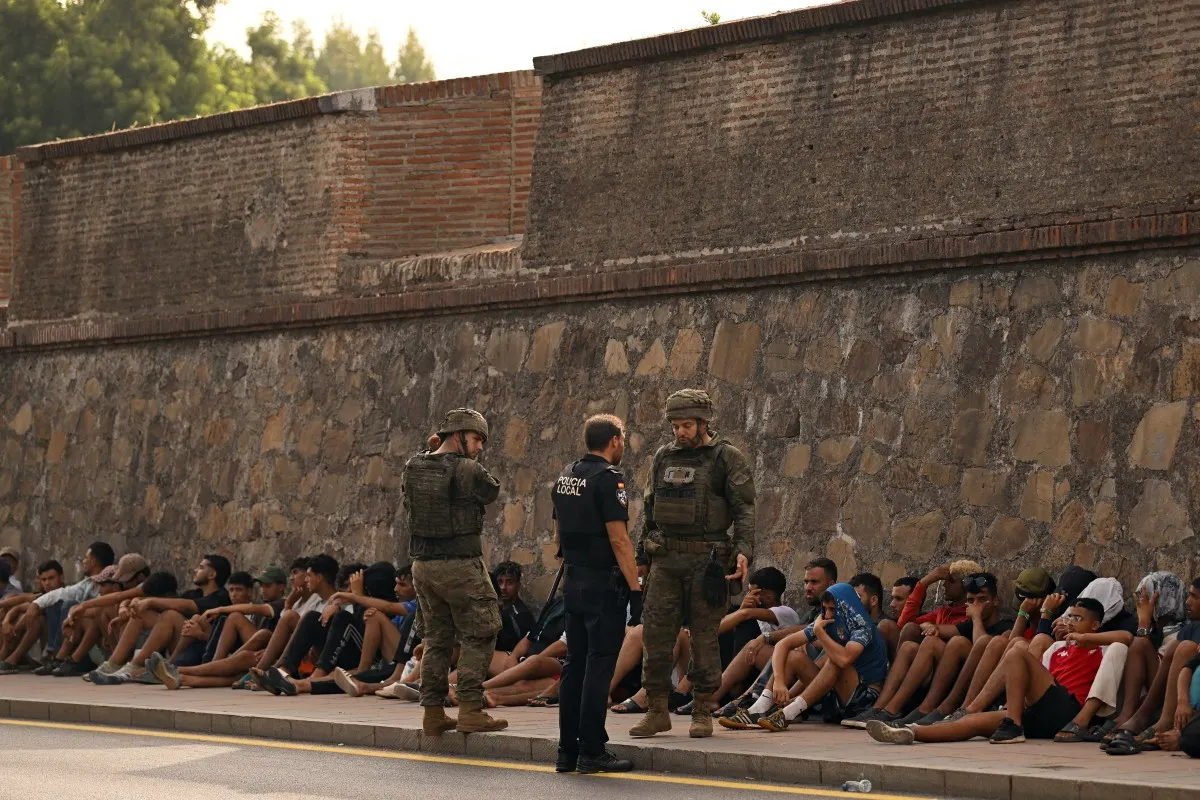
A majority of EU countries called on Saturday for emergency talks on the sudden inflow of tens of thousands of migrants into Spain’s enclave of Ceuta in North Africa.
An open letter from the leaders of 22 of the EU’s 27 members demanded the bloc’s interior ministers have a video meeting “as a matter of urgency” to agree a speedy coordinated response, and to “prevent further uncontrolled crossings”.
“We have a duty to effectively deter and relentlessly combat illegal migration,” it said.
READ ALSO: Can an EU member state be kicked out of Schengen zone?
The letter was initiated by Italian Prime Minister Giorgia Meloni, whose country has temporarily suspended Schengen-area rules with Spain, and by her Danish counterpart, Mette Frederiksen, who said on Friday that the EU should consider suspending Schengen cooperation with Spain.
Among the other signatories are German Chancellor Friedrich Merz and the prime ministers of Hungary, Sweden and Poland, but not the French and Portuguese leaders, whose countries directly border Spain.
READ ALSO: Danish PM calls for Spain to be suspended from Schengen agreement
“We cannot allow uncontrolled mass crossings, the instrumentalisation of migration or other hybrid threats to create the perception that illegal entry into the European Union is possible,” it said.
“Such a perception would encourage further attempts, undermine confidence in our common migration policy and have repercussions for all Member States.”
It suggested that “ministers should in particular consider enhanced Frontex support and the effectiveness of EU cooperation with Morocco.”
“We take note that no unauthorized onward movements have been recorded towards Europe,” it added.
Spain’s interior ministry said Saturday that nearly all of the 60,000 migrants who breached the border since Wednesday had left and the situation in Ceuta was nearly back to normal.
This comes as France’s Interior Minister Laurent Nunez on Saturday said his country would not seek Spain’s suspension from Schengen rules, after tens of thousands of migrants entered Spain’s enclave of Ceuta in North Africa.
“Spain does not need to leave the Schengen zone. It’s absolutely not on the table. We have great cooperation with Spain,” he told reporters.
His comments came a day after Italy announced that it had suspended for a month its Schengen deal with Spain allowing for visa-free movement between borders.
“We are not asking for Spain’s suspension from Schengen,” he added.
France has stepped up controls at its southern border with Spain, Nunez said.
Spanish officials have stressed that, under Schengen Area rules, Ceuta and another Spanish enclave in North Africa, Melilla, have specific procedures in place applying border controls for anybody boarding air or sea transport to mainland Europe.
Irregular entry into Ceuta does not confer a right to remain in Spain, travel to the mainland, or move freely throughout Europe, they said.


