


The unexpected election results from Maharashtra and Jharkhand brought out the importance of direct cash transfers like Maharashtra’s Ladki Bahin Yojana and Jharkhand’s Maiya Yojana. These schemes, however, have raised concerns about fiscal sustainability and the escalating competition among political parties for bigger payouts.
While direct cash transfers are seen as populist and are difficult to justify economically, they can at times serve as partial compensation for the unpaid care work performed by women. This work falls disproportionately on women because of cultural and social factors compounded by chronic care infrastructure deficiencies. Government data shows that nearly half of young women in India are neither working nor pursuing studies. Being out of the labour force closes out opportunities for gaining financial independence, and has implications for the economy’s growth potential.
Even working women endure the ‘double burden’ of balancing outside jobs with household responsibilities, which aren’t reduced despite their contributions to family income.
Care infrastructure can significantly ease the burden on women, yet government spending and execution in this area has been inadequate. A stark example is the National Crèche Scheme, which faced severe budget cuts post-Covid-19 due to low utilisation rates, leading to a drop in the number of crèches under the scheme from 25,000 in 2013 to just 3,900 in 2023. In an attempt to address this issue, the scheme has been subsumed into the Palna Scheme, which has also introduced the concept of Anganwadi cum Crèches.
However, Palna has experienced a slow take-off, with only 13 per cent of the approved Anganwadi-cum-Crèches currently operational. This highlights the pressing need to prioritise and accelerate the implementation of this scheme. The political appeal of cash transfers cannot be understated, however, reversing the Budget cuts and increasing care infrastructure investment would be a far more effective way to free up women’s time and encourage their participation in economic activities. Unlike cash transfers, such investments are less prone to competitive populist pressures and offer greater fiscal sustainability. Projections suggest that over the next three decades, India’s shifting demographics will, lead to increased demand for elderly care even before childcare needs would begin to reduce.
Gender disparity
According to India’s Periodic Labour Force Survey, nearly 79 per cent of young women cite childcare and household responsibilities as the primary barriers to participating in education or employment, compared to just 3 per cent of young men. This gender disparity highlights how care-giving responsibilities limit young women’s access to work opportunities, while also confining them to domestic roles. A recent SBI report estimated that this unpaid work done by women is equivalent to 7.5 per cent of India’s GDP in 2023.
The picture does not change much across States. The PLFS data suggests that time spent by young women on giving care to family members is high in States where their participation in education or employment is low (see Figure). This correlation is more pronounced in rural areas. Four of every five young women in villages report not participating in education or employment due to being engaged in care activities within their household.
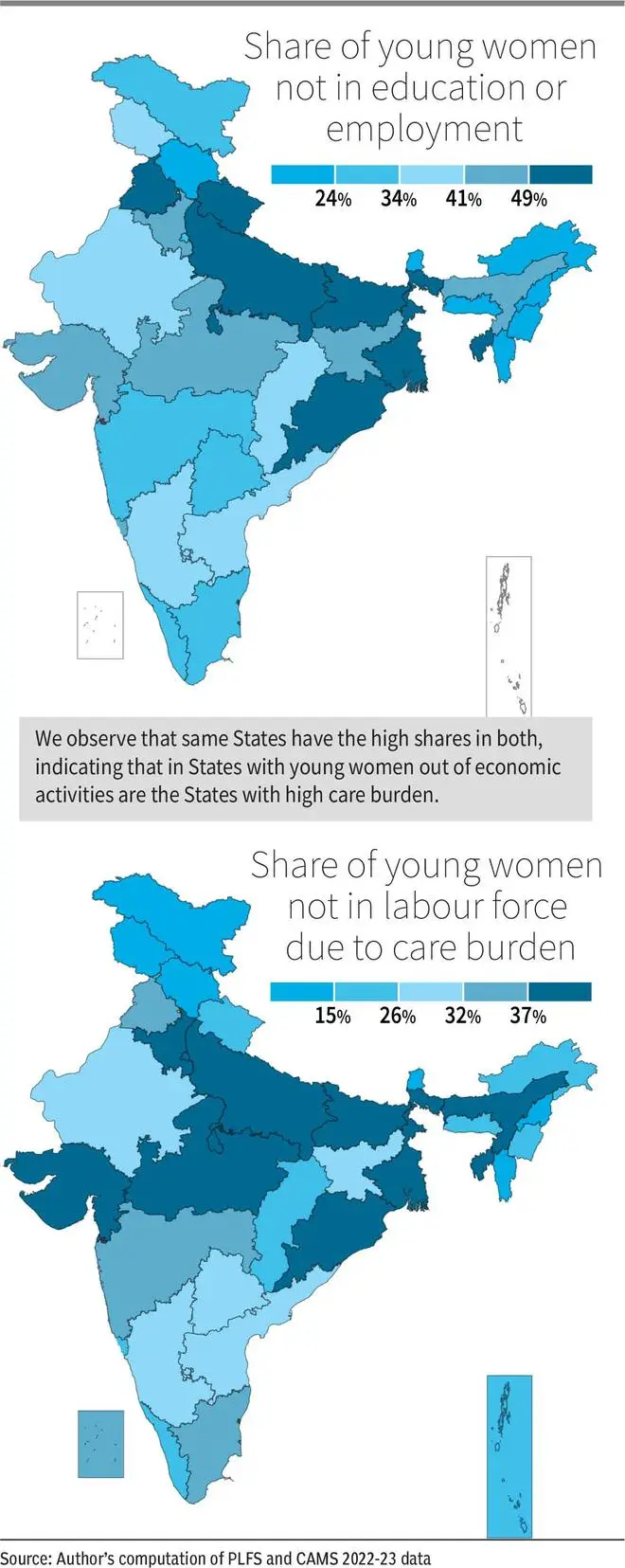
The migration of male members to cities leaving the young and elderly in the care of women, intensifies this care burden. It is further compounded by the large presence of joint families in rural areas.
Although social and cultural hurdles would also have to be addressed, still providing care infrastructure will to an extent allow these women to consider taking up education or paid work. The Central government currently spends nearly 0.1 per cent of GDP (0.73 per cent of FY 23-24 Budget) to care infrastructure and services — a relatively low figure compared to other developing countries, which earmark between 1 per cent and 3.9 per cent of their GDP to this sector.
Restoring Budget allocations is essential, but equally important is involving State governments in the design and implementation of care infrastructure and related schemes. States, being closer to the ground, are better equipped to create programmes that align with the cultural intricacies of their regions. A notable example is Karnataka’s Koosina Mane scheme, operating over 3,000 crèches in rural areas, serving more than 22,000 children. These crèches provide not only a safe space but also nutrition for the children in their care, freeing up significant time for rural women.
This has enabled many to take up work, particularly through MGNREGA, providing an additional source of income to their families. Initiatives such as this highlight the effectiveness of localised interventions and underscores the urgent need for increased fiscal transfers from the Central government to States, enabling the replication and scaling of such impactful efforts.
The writers are with ICRIER, an economic think tank based in Delhi. Views are personal


