


Peak travel season is in full swing, but are there certain Swiss regions you should not visit this summer because of alerts in place?
It is true that large areas of the country are currently impacted by drought and high wildfire risks, which will remain in effect until a good amount of rain falls – and weather forecasts are not calling for any substantial precipitation in the immediate future.
Consequently, much of the normally green and lush vegetation – from pastures and meadows to parks and forests – is currently dried out. And water level in Swiss lakes and rivers is the lowest it has been in decades.
READ MORE: Swiss rivers and lakes at lowest levels in 20 years
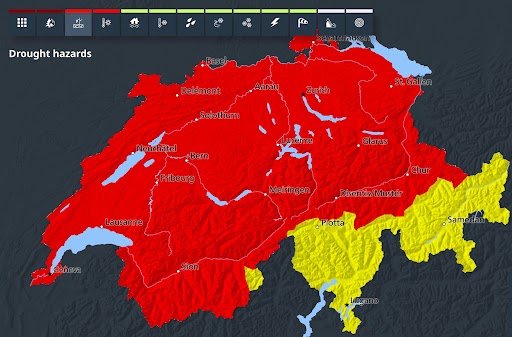
This is the most current map indicating the areas of the country that are most impacted by drought:
MeteoSwiss
The red area, which spans most of the country, indicates a Level 4 (‘High Danger’) alert, which means that “a significant increase in drought conditions is expected.”
“Should the trend toward another heatwave in early August continue, the situation would become critical for many rivers, lakes, and forests, and this would persist until autumn,” MeteoNews weather services pointed out.
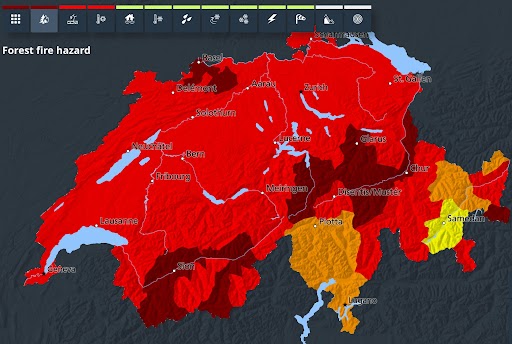
In terms of forest fire risks, this is what the situation looks like right now:
MeteoSwiss
The map shows that most of the country (red areas) is under the Level 4 (‘High Danger’) alert, and some – parts of Valais and central Switzerland – are under the highest, ‘Very High Danger’ category ( Level 5, dark red). Orange signifies a ‘medium’ risk.
This means, according to MeteoSwiss, that “very hot ground fires and widespread crown fires may occur. Burning embers may be thrown over large distances and spark new fires. Lightning strikes are highly likely to cause a fire.”
Does this mean you should stay away from impacted areas this summer?
Not at all.
It’s true that a huge swathe of land is under a more or less severe danger warning, but these ares are still safe to visit – provided you follow the rules in place and don’t take any actions that could worsen the situation.
The rules include compliance with local fire and other advisories as well as proper behaviour, adapted to the danger level declared for a given region.
In Switzerland (as in many other countries), the risk of natural disasters – including earthquakes, avalanches, flooding, and wildfires – is rated by the government numerically from 1 (‘low)’ to 5 (high).
Here’s what they mean:
Level 1 – No or low danger (green)
Ground and surface fires are unlikely to occur. Tree crowns are not affected. A lightning strike is unlikely to cause a fire.
What you should and should not do:
Do not throw away burning/smouldering cigarettes, matches, etc. in or near the forest.
Always watch a fire and extinguish any sparks immediately. Always extinguish embers completely when leaving, ideally with water and sand/earth.
Speed of spread: Usually slow.
Level 2 – Moderate danger (yellow)
Ground and surface fires may occur. Tree crowns are unlikely to be affected. A lightning strike may cause a fire.
Recommendations for action:
Do not throw away burning/smouldering cigarettes, matches, etc. in or near the forest.
Always watch a fire and extinguish any sparks immediately. Always extinguish embers completely when leaving, ideally with water and sand/earth.
Speed of spread: Slow to medium.
Level 3 – Considerable danger (orange)
Ground and surface fires may occur. Individual tree crowns may also be affected. Lightning strikes are likely to cause a fire.
Recommendations for action:
Always watch a fire and extinguish any sparks immediately. Always extinguish embers completely when leaving, ideally with water and sand/earth.
Do not light fires outdoors
Follow the orders of the local authorities (e.g. fire bans).
Speed of spread: Rapid in open terrain, medium in forest.
Level 4 – High Danger (red)
Hot surface fires spreading to individual tree crowns may occur. Burning embers may be thrown and spark new fires. Lightning strikes are highly likely to cause a fire.
Recommendations for action:
Do not light fires in strong winds.
Follow the orders of the local authorities (e.g. fire bans).
Speed of spread: Rapid in open terrain and in forest.
Level 5 – Very High Danger – dark red
Very hot ground fires and widespread crown fires may occur. Burning embers may be thrown over large distances and spark new fires.
Lightning strikes are highly likely to cause a fire.
Recommendations for action:
Do not light fires outdoors.
Follow the orders of the local authorities (e.g. fire bans).
Speed of spread: Very rapid over long periods in open terrain and in forest.
Many activities are still allowed
Typical summer activities that don’t increase the danger of wildfires can still be enjoyed.
You can, for instance, still swim in Switzerland’s lakes and rivers; go camping; and hike on its trails.
For the two last activities, however, special precautions should be taken.
While camping, for instance, do so only in specially designated places and heed local warnings (if any) about lighting campfires.
In terms of hiking, most trails are perfectly safe, especially those at low elevations.
According to the Swiss Alpine Club (SAC), however, due to the consequences of extremely high temperatures this summer, “classic high-mountain climbs may therefore be more difficult than in previous years.”
“Crevasses are now exposed and some access routes have been altered, so choosing the correct route can be challenging,” SAC pointed out. “Some climbs are therefore currently discouraged.”
This link highlights mountain routes that are deemed unsafe.
READ MORE: How hot weather makes climbing Swiss Alps ‘extremely dangerous’


