

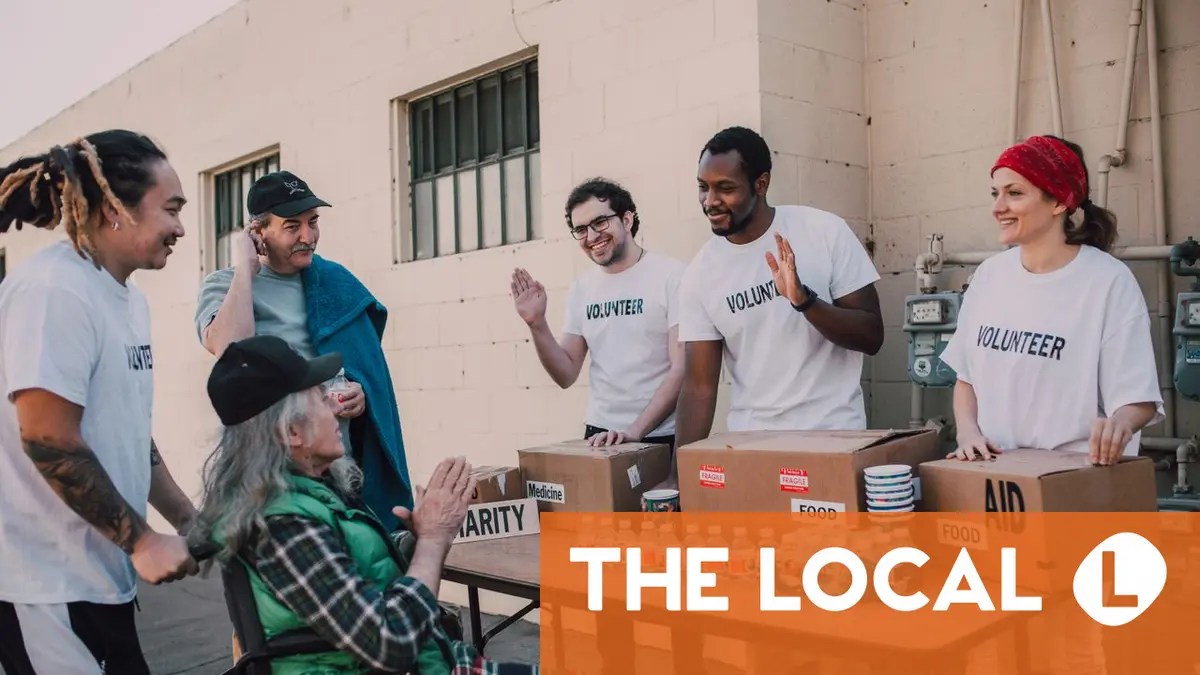

In Austria, foreign nationals may qualify for citizenship sooner if they have completed at least three years of voluntary work. Is there a similar rule in Switzerland as well?
Concretely, Austrian law allows people engaged in certain types of volunteer activities to apply for naturalisation after a shorter wait period: six years instead of ten.
Switzerland also allows a shorter residency requirement under certain circumstances, but volunteering isn’t one of them.
The only category of foreigners eligible for shorter residency requirements – five years instead of ten – are those married to Swiss citizens.
But even though their wait is cut in half, they don’t get any breaks as far as other conditions for citizenship are concerned.
Just like other foreigners, they too must demonstrate the required level of proficiency in the national language of the canton where they live, and also be fully integrated into their local communities and Swiss way of life in general.
So, contrary to Austria, volunteering is not going to have any effect on your naturalisation timeline, but it can be a decisive factor in whether or not you will become a Swiss citizen at all.
Don’t miss our journalists’ daily news roundup from Switzerland
How is that?
Along with the residency and language requirement, integration plays a major role in a naturalisation process.
Integration comes in many shapes and colours – being gainfully employed, respecting Swiss laws, values and way of life, and being a part of one’s local community are foremost among them.
It is particularly the last expectation that could determine whether or not an applicant’s status will change from a ‘foreigner’ to ‘Swiss citizen’.
In Switzerland’s three-tier naturalisation procedure (federal, cantonal, and communal). the latter – typically, a municipal committee or a panel composed of local residents – will ultimately decide whether to grant a candidate the citizenship.
That’s because the local residents are believed to be in a better position to ‘judge’ whether foreigners living in their midst are integrated in community well enough to become Swiss — something that neither the cantonal nor federal authorities can ascertain.
So even if a person meets all the requirements set on cantonal and federal levels, each municipality autonomously decides on the naturalisation applications.
READ MORE: How your Swiss commune plays a key role in your citizenship application
.And it is precisely at this ‘grass-roots’ level that some applicants fail in their bid for naturalisation, when the committee decides – though often for arbitrary reasons – that a foreigner is not sufficiently integrated into their local communities to warrant Swiss citizenship.
In such situations, volunteering could be a strong point in the applicant’s favour – not to cut the wait time for naturalisation, but in obtaining the citizenship.
Nothing demonstrates a foreigner’s interest in their local communities, and their overall level of integration as well – better than volunteering.
Each town and village has places where such help is needed – whether at charities and other organisations, local schools and churches or, as is customary in many small communities across the country, by joining a local fire brigade.
READ MORE: How foreign residents can become part of their local Swiss community


