


On June 14th, Swiss voters will decide whether to accept the hard-right initiative that seeks to stop population growth by limiting the number of immigrants from the EU allowed to work and live in the country. But could the ‘yes’ vote trigger a ‘preemptive’ migration surge?
To understand why this question is relevant, let’s look at what the approval of the initiative would entail.
The Swiss People’s Party (SVP) ‘No to 10 million’ initiative demands that Switzerland’s population must remain under 10 million until 2050.
If it passes 9.5 million before then – the population is currently around 9.1 million – then the government must take action to reduce immigration. And if the 10 million mark is passed before 2050, the Swiss government will be forced to break its agreements with the EU, including free movement within two years.
READ MORE: What exactly does the Swiss ‘no to 10 million’ anti-immigration proposal aim to do?
Here’s what could happen
These are some of the potential population growth scenarios, according to the Federal Statistical Office (FSO).
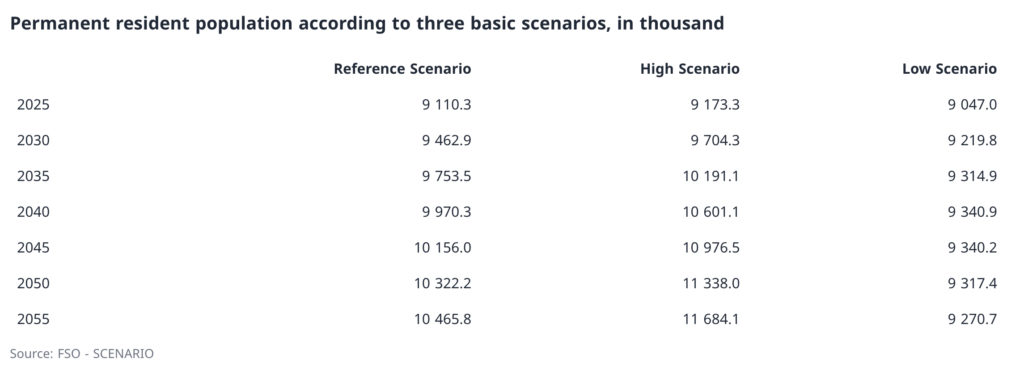
As you can see, even under the ‘highest’ scenario, the 10-million mark will not be exceeded until 2034/35 – that is, roughly eight or nine years from now.
Under others, this treshold won’t be reached for more than a decade.
What does this mean in terms of immigration?
A ‘yes’ vote could actually have the opposite effect of that sought by the initiative’s instigators.
Specifically, it might end up triggering a rush of immigrants from the European Union, hurrying to obtain residence and work permits before stricter immigration laws go into effect.
“In the short run, such a catch-up effect is realistic,” migration expert Cornelia Lüthy, former vice director of the State Secretariat of Migration (SEM), told The Local.
“We have seen such effects under the transitional regime for new EU-member states, when Switzerland re-introduced quotas for a limited period of time.”
In 2017, for instance, the government invoked the ‘safeguard clause’ in relation to Romanian and Bulgarian citizens, following a spike in immigration from those countries.
And Switzerland also used this clause to limit work permits for Croatian nationals in 2023 and 2024.
Both situations were, however, temporary.
And there is more
Another precedence was a previous SVP bid to limit immigration, which a very narrow majority of voters – 50.3 percent – approved in a referendum on February 9th, 2014 (interestingly, Switzerland’s population was ‘just’ 8 million at the time).
Approximately 74,700 foreigners came to Switzerland that year, rushing, as it were, to get their foot in the door before the gates were shut. (In the end, however, this particular measure was never implemented, the government opting for a ‘lighter’ version instead, that would give Swiss workers some preference in the job market).
First up, and then down
Immigration surge in case of the positive outcome of the June 14th referendum would, however, be temporary.
Though “numbers could go up before new, stricter regulations would apply, in the long run, they’d need to go down to meet the threshold of the SVP initiative,” Lüthy said.


