

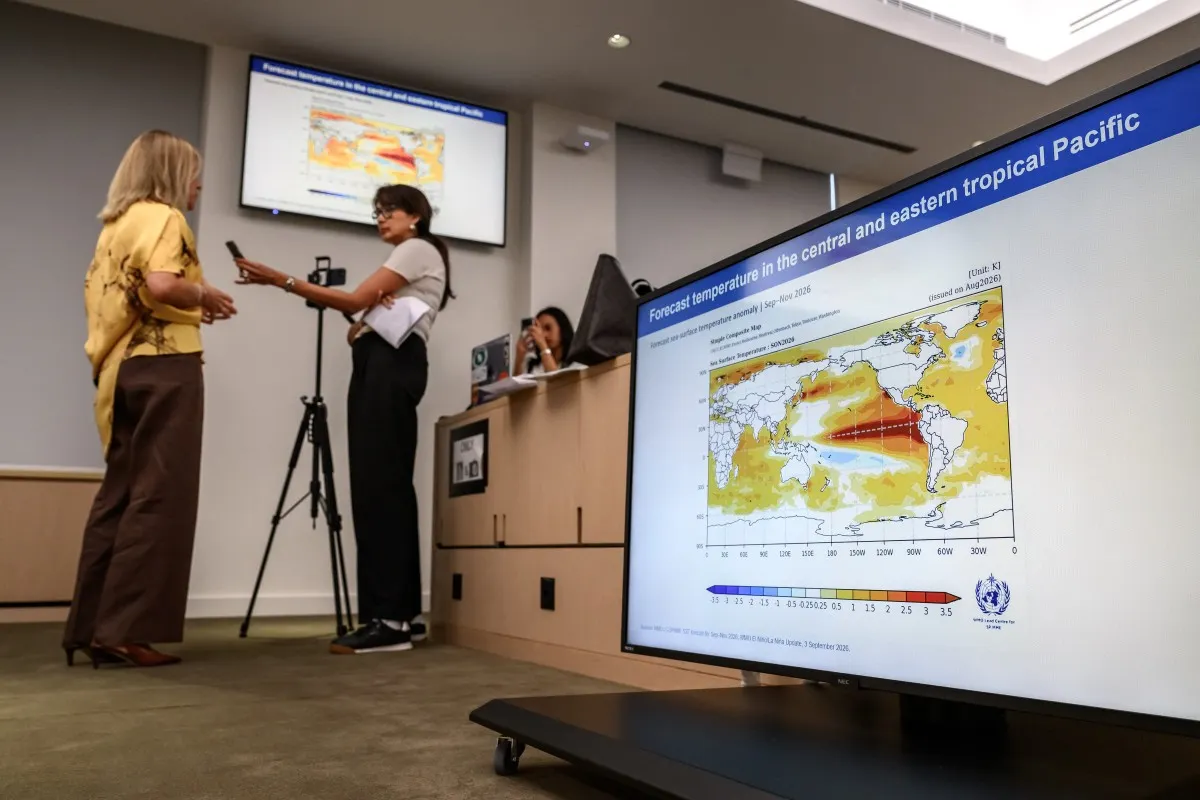
With Europe already seeing record-breaking temperatures and extreme weather episodes the summer, here’s how meteorologists say the supersized El Niño phenomenon could hit the continent’s climate in the coming months.
What is El Niño?
El Niño is a global climate phenomenon related to warming waters in the Pacific Ocean that can cause consequences around the globe.
It’s a naturally-occurring phenomenon not caused by climate change but scientists expect it will exacerbate the heat of a planet already warming from burning fossil fuels, while amping up extreme weather events.
Experts say El Niño happens cyclically every two to seven years, and current schedules mean that 2026 or 2027 could therefore likely be the hottest year on record, boosted by El Niño.
This one is also forecast to be the strongest since comparable records began four decades ago, the United Nations’ climate agency has warned, with the UN chief saying the world was in the “danger zone of extreme weather”.
READ ALSO: ‘We’re heading for catastrophe’ – The summer climate change hit Europe
When will El Niño next occur?
According to forecasts, El Niño will peak towards the end of this year, though its knock-on impacts for the climate will continue well into 2027, said the World Meteorological Organization (WMO).
The WMO forecasts that El Niño will “intensify steadily” and “dominate climate patterns” from August, predicted to become “very strong” and will likely persist until February.
“If this trajectory continues, it may be stronger than anything since our monitoring began,” WMO chief Celeste Saulo told reporters in Geneva recently.
How will it hit Europe?
Europe is unlikely to see the most direct or severe consequences from El Niño. That doesn’t mean it won’t impact the weather or temperature, however.
Information from the Centro Euro Mediterraneo sui Cambiamenti Climatici (CMCC) states that “although these indirect impacts are already being studied, an interesting aspect that requires more attention is how El Niño will interact with Europe’s current and future climate system, which is already exceptionally warm”.
One possible impact is different climate consequences in different parts of the continent.
“For the Mediterranean, El Niño does not act through a simple one-to-one cause-and-effect link,” CMCC explains, adding that “evidence shows that although the El Niño Southern oscillation does affect the European climate, the signal is seasonal, sometimes nonlinear, and impacted by other factors such as conditions in the Atlantic and Pacific.”
However, it can cause second-hand consequences, namely abnormally high temperatures and rainfall across the rest of the world, including Europe.
France’s state weather agency Météo France says that “If atmospheric conditions allow and the phenomenon is intense enough, the impacts of an El Niño can spread beyond the equatorial and Pacific regions, particularly during winter in the northern hemisphere”.
The consequences could mean we are set for an unusual winter in Europe.
According to guidance from the European Commission: “In Europe, this El Niño could be strong enough to flip the pattern: instead of colder-than-normal autumn temperatures that typically accompany it, Europe may experience warmer-than-normal conditions, with that warmth building towards spring 2027.”
However, CMCC also states that “some past El Niño events have been associated with colder-than-average conditions in parts of northeastern Europe, often linked to higher pressure over Scandinavia, weaker westerlies, and a southward shift of the Atlantic storm track. This pattern can favour wetter conditions over the Mediterranean and France and drier conditions over northwestern Europe and Norway.”
El Niño does also increase the chance of extreme weather events, such as wildfires or floods.
Following Europe’s historically hot summer, however, and with the Mediterranean Sea seeing higher average temperatures, experts say El Niño could already be contributing to strong rainfall in the autumn.
READ ALSO: Will the European Union take up the climate fight after brutal heatwaves?
“We expect very heavy rainfall when atmospheric conditions are conducive to the formation of weather disturbances, due to the warming of the seas,” Davide Faranda, a researcher at France’s CNRS Laboratory of Climate and Environmental Sciences, told Le Parisien.
The difficulty, meteorologists say, lies in distinguishing this potential influence of El Niño from that of other factors which determine winter weather.
“There is a combination of effects that interact with one another,” points out Jean-Michel Soubeyroux, deputy scientific director of the Climatology Department at Météo France. “In Europe, the weather conditions next winter will also depend on what happens in the North Atlantic Ocean, for example.”
“Other factors will have a significant impact on the average seasonal climate and could offset any effects of El Niño,” adds Laurianne Batté.
In other words, El Niño, however exceptional it may be this year, is just one piece of the jigsaw when it comes to understanding Europe’s changing climate.
With reporting from AFP.
