


Cocoa beans have become a valuable commodity in the last couple of years due to a drop in global cocoa production.
EPA/LEGNAN KOULA
From Ghana to Switzerland, the search for scarce capital to buy cocoa has the industry looking to financial instruments like commercial paper, bonds and flexible loans to plug liquidity gaps.

Ghana is the world’s second-largest producer of cocoa. It is also the top source of beans for manufacturing Swiss chocolates. However, instead of benefiting from the record high cocoa prices in the last couple of years, Ghana’s cocoa industry has been fighting for survival due to a lack of capital to pay farmers.
For over three decades, Ghana’s cocoa board COCOBOD had relied on a syndicated loan model to purchase cocoa from its nearly 800,000 cocoa farmers. A consortium of international banks would advance the money COCOBOD needed to buy cocoa from farmers or Licenced Buying Companies (LBCs). The loans were considered reasonably secure as they were backed by future cocoa exports earnings. However, a terrible harvest in 2023 (almost half of the projected 800,000 tonnes) meant lower export revenues to repay the loans. In 2024, the Ghanaian finance ministry had to step in with a $70 million (CHF57 million) bridge loan to prevent a default by COCOBOD. Suddenly, the syndicated loan model was not as secure and international lenders became less keen to participate, even at interest rates as high as 8%.
“This resulted in a loss of over $1 billion which would have gone to cocoa farmers and other stakeholders,” stated a COCOBOD press releaseExternal link from February detailing the extent of the crisis.
With the banks backing out, COCOBOD tried to get cocoa traders to advance money for future cocoa deliveries. But as the price advantage offered by older contacts over the market price diminished, the proposition became less attractive to traders and this model was abandoned.
“The current financing model was invented as a necessity after the syndicated loan failed, after 32 years of successful implementation, and it has proven not to be sustainable,” said COCOBOD.
More
More
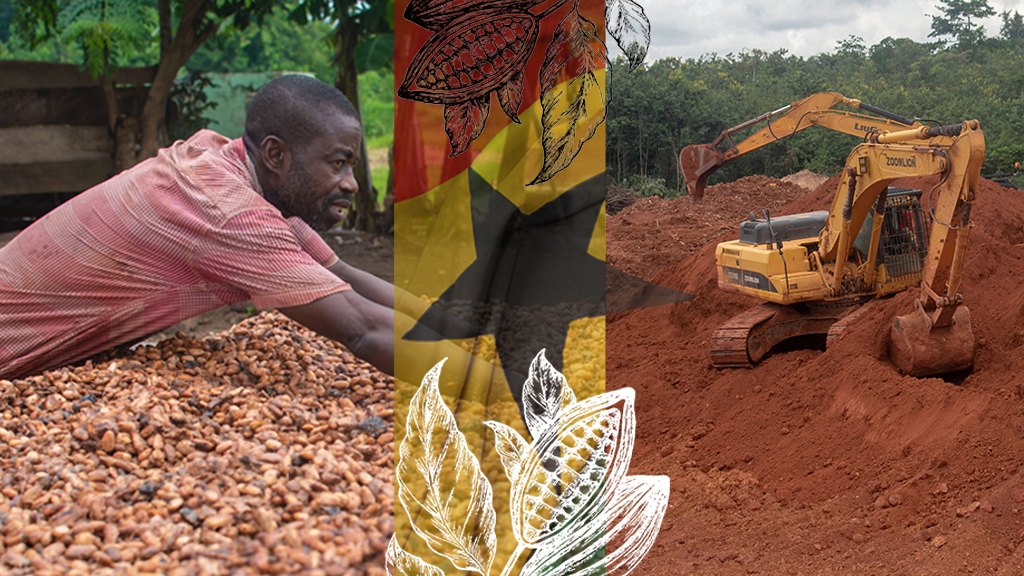
How gold mining in Ghana is threatening Swiss chocolate
Commercial paper and bonds
In September this year COCOBOD announced a new financial model based on the issuance of short and long-term bonds. The board said it plans to raise GH¢16.3 billion (around $1.4 billion) on the domestic financial market through a special purpose vehicle called Cocoa Capital PLC. Of this, GH¢14 billion would be short-term debt (commercial paper) to fund cocoa purchases in the 2026/2027 season and the remaining GH¢2.3 billion would be medium- and long-term debt (corporate bonds) to repay COCOBOD’s existing financial obligations.
So far, the new strategy seems to be working. The inaugural first tranche issue of commercial paper attracted GH¢3.39 billion in commitments (against a target of GH¢4 billion) from domestic investors at an interest rate of 11% per annum. This is an encouraging sign for COCOBOD, which had announced a producer price increase in September of GH¢42,400 per tonne for the 2026/27 cocoa season compared to GH¢41,392 per tonne in the 2025/26 season. The Ghana Cocoa Board Act 2026 requires COCOBOD to guarantee farmers 70% of the gross export revenue, known as the realised gross free-on-board (FOB) price of cocoa. The recently announced producer price (equivalent to GH¢2,650 per 64-kilogram bag of cocoa) brings the farmers’ share to 71.18%.
“The new financing model, alongside the overhaul of the existing sector regulation through the Ghana Cocoa Board Act of 2026, has the potential to address the failures of the previous models. The fact that the financing models are part of a more integrated strategy, aimed at paying farmers a better price (70% of gross export value), is laudable in principle,” says Christian Robin, managing director of the Swiss Platform for Sustainable Cocoa, a coalition of chocolate makers, retailers, NGOs and academia.
However, Robin feels the jury is still out on whether tapping financial markets to pay for cocoa has the potential to address the failures of the previous model. A lot depends on the outcome of the second and third commercial paper tranches of GH¢4 billion and GH¢6 billion respectively and their interest rates. It also remains to be seen whether contracted 2026/27 cocoa deliveries ship on time and whether farmers and licensed buying companies are paid promptly.
“For our manufacturers, a reliable cocoa supply and predictable deliveries are essential. Generally, we welcome efforts that make the system more stable and ensure correct and timely payment of cocoa farmers. Whether Ghana’s new financing model will improve supply stability or create additional risks remains to be seen,” says Roger Wehrli, director of Chocosuisse, the association of Swiss chocolate manufacturers.
Swiss chocolate giant takes the leap
It is not just cocoa producers like Ghana that are facing a capital crunch. Barry Callebaut – the Zurich-based B2B chocolate firm that dabbles in everything from sourcing and processing cocoa beans to manufacturing premium chocolates, fillings and decorations – also found itself pressed for cash due to record cocoa prices in 2024 and 2025. Net profit for the 2024/2025 reporting period fell by 35.9%.
“The extreme cocoa bean price volatility over the past two years was unprecedented. Given the need to secure cocoa beans well ahead of production, the sharp increase in bean prices drove a substantial rise in net working capital for chocolate producers like Barry Callebaut,” says Matteo Lindauer, analyst at Vontobel bank’s Swiss equity research division. Net working capital is the amount of money a company has available to operate and a measure to gauge the short-term financial health of an organisation.
In January 2024 Barry Callebaut, in a bid to tackle price volatility, tapped the Swiss franc bond market for the first time in its history, issuing CHF600 million ($730 million) in bonds. This strategy was so successful that the company has issued an additional CHF730 million in Swiss franc bonds and €2.45 billion (CHF2.23 billion) in euro bonds since.
“The unprecedented increase and volatility in cocoa bean prices significantly increased working-capital requirements across the industry. Barry Callebaut therefore took steps to ensure a resilient and flexible funding structure and diversify its funding sources,” a company spokesperson told Swissinfo by email.
The spike in cocoa prices in 2024 from around $4,000 per tonne to a high of $12,000 per tonne substantially raised the cash demands for processors like Barry Callebaut who trade in cocoa futures to hedge against price increases. The money can eventually be recovered from customers, but the company must stump up a large amount of cash to cover this margin call. This is why Barry Callebaut’s free cash flow dropped to CHF2.3 billion in the 2023/2024 reporting year.
More

More
How the humble cocoa bean gets turned into chocolate and money
To avoid a repeat of such a sudden cash crunch, Barry Callebaut announced in April that it had set up a €2 billion borrowing base facility normally used by commodity traders to handle cocoa price spikes. This is a kind of flexible loan that allows the company to access more capital independent of its creditworthiness. This is because the firm’s cocoa inventories serve as collateral. Thus when the price of cocoa rises, the value of Barry Callebaut’s inventory also rises, allowing it to access more credit to cover margin calls without dipping into its own capital. According to Lindauer, this flexible loan setup provides an important liquidity buffer and strengthens funding security. It also reduces the likelihood of a recurrence of the margin-call pressures experienced during the previous cocoa cycle.
Since then, lower cocoa prices and financial optimisation have helped Barry Callebaut generate a lot more cash and deleverage significantly. The world’s leading manufacturer of cocoa and chocolate products has used available liquidity to buy back €849 million of outstanding bonds.
“Looking ahead, our focus remains on disciplined capital allocation, continued deleveraging and maintaining an appropriate, diversified and flexible funding,” the company spokesperson says.
The International Cocoa Organization has estimated that the annualised monthly volatility in US cocoa futures increased from 3.95% in October 2023 to 18.73% in April 2024. While the cocoa prices have stabilised in recent months, the industry is still reeling from record price fluctuations.
“Financial markets help companies bridge liquidity needs and manage price risk, but they do not reduce volatility itself,” Robin warns.
According to Barry Callebaut’s own analysisExternal link, chocolate manufactures are trying to better cushion price shocks by securing forward cocoa supplies when market conditions are favourable. They are also passing higher cocoa prices onto consumers in a staggered manner.
Edited by Virginie Mangin/ts


