


China is facing a repeat of the tensions and uncertainty from the first presidency of Donald Trump, only with a weaker economy that’s even more reliant on exports than it was during the first trade war with the US.
Author of the article:

Published Jan 19, 2025 • 4 minute read
Article content
(Bloomberg) — China is facing a repeat of the tensions and uncertainty from the first presidency of Donald Trump, only with a weaker economy that’s even more reliant on exports than it was during the first trade war with the US.
Article content
Article content
China’s record trade surplus of nearly $1 trillion last year was equivalent to more than 5% of its gross domestic product, the highest level since 2015. The surplus drove almost a third of the expansion last year, the most since 1997, according to data released last week.
Advertisement 2

Article content
That dependency on overseas markets adds to a multitude of challenges facing President Xi Jinping: persistent deflation, lackluster consumer demand, an extended property slump and a currency under pressure. Bond yields are showing that markets expect the world’s No. 2 economy to weaken further.
To counter those forces, Beijing will likely continue to boost government borrowing this year to support an ambitious economic growth target. But rising protectionism in the US and other major trading partners could threaten one of China’s most reliable growth drivers.
“The biggest bright spot in the economy last year was exports,” said Jacqueline Rong, chief China economist at BNP Paribas SA. “That means the biggest problem this year will be US tariffs.”
BNP Paribas’ base case is that Trump will impose 10% tariffs on Chinese goods, Rong said last week, although it’s still unclear whether the European Union and emerging markets will follow suit and raise trade barriers targeting China too.
After he won election in November, Trump said he would raise tariffs on all US imports from China by 10% on top of levies already in place. At other times, he has floated hitting Chinese goods with even higher tariff rates after he takes office Monday.

Top Stories
Article content
Advertisement 3
Article content
In response, companies raced to stock up, boosting purchases from China in the final months of last year and potentially pulling forward demand from this year. Chinese firms exported almost $50 billion worth of goods to the US in December, the highest single month total since mid-2022. A lull may come next, with the Lunar New Year holiday falling later this month.
Some Trade Diversification
US tariffs over the past seven years have already pushed some companies to move their factories out of China or source from elsewhere. American companies now buy less than 15% of China’s shipments directly, down from 19% at the end of 2017.
Despite hopes that some of that manufacturing would move back to the US, most of it went to markets such as Vietnam, which is now taking record shipments of Chinese electronic parts to assemble into products to send to the US and elsewhere.
China’s exports to Vietnam soared to a record last year, as did that nation’s shipments onto the US. Ranked by bilateral trade balances, Vietnam’s trade surplus with the US is the now the third-largest, after China and Mexico.
Advertisement 4
Article content
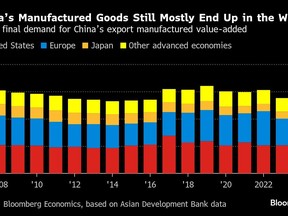
And although direct Chinese exports to the US have shrunk a little in importance over the past four years, the world’s largest economy is still the most important source of final demand for China, buying more than half a trillion dollars worth of goods last year, the equivalent of almost 3% of China’s GDP.
New research from Bloomberg Economics confirms that while both nations report having diversified their trade from each other, the US continues to be the largest single destination for Chinese manufacturing value-added.
Sanctions and Tariffs
If the US does impose new levies on China, Beijing can retaliate with its own tariffs, as it did before. The government has also built up new retaliatory tools, as seen in the recent ban on exports to the US of some metals and the sanctioning of more than a dozen US defense firms in the last month.
“China’s efforts will become more aggressive” on export controls, said Alex Capri, author of Techno-Nationalism: How It’s Reshaping Trade, Geopolitics and Society. “The solid growth they saw in 2024 despite US export controls might give them confidence to roll out more of their own export controls and constrictions on outbound exports in critical minerals, magnets, batteries and other goods.”
Advertisement 5
Article content
China’s government has been trying to buy fewer commodities from the US and more from Brazil, Russia and other friendlier nations, as part of a years-long effort to diversify its trading relationships, including by signing trade deals with South East Asian nations and creating the world’s biggest tariff-free zone. That has reduced exposure to the US but may also make any retaliation through tariffs on US goods even less effective than last time.
Chinese companies may try to redirect more goods to other markets to make up for lost sales in the US, but there’s no guarantee other nations won’t impose their own tariff barriers if imports suddenly soar. Countries in South America have already placed duties on Chinese steel.
North American Tariffs
The return of Trump is spurring Mexico to act, with President Claudia Sheinbaum imposing tariffs aimed at reducing reliance on Chinese imports. She’s trying to dissuade Trump from hitting goods from Mexico with a 25% import tax.
Other nations are taking early defensive steps include Canada, which announced new tariffs on Chinese-made electric vehicles and metals in September. The European Union and Turkey have hit Chinese-made EVs with tariffs.
In the end, the most effective tool at Beijing’s disposal may be a long-prescribed structural change: refocusing on the domestic economy and boosting local consumption to replace the demand lost to a new trade war with the US.
“Fiscal measures, which have remained very conservative thus far, would be the most sensible, especially stimulus payments to households to increase domestic consumption,” said Martin Chorzempa, senior fellow at the Peterson Institute for International Economics in Washington.
—With assistance from Fran Wang and Yujing Liu.
Article content

