


Mari Carmen Mata remains furious with Spanish Prime Minister Pedro Sánchez over his response to the mass arrival of migrants in Ceuta, a crisis complicating the Socialist leader’s bid for re-election next month.
“We want nothing to do with him,” the 58-year-old nursing assistant told AFP in the centre of the Spanish territory in north Africa.
More than two months after upwards of 70,000 migrants entered Ceuta from neighbouring Morocco on July 30th and 31st, life in the city, home to around 80,000 people, remains far from normal.
Most returned to Morocco in the following hours, but thousands have remained for weeks in often dire conditions.
READ ALSO: Why are there still thousands of migrants in Spain’s Ceuta?
A sense of abandonment among residents is giving fresh ammunition to the main opposition conservative Popular Party (PP) and the far-right Vox ahead of an early general election on November 29th.
Criticism in Ceuta — governed by the PP for more than 25 years — centres largely on the central government’s migration policy and what many see as a lack of firmness towards Morocco, which claims sovereignty over the territory.
“We thought our government was going to do something in the short or medium term, but we’ve been here for two months and these people haven’t been sent back,” said Rubén González, gesturing towards groups of migrants still wandering through the city.
Don’t miss our journalists’ daily news roundup from Spain
“Catholics, Muslims, Jews, Hindus — we’re all on the same page. We feel abandoned here,” added the 33-year-old civil servant.
READ ALSO: Spain’s PM softens tone with Morocco amid fears of new Ceuta migrant rush
González describes himself as a centrist voter but said he would vote for the right in the coming election.
Sonsoles Jiménez, a 51-year-old businesswoman, agreed, saying “in any other country they wouldn’t have allowed what is permitted here in Spain”.
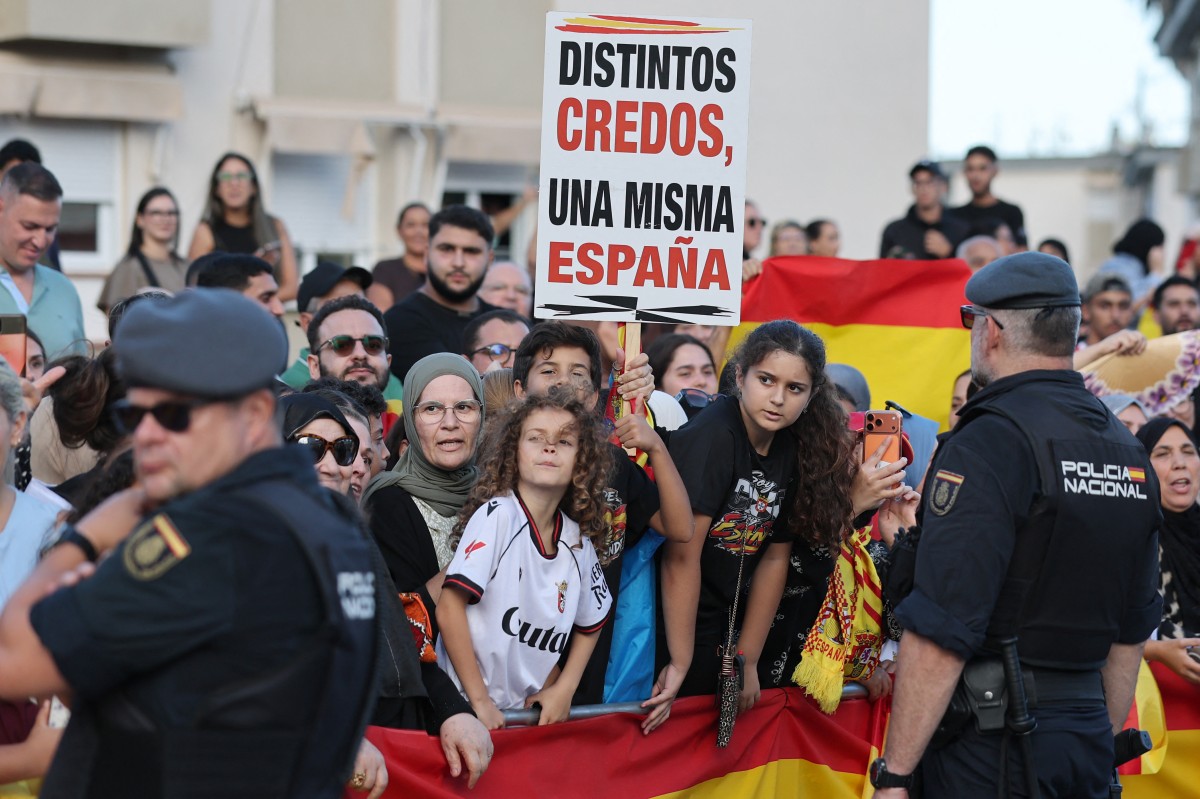
A Ceuta resident holds a banner reading ‘Different religions, only one Spain’ during the Spanish Royals visit to the Spanish North African enclave of Ceuta, on October 13, 2026. (Photo by Thomas COEX / AFP)
‘Hybrid attack’
The unprecedented migrant surge dominated headlines in Spain for weeks, with the right accusing Sánchez – one of Europe’s last remaining socialist leaders — of being soft on immigration.
His left-wing government had already faced criticism over its decision to open a path to legal status for hundreds of thousands of undocumented foreign residents.
PP leader Alberto Núñez Feijóo made Ceuta his first campaign stop, pledging to help restore “normality” to the territory.
READ ALSO: Can Spain’s Sánchez survive Ceuta migrant crisis?
The leader of Vox, Santiago Abascal, visited Ceuta a few days later on October 12th, Spain’s national day, alongside Jordan Bardella, leader of France’s ascendant far-right National Rally party.
Sánchez has no plans, for now, to return to Ceuta, after a brief visit on July 31st.
He did not accompany King Felipe VI and Queen Letizia on their historic visit to the city last week.
“The government made a mistake by treating this crisis as a migration crisis. It wasn’t just that: it was a hybrid attack,” political scientist Cristina Monge told AFP.
She was echoing critics who accused Morocco of deliberately allowing or encouraging the migrant surge to challenge Spain’s sovereignty over Ceuta and Melilla, its other north African territory.
Both the Moroccan government and Sánchez rejected the allegations.
‘Defend our city’
A September poll published by the El País daily found that 63 percent of Spaniards rated Sánchez’s handling of the Ceuta surge negatively, including 50 percent who described it as “very bad”.
But the eviction of 87-year-old pensioner Maricarmen Abascal from her lifelong Madrid home has helped shift the political debate towards Spain’s housing crisis instead.
The issue has sparked nationwide protests and could give Sánchez, in office since 2018, a boost ahead of the election.
The PP and Vox are pushing to put “immigration, the crisis in Ceuta, Morocco and corruption” at the centre of the campaign, while left-wing parties are trying to shift attention towards housing, social rights and pensions, Monge said.
“Public debate is now focused on social issues,” she said. “If the campaign continues along these lines, the question of Ceuta will eventually slip into second or even third place.”
That prospect worries many residents of Ceuta.
“What we want is to be able to defend our city, and for Spain and Europe to defend what belongs to them,” Jiménez said.
Article by Rosa Sulleiro


