


A new report recommends building renewable energy infrastructure in places where no new roads are needed and where there is already a connection to the electricity grid – for example, near tourism and ski facilities.
Keystone / Martin Ruetschi
Expanding renewable energy in the Alps is essential to Switzerland’s energy transition and winter power supply. Recent research reveals how this can be done without jeopardising biodiversity.
Switzerland is fast-tracking big solar and wind power plants to meet its climate goals. By 2035, renewable energy sources (excluding hydropower) are meant to generate six times more electricity than today, as mandated by a new law on energy supply approved in a popular vote this summer.
“With the current legal framework, there is a risk that this expansion will be at the expense of biodiversity,” warns Sascha Nick, a researcher at the Swiss Federal Institute of Technology Lausanne (EPFL). His concern stems from research that he led, in which 45 scientists from the fields of renewable energies, climate research and biodiversity took part. They recently issued a reportExternal link with urgent policy recommendations.
“The good news is that with careful planning, we can significantly expand renewable energy without jeopardising biodiversity,” says Nick. However, the report’s conclusions are clear: this expansion must follow an integrated approach that balances energy needs and biodiversity.
More
Solar energy in ski resorts
Switzerland may be small, but it has an exceptionally wide variety of animal and plant species, especially in the Alps, as well as forests and floodplains. But scientists say they are inadequately protected and increasingly threatened by industrial agriculture, urban sprawl, and roads.
To close the winter energy gap, Nick’s research group highlights the need to expand wind and solar energy in the Alps, home to many ecologically rich and sensitive habitats. However, such locations are controversial and planned projects repeatedly meet resistance from local populations and environmental organisations.
The authors call for a national strategy, prioritising initiatives with minimal or even positive impacts on biodiversity. They also emphasise the importance of democratic processes: while approval procedures should be streamlined and accelerated, local participation must not be curtailed in the name of urgency – only if the population is involved in planning energy projects will they be widely accepted.
More

More
Construction starts on first large-scale solar park in Swiss Alps
Focus on smaller projects
One recommendation in the report published in October is to re-evaluate the minimum size for projects of national importance, allowing smaller projects to receive federal funding. Instead of building a few large solar parks, numerous smaller installations could be built – preferably at sites where no new roads are needed and where there is already a connection to the electricity grid, for example near existing tourism and ski facilities or in areas that have already been damaged by winter sports and are no longer suitable for skiing due to climate change.
“Politicians often say that we have to choose between biodiversity and climate protection,” says Nick. “The question should rather be: more renewable energy or skiing?”
Wind power: considering birds and bats
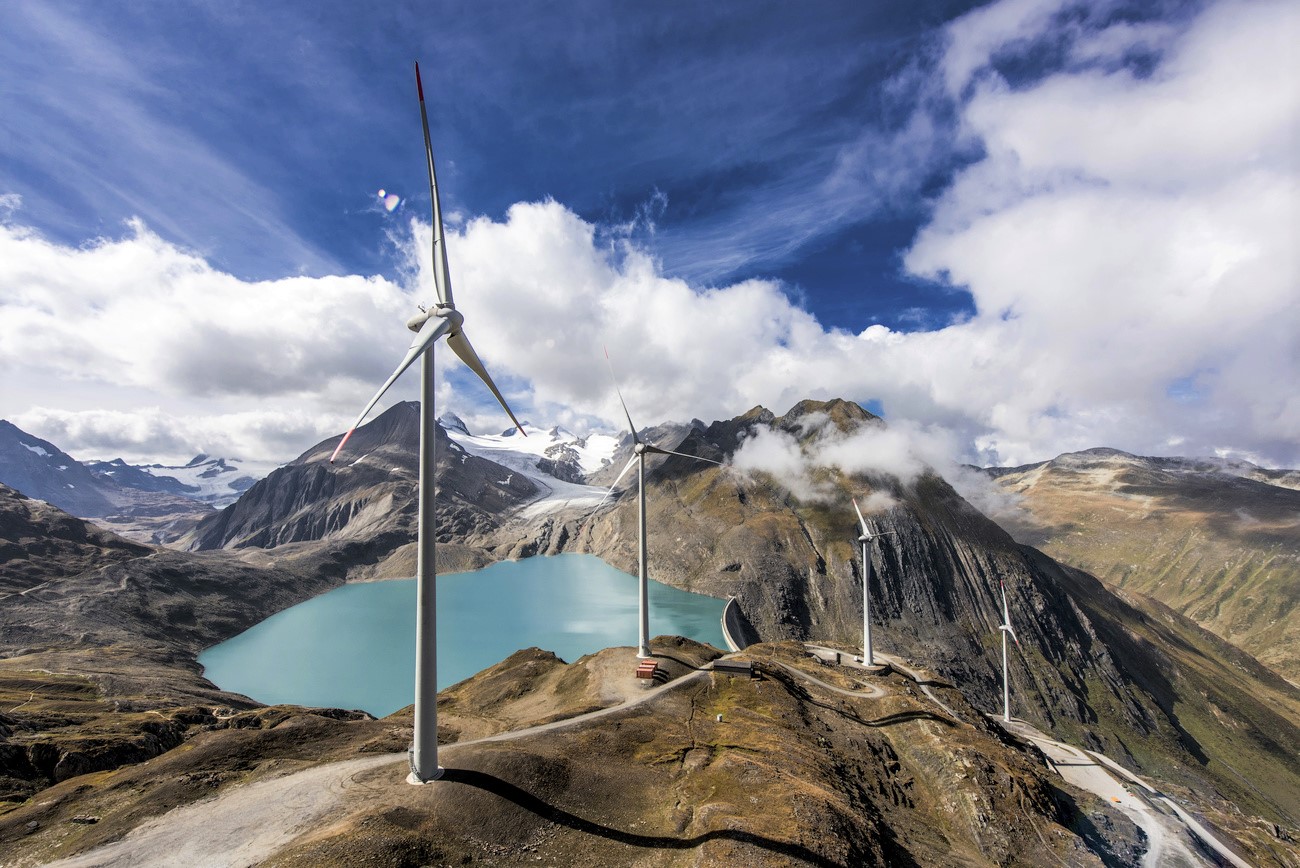
Site selection is also key when expanding wind power. Raphaël Arlettaz, professor of conservation biology at the University of Bern and co-author of the report, has spent years studying the risks that wind turbines pose to birds and bats. His team developed cartographic models to identify high-risk areas for bearded vultures and golden eagles based on their frequent flight paths in the Alps. South-facing, steep slopes with good updrafts and areas with significant ibex populations are particularly critical. Known migratory bird corridors or breeding areas of endangered bird species should also be factored into planning, says Arlettaz: “We should avoid wind turbines in such sensitive areas if we want to protect our birdlife.”
More
More
Will the Swiss countryside soon be dotted with wind turbines?
For bats, the risk could be mitigated by shutting turbines down completely when wind speeds are low: in studies in the Rhone valley, Arlettaz and his colleagues found that local species such as mouse-eared bats and the European free-tailed bat fly close to the ground and along hedges and other structures during strong winds, only venturing into turbine-danger zones when wind speeds are lower. “Adjusting turbine operations may reduce electricity production slightly, but it drastically minimises collision risks,” Arlettaz concludes.
But careful planning of new energy projects alone is not enough. The authors of the reports also draw attention to existing infrastructure. For example, existing electricity pylons could be made safe for birds. In a 2010 study, Arlettaz and his colleagues showed that certain medium-voltage power line pylons are the number one cause of death for eagle owls in Switzerland. Storks, owls, kites and other birds of prey also die every year from electrocution – despite the fact that it would be possible to make these lines safe for birds by laying them in the ground or insulating them. “We should solve these problems before we install new power plants in the Alps,” says Arlettaz.
‘A little bit of imagination’ needed to integrate energy and biodiversity
When asked for an independent assessment of the report, Leon Bennun, chief scientist at The Biodiversity Consultancy in Cambridge, UK, also emphasises the importance of integrated planning.
“If Switzerland aims to expand its renewable energy while preserving biodiversity, it should not think in terms of individual projects, but look at the whole system,” he says. “We need to get away from thinking in silos and only considering individual aspects, project by project.”
More
The Swiss Alps are beautiful, but are they biodiverse?
He adds that restoring and conserving nature, social benefits, security and energy production all have “synergies and trade-offs” that need to be considered on a larger scale.
“But piecemeal decision-making is still far more common,” Bennun says.
He sees promise in smaller, decentralised projects. While energy planning in many countries favours large-scale projects, smaller, community-driven initiatives have the potential to protect biodiversity and engage local populations, fostering acceptance.
“With a little bit of imagination, wind turbines, solar or biogas plants can become community assets that are valuable for people as well as for plants and animals,” he says.
Edited by Sabrina Weiss and Veronica DeVore


