


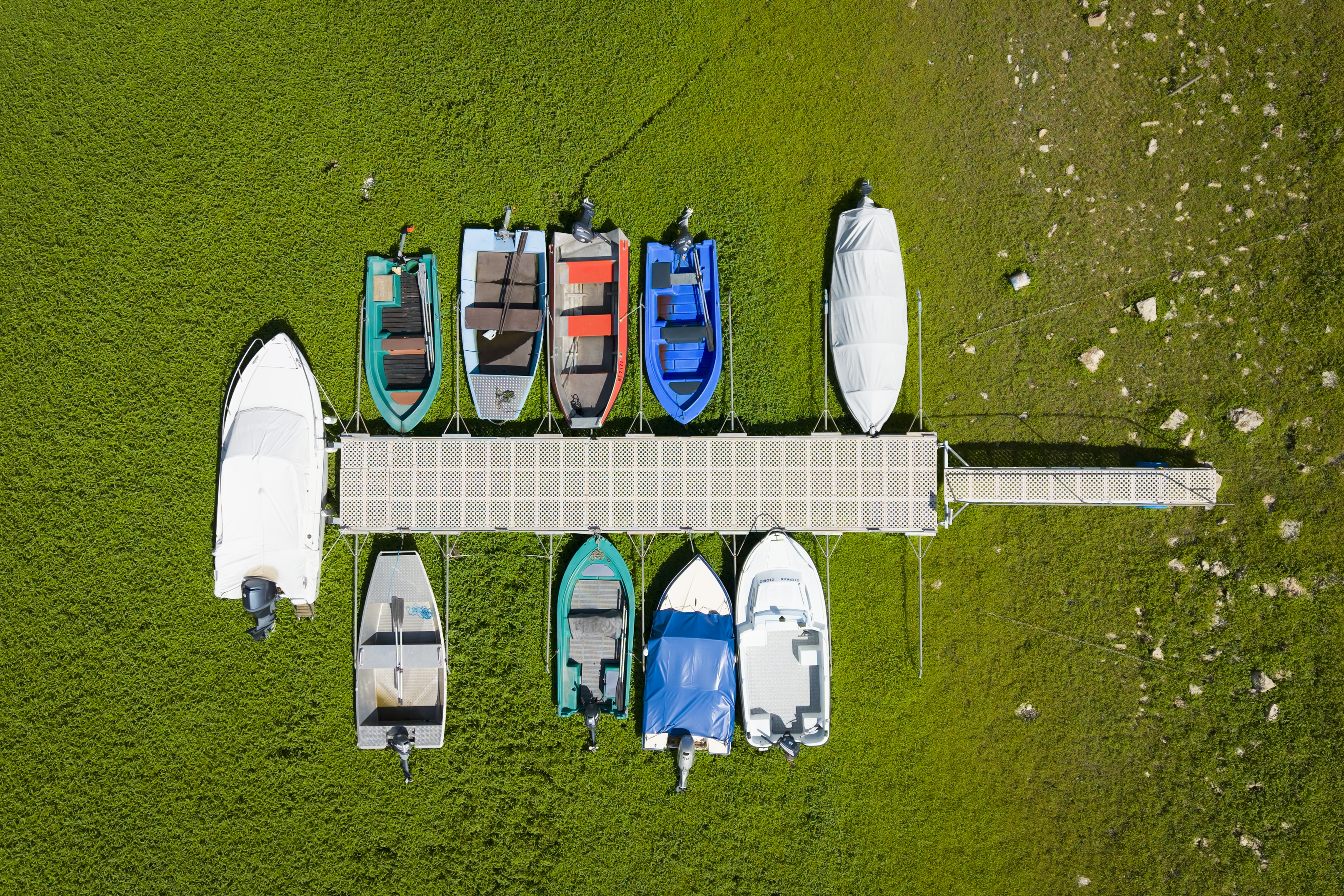
Stranded boats stuck in mud, overgrown with grass, on Lake Brenets in northwest Switzerland, August 22, 2026.
Peter Klaunzer / Keystone
The total amount of water on Earth remains stable, but climate change is altering its distribution. As a result, some regions face growing water shortages, while others are increasingly affected by flooding, fuelling geopolitical tensions. Switzerland is not immune.
In Switzerland, turning on a tap for a glass of water is something most people take for granted. Yet for many people around the world, access to water is not guaranteed.
Freshwater resources are becoming increasingly scarce in many regions. According to a reportExternal link published in September by the World Meteorological Organization (WMO), river levels fell to their lowest point in more than three decades in 2025. These figures do not yet include the exceptionally hot and dry European summer of 2026.
More
More
Switzerland sees hottest and driest summer on record
The total amount of water on Earth is not decreasing. Instead it continues to circulate between oceans, soils, groundwater, lakes, rivers and glaciers.
As the French chemist Antoine Lavoisier famously observed, “nothing is lost, nothing is created, everything is transformed”. The principle applies particularly well to water, Thibault Datry told Swiss public broadcaster RTS.
A change in distribution
But the director of research in ecohydrology at the French National Research Institute for Agriculture, Food and the Environment points to a shift where freshwater is found.
“Since the creation of the Earth, the amount of water has remained unchanged. What has changed is its distribution between different reservoirs: surface and groundwater, freshwater and saltwater,” he explains. As glaciers and polar ice caps melt, more freshwater flows into the oceans. “We gain salt water and lose freshwater.”
Depending on its cycle, ocean water continues to evaporate, forming clouds that eventually return moisture to the land as precipitation. But winds and atmospheric currents do not redistribute this moisture evenly across the globe.
Africa, for example, experienced an exceptionally dry year in 2025 while also suffering severe floods, according to the WMO report.
Long associated with drought and famine, the Sahel is experiencing a return of water. Since the 1990s, rainfall has increased and groundwater levels have risen. But the trend has also brought more flooding and new challenges for agriculture.
One explanation is the return of the West African monsoon. Reduced pollution from coal burning has contributed to warming in the North Atlantic, allowing more moisture to penetrate further into the region.
Changes in land use also play a role. Replacing grasslands with shallow-rooted crops reduces evapotranspiration, meaning more water remains in the soil. But explosed soils sometimes form a crust that are not very permeable, causing rainwater to run off rapidly and increasing the risk of flooding.
The Sahel must therefore adapt to this new situation. Rainfall is becoming more intense but also more irregular, while dry periods are common. This can disrupt sowing and harvests. The return of water offers opportunities, but it does not remove the challenges posed by climate change.
“The moisture is not redistributed homogeneously, but the fresh water did come back at some point,” says Datry.
More erratic rainfall
Climate change is amplifying these contrasts. “All the most extreme years have occurred within the last twenty years,” says Bettina Schaefli, professor of hydrology at the University of Bern and president of the Hydrology Commission of the Swiss Academy of Sciences.
According to Scheffler, the trend is likely to intensify. “We know that regions that are already dry today are likely to become even drier. Other regions, such as Switzerland, may see little change in total annual rainfall.”
The challenge lies in how that rainfall is distributed throughout the year. “In France and Switzerland, we are moving towards a system that, if I exaggerate, resembles a monsoon climate, with six months of rain and six months without,” says Datry.
More

More
Switzerland braces for more heatwaves, droughts and violent storms
Heavy rainfall and flooding do not necessarily replenish water reserves. In Switzerland and France, aquifers and rivers still held abundant water in mid-May. Just a few weeks later, however, the situation had become exceptional, Datry notes.
Switzerland must also negotiate
The changing distribution of water is affecting agriculture and industry, and is increasingly becoming a source of geopolitical tensions. India and Pakistan have long disagreed over the management of dams and canals. Ethiopia and Egypt, meanwhile, remain at odds over the use of Nile waters following Ethiopia’s construction of the Grand Ethiopian Renaissance Dam. Egypt considers the project a potential threat to its water security.
Switzerland is not exempt from such challenges. One recurring question concerns Italy: should Switzerland release more water so Italy can irrigate the Po Valley more?
More

More
Switzerland gives Italy more water from Lake Lugano
“We were not used to having to worry about coordinated water management. Now we are seeing new conflicts that did not exist before. Until five or six years ago, people assumed that we had enough water for everyone. Suddenly, we are having to discuss it,” says Scheffler.
France faces similar concerns. According to Datry, the flow of the Rhône could decline by 25% by 2050. Several French nuclear power plants depend on the river for cooling water.
“It’s already a political issue today,” he says.
More

More
Switzerland’s worst-case climate scenario now more likely, say scientists
Translated from French, sub-edited by Simon Bradley/amva


