

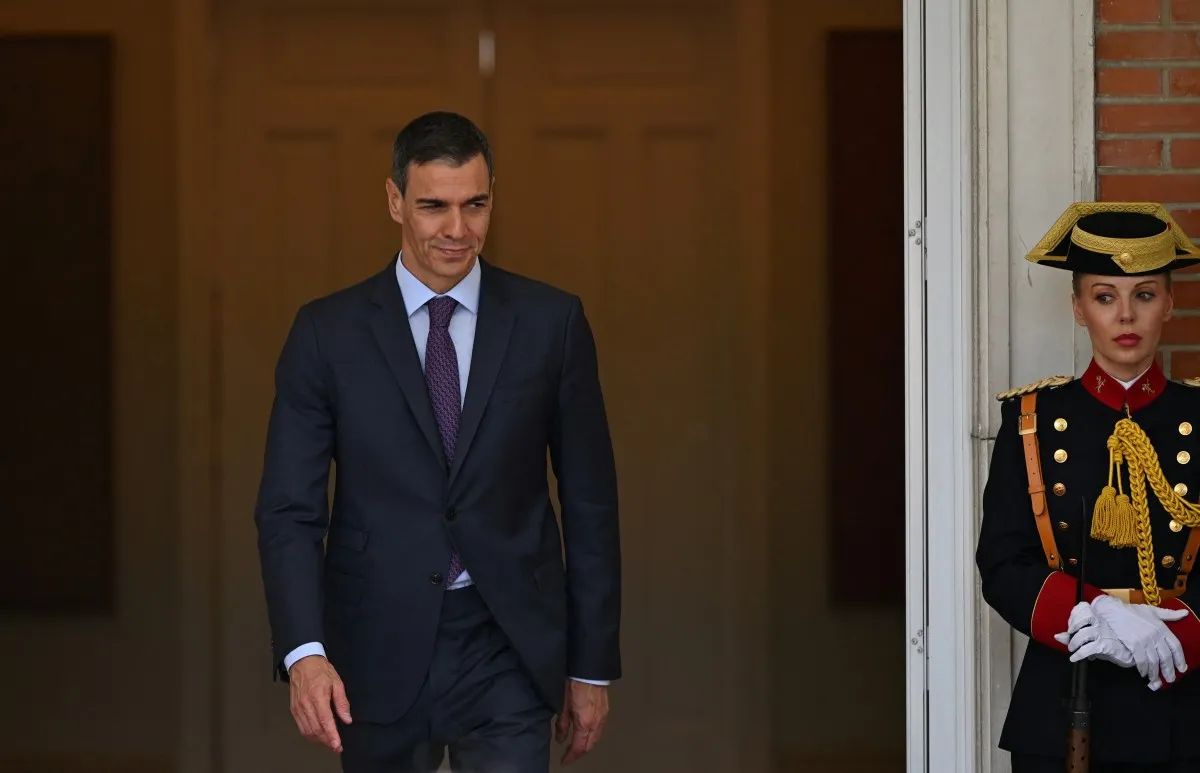
The unending migration crisis in Spain’s north African territory of Ceuta is inflicting potentially terminal damage on Prime Minister Pedro Sanchez ahead of next year’s general election, analysts say.
But the Socialist, a global progressive hero who has made escaping seemingly hopeless positions a trademark since taking office in 2018, can still turn things around, they told AFP.
READ ALSO: Intel reports show Spain was warned 18 times of Ceuta mass entry threat
What’s the situation?
More than 70,000 migrants streamed into Ceuta from neighbouring Morocco on July 30 and 31, in an unprecedented rush that left scores dead.
Thousands remain in the small city, increasing tensions with increasingly frustrated locals who demand their expulsion and a return to normality.
The crisis has generated a constant churn of negative headlines and dominated the political debate for six weeks.
“A crisis of this nature cannot be solved in a short space of time” and “is eroding” the government, said Jaime Ferri Dura, a political science professor at Madrid’s Complutense University.
The government is trying to accelerate the return of the migrants. However, it must first identify them to check if they are entitled to asylum, while unaccompanied children require special protection.
But according to Anton Losada, a politics professor at the University of Santiago de Compostela, Sánchez’s government “has taken an age to mobilise the emergency resources that are needed”.
Unanswered questions
Two unresolved questions weigh down on the government: what did it know about the migrant surge beforehand, and what role did Morocco play?
This week the government declassified 40 intelligence documents about the migrant surge — a gambit that may have backfired.
It said the files proved what it has always maintained — that no one had warned about the scale of the incident.
For the conservative and far-right opposition, the documents show the government received warnings and failed to act.
A report by the National Intelligence Centre (CNI) from July 29 flagged “several calls to carry out entries into Ceuta” in Facebook groups, one of them with more than 160,000 members.
A CNI source said the body “did not foresee the scale and nature of what ended up happening”.
Sánchez has said no “solid proof” exists that the rush was planned by Morocco, with which his government has striven for years to improve historically delicate relations.
The Moroccan government broke its silence on Thursday, saying there were “no facts or reports” proving its involvement, and rejected being the “scapegoat for political score-settling” in Spain.
But that defence appears to have little sway as suspicions continue to swirl.
A poll published in conservative daily El Mundo said 90 percent of Spaniards believe Rabat was behind the events.
Spain’s top criminal court opened an investigation into the mass entry, pointing to an “undeniable facilitation” in Morocco and a Spanish police report that flagged “total permissiveness” by Moroccan security forces.
Who benefits?
The main beneficiary appears to be far-right party Vox, the third-largest group in parliament which has denounced an “invasion” of Ceuta orchestrated by Morocco.
A survey published in left-leaning daily El Pais found 63 percent of interviewees believed Sánchez had managed the crisis “very badly” or “badly”, while Vox was “most capable of handling immigration”.
The questionnaire also found that Vox was the formation whose polling numbers increased the most.
Together with the mainstream conservative Popular Party (PP), which leads most election surveys, they would win more than half of the votes.
Ferri Dura noted that the far right has “capitalised on” migration crises in other European countries such as Italy and Germany.
The end for Sánchez?
The opposition wants to make Ceuta the decisive blow for the minority government, which has spent years grappling with corruption probes into Sánchez’s family and heavyweights in his Socialist party ahead of next year’s election.
Analyst Losada said the crisis would do “significant” damage to Sánchez if it “continues to drag on”, but if the government “finds a more or less satisfactory solution, it will be just another issue”.
Ferri Dura also warned against declaring Sánchez politically dead, saying he could lean on Spain’s strong economic performance.
“Sanchez always has the ability of pulling rabbits out of the hat,” the analyst concluded.
READ ALSO: Why are there still thousands of migrants in Spain’s Ceuta?
