

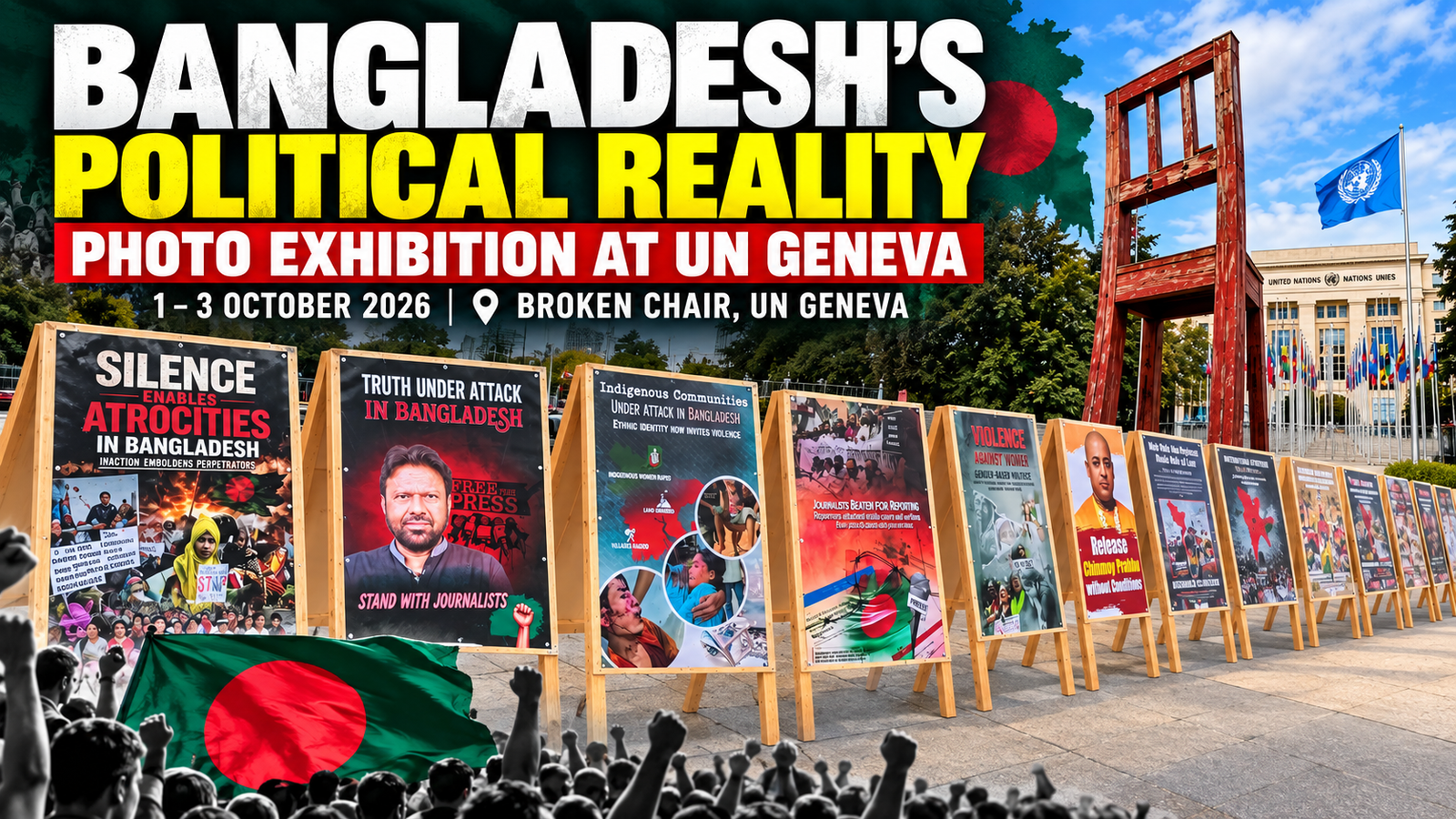
GENEVA — A three-day outdoor photo exhibition near the Broken Chair, opposite the United Nations Office at Geneva, brought attention to a range of political, human rights and press-freedom concerns relating to Bangladesh from 1 to 3 October 2026.
Displayed in one of Geneva’s most visible spaces for international advocacy, the exhibition featured photographs, posters and graphic presentations addressing issues including freedom of expression, the treatment of journalists, religious and ethnic minorities, indigenous communities, violence against women, political intimidation and the rule of law.
The exhibition’s visual material presented the perspectives and allegations of its organisers and contributors, with several displays calling for greater international attention to developments in Bangladesh.
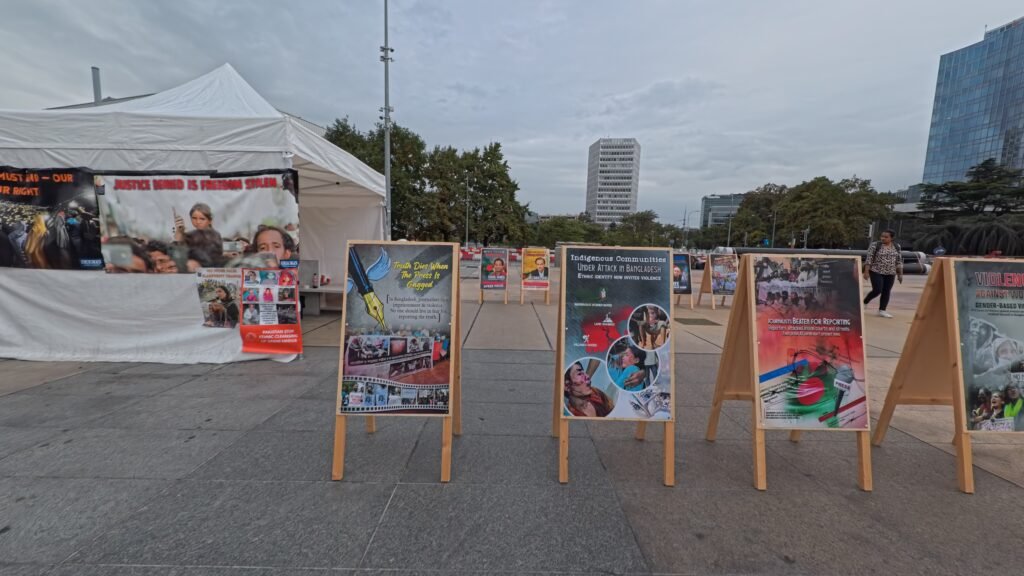
Among the most prominent themes was press freedom. Posters carried messages such as “Truth Dies When the Press Is Gagged,” “No Press Freedom in Bangladesh” and “Truth Under Attack in Bangladesh,” while individual displays highlighted journalists including Shakil Ahmed, Mozammel Babu, Farzana Rupa and Shyamal Dutta.
Concerns over the treatment of journalists in Bangladesh have also been raised independently by international human-rights and press-freedom organisations. In April 2026, UN human-rights experts communicated concerns to the Bangladeshi authorities regarding reported arrests, criminal prosecutions and arbitrary detention of journalists, as well as alleged mob violence against media outlets and cultural centres.
The Committee to Protect Journalists has likewise documented a series of cases during 2026 involving detained or prosecuted journalists and has repeatedly urged Bangladeshi authorities to strengthen protections for independent media and freedom of expression.
Minority and Indigenous Rights Featured
Another significant component of the Geneva exhibition focused on the situation of religious minorities and indigenous communities.
One display, titled “Indigenous Communities Under Attack in Bangladesh,” presented allegations concerning violence, land disputes and attacks affecting indigenous populations. Other posters addressed the situation of religious minorities and carried photographs from demonstrations calling for greater protection.
These presentations were framed by organisers as an appeal for international scrutiny and accountability. As with other material exhibited, the claims displayed represented the perspectives of those responsible for the exhibition and should be distinguished from independently established findings.
The exhibition also addressed gender-based violence, displaying photographs and messages concerning the protection of women and girls.
Rule of Law and Political Accountability
Several displays went beyond individual cases and raised broader questions concerning political accountability, governance and the rule of law.
One poster declared that “mob rule” had replaced the rule of law, while another called for urgent international attention, arguing that domestic remedies had failed. Other displays called for the release of particular individuals and criticised what organisers described as politically motivated or discriminatory treatment.
The exhibition took place at a particularly significant moment for Bangladesh. Following the political upheaval of 2024 and subsequent institutional transition, parliamentary elections were held in February 2026. In July, UN human-rights experts described the period as both an opportunity for democratic renewal and a moment of high expectations for institutional reform and stronger protection of human rights.
At the same time, international organisations have continued to raise concerns over freedom of expression and the safety of journalists. In September 2026, CPJ warned about provisions in a proposed cybercrime law that it said could expose journalists to lengthy prison terms for certain forms of reporting.
Former Bangladesh Parliamentarian Speaks to Geneva Times
As part of Geneva Times’ coverage of the exhibition, Prof. Dr. Md. Habibe Millat, MBBS, FRCS (Edin), President of the Global Center for Democratic Governance and a former Member of the Bangladesh Parliament, was interviewed at the exhibition.
During the interview, Prof. Millat discussed the purpose of bringing the exhibition to Geneva and offered his perspective on Bangladesh’s political environment, human-rights situation and democratic governance.
His interview forms part of the Geneva Times video report documenting the exhibition and the messages presented to the international community.
Bringing Bangladesh’s Debate to Geneva
The decision to stage the exhibition near the Broken Chair gave the event particular visibility.
The area opposite the United Nations Office at Geneva has long served as a gathering point for civil-society organisations, campaigners, victims’ groups and political movements seeking to bring human-rights concerns to the attention of diplomats, UN representatives, journalists and the international community.
Over the three days, the Bangladesh exhibition transformed the public space into a visual platform for advocacy. Rows of wooden display stands carried photographs and messages intended to confront passers-by with questions surrounding political freedoms, minority protection, journalistic independence and accountability.
The exhibition’s central message was unmistakable: its organisers wanted developments inside Bangladesh to remain part of the international human-rights conversation.
Yet the allegations and political interpretations contained in the exhibition should also be understood in their proper journalistic context. Bangladesh remains politically contested, and competing political actors and institutions may dispute particular allegations, interpretations and characterisations presented by campaigners.
For independent media, the responsibility is therefore not simply to reproduce competing political narratives, but to document them, distinguish allegations from verified facts and provide space for scrutiny from all relevant sides.
The Geneva exhibition nevertheless demonstrated how domestic political disputes can increasingly reach international forums, particularly Geneva, where questions of human rights, accountability and governance receive sustained diplomatic and civil-society attention.
Watch the Geneva Times Video Report
Watch the Geneva Times video from the exhibition, including an interview with Prof. Dr. Md. Habibe Millat, President of the Global Center for Democratic Governance and former Member of the Bangladesh Parliament.
Click here to watch the full Geneva Times video report and interview on YouTube.
Editor’s Note: Statements, photographs and allegations displayed during the exhibition represent the views and claims of their respective organisers or contributors. Their inclusion in this report does not constitute independent endorsement by Geneva Times. Geneva Times has presented independently sourced context where available.

