


Image taken at talks aimed at drafting a treaty on controlling Lethal Autonomous Weapon Systems, aka ‘Killer Robots’.
Mark Henley
More than 70 countries, along with the United Nations, humanitarian organisations and NGOs, are calling for negotiations on an agreement regulating autonomous weapons. A decision is expected in Geneva at the end of November.
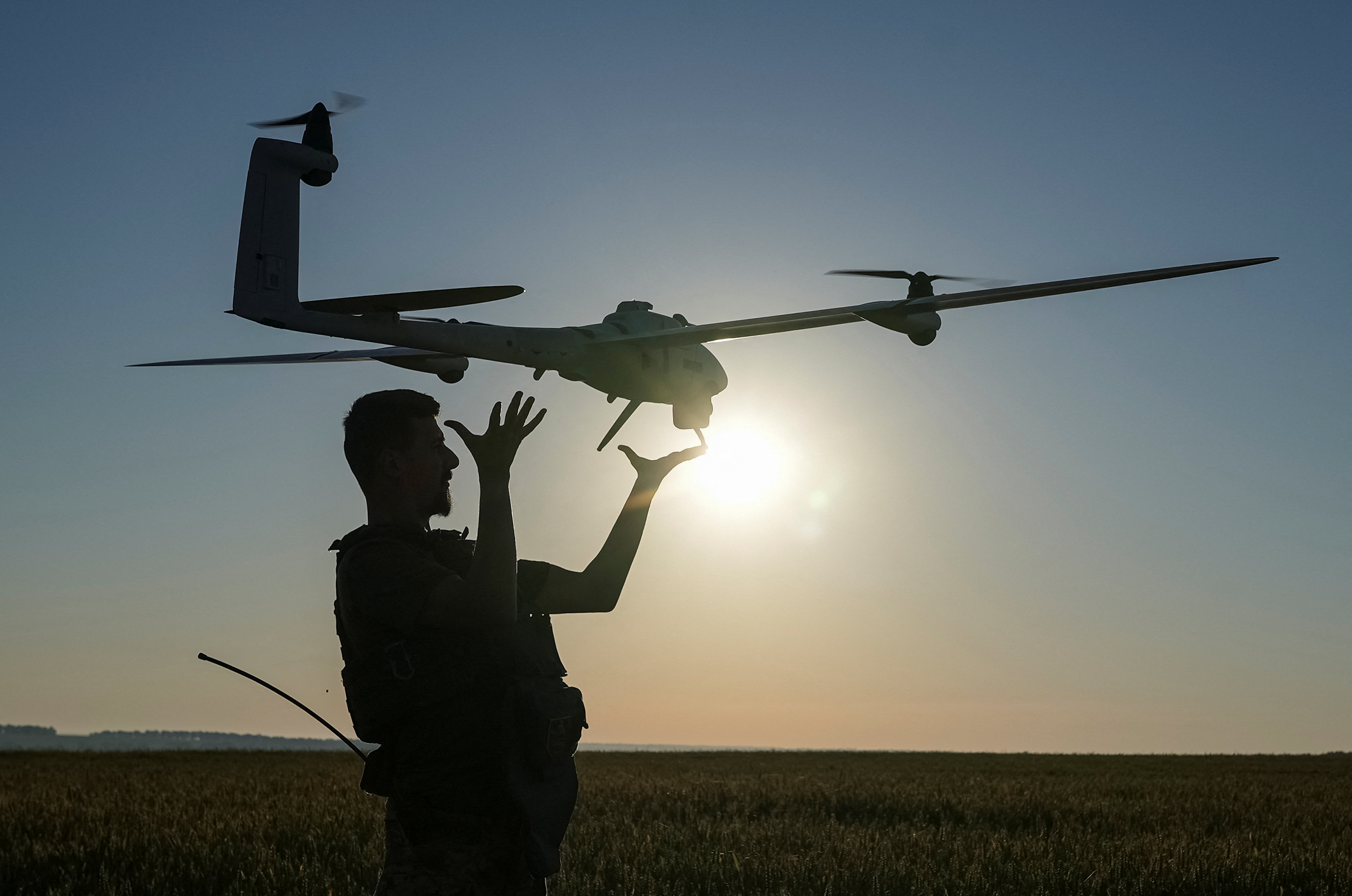
The use of a Russian autonomous drone controlled entirely by artificial intelligence (AI) that killed civilians was first documented on July 6. The drone accidently killed three people in the Ukrainian city of Zaporizhzhia, prompting immediate condemnation by the UN High Commissioner for Human Rights Volker Türk.
Addressing the UN Human Rights Council in Geneva on September 7, Türk also noted that Ukraine had tested fully autonomous drones. “I join calls for the urgent prohibition of weapons that can kill without human intervention,” Türk said.
Autonomous weapon systems targeting military objectives are not new. They have existed on warships to defend themselves against incoming missiles for decades.
However, rapid advances in sensors, algorithms and AI are dramatically expanding their capabilities, fuelling a global race among governments and companies to develop and deploy ever more sophisticated weapons.
This new generation of autonomous weapons, often called “killer robots”, can now identify and engage targets without human involvement. Such AI-powered weapons with increasing levels of autonomy have already been used not only in Ukraine but also in conflicts in Gaza, southern Lebanon and Sudan.
Yet no international regulations currently govern such weapons, making accountability difficult in case of a breach of international law.
According to experts, however, there have so far been no confirmed cases of fully autonomous weapons deliberately targeting civilians. The Russian drone on July 6 was most probably targeting a gas station, according to interviews of experts conducted by the The New York Times. Once it got close to its original target it chose to veer off course on its own and crashed into a wall.
Calls for regulation
The UN, the International Committee of the Red Cross (ICRC) and NGOs have been calling for years for regulation of autonomous weapons. Their concern is that such systems may not be capable of distinguishing in real time between combatants and people protected under international humanitarian law, such as civilians or wounded soldiers.

The use of a Russian autonomous drone controlled entirely by AI that killed civilians was first documented on July 6.
Mark Henley
“It is difficult to imagine how autonomous weapons could be used against people in real combat situations without creating significant risks of violating international humanitarian law,” Heidi Kandiel, a legal adviser on emerging military technologies at the ICRC, told Swissinfo.
International humanitarian law prohibits attacks on civilian targets as well as indiscriminate and disproportionate attacks. Warring parties in a conflict must minimise civilian casualties wherever possible.
A moral red line
In a joint statement at the end of August, UN Secretary-General António Guterres and ICRC President Mirjana Spoljaric warned that the rapid development of autonomous weapons could soon cross “a moral red line” by allowing machines to decide whether humans live or die.
Military technology is advancing at record speed, they warned, adding: “Negotiations must begin now to urgently adopt a legally binding instrument regulating autonomous weapon systems, including clear prohibitions and restrictions.”
More

More
Control-All-Delete
Their comments came ahead of a review conference of the UN Convention on Certain Conventional Weapons (CCW), due to take place in Geneva from November 16-20. The 128 states parties to the convention have spent over a decade discussing how to regulate autonomous weapons. Central to the debate is how to ensure meaningful human control over their use.
At the November conference, which will be chaired by Swiss UN Ambassador Julien Thöni, member states will be asked to decide whether to launch negotiations on an instrument regulating these weapons. Any decision must be reached by consensus.
The basis for those discussions will be a report by the Group of Governmental Experts (GGE), which was adopted by consensus by CCW states in early September. The report outlined measures aimed at ensuring human control over autonomous weapon systems and compliance with international law. It also reaffirmed that responsibility for decisions over life and death cannot be delegated to machines.
More than 70 countries, including Switzerland, have already voiced support for negotiations on a legally binding instrument, such as an additional protocol to the CCW. The United States and Russia, however, favour national guidelines over binding international rules.
Push for ban on anti-personnel systems
Critics argue that the GGE report omits key issues that had been discussed for years such as ethical considerations and concepts of reliability, predictability, traceability and explainability.
“It is disappointing to see core concepts removed at the last minute in order to achieve consensus,” said Laura Varella of the Geneva-based Women’s International League for Peace and Freedom (WILPF).

The UN and ICRC have called for a ban on autonomous anti-personnel weapons.
Mark Henley
Stop Killer Robots, a global coalition of more than 300 NGOs, criticised the report for failing to include a ban on autonomous anti-personnel weapon systems. The coalition says this must be addressed as soon as the negotiations begin.
The UN and ICRC in their joint statement also called for a prohibition on autonomous anti-personnel weapons, as well as “unpredictable” autonomous systems where operators cannot foresee the outcome of their deployment.
Switzerland considers it a priority for the November review conference to grant the GGE a mandate to negotiate an international legal binding instrument on autonomous weapons, according to Switzerland’s UN mission in Geneva. But it says it is prepared to show flexibility to facilitate its adoption.
For Switzerland, it is essential to ensure that “every use of autonomous weapon systems relies on the necessary human judgement and control”, which it considers fundamental elements of international humanitarian law.
The Swiss mission also noted that even autonomous weapons not designed to target people can still cause human casualties if they strike a vehicle or building.
What if there is no consensus?
If the review conference fails to agree on a negotiating mandate, several alternatives are possible. States could continue deliberations within the CCW, they could request a resolution of the UN General Assembly or they could start negotiations outside the CCW framework.
For Stop Killer Robots, any measure that is not legally binding would be insufficient, Elizabeth Minor, the coalition’s head of policy, told Swissinfo. She says increasing autonomy in weapon systems poses a serious threat to civilian protection and to humanity more broadly.

Stop Killer Robots says any measure that is not legally binding would be insufficient.
Mark Henley
“If no agreement on a negotiating mandate is reached at the review conference, states must use every procedural avenue available to launch negotiations,” Minor said.
Under Article 8 of the CCW, a state or group of states can submit a proposal to the UN Secretary-General to negotiate a new protocol. Member states would then be consulted, and if a majority supports the proposal – at least 65 states – a negotiating conference open to all UN members can be convened.
This approach was used for negotiations on anti-personnel landmines that eventually led to the 1997 Ottawa Convention as well as for the Convention on Cluster Munitions (Oslo Convention), adopted in 2008.
Negotiations without major powers?
Some governments nevertheless want negotiations to remain within the CCW framework, arguing that otherwise key military powers may not participate.
A proposal submitted by Belgium, France, Germany and Singapore for the review conference reflects this concern. It outlines several possible paths forward, including a non-binding code of conduct as a first step toward a legally binding agreement.
According to Minor, some heavily militarised states have repeatedly opposed legal rules on autonomous weapons and broader global regulation of AI in relation to the use of force.
“States that care about international law and civilian protection must begin negotiations now, even without those countries,” she argued. “They need to establish rules for their own practices that meet their humanitarian obligations while also exerting normative pressure on others regarding unacceptable technologies and practices.”
Edited by Virginie Mangin/ds
More
More


