


Life in Tehran appears to be edging back toward peacetime normalcy as a cease-fire holds and negotiations between the United States and Iran continue. Cafes that shuttered during air strikes have reopened. Streets that were once empty are again busy with traffic and pedestrians. Shops are open late, and families have returned to evening walks.
Most Iranians say they are relieved that the bombing has stopped and that daily life is no longer punctuated by the fear of explosions. But beneath the calm surface, a deeper sense of anger and disappointment lingers among some.
According to several Iranians who spoke to RFE/RL’s Radio Farda, the end of the fighting has brought peace, but not the change many had hoped for. All those interviewed asked that only their first names be used for fear of reprisal from the authorities.
Maryam, a cook who lives in one of Tehran’s high-rise buildings, remembers how she heard “people cheering and dancing” outside the apartment block when state television announced Iranian Supreme Leader Ayatollah Ali Khamenei had been killed in US and Israeli air strikes.
Maryam said she and others endured hunger, air attacks, and the deaths of civilians, believing the regime would eventually collapse.
“During war we all stayed at home, with no money, no job but full of hope. We thought we don’t have a job, but it will change, we don’t have money, but we’ll gain our freedom instead,” Maryam said.
“Even when our windows were shuttered…and our homes were destroyed, we took that in our stride too, saying that soon we will celebrate the departure of the regime and then rebuild our country together.”
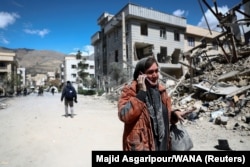
A woman talks on her phone in a residential Tehran neighborhood that was damaged in an air strike in March.
Maryam said people thought “becoming free has a price” and that they were paying “the price of freedom.”
But she said some people have been left with a sense of betrayal and exhaustion as Washington returns to talks with Tehran and the Islamic republic remains firmly in control — a sentiment shared by several other Iranians who spoke to Radio Farda.
During the conflict, US President Donald Trump initially said he wanted to remove Iran’s leadership and support its people. But the resumption of negotiations has left some Iranians feeling abandoned.
In the northwestern province of Gilan, a mother of one, Haleh said she and her friends believed the death of Ali Khamenei on February 28, the first day of the conflict, would mark the beginning of the end for the Iranian establishment and a political change was imminent.
Instead, she said Iranians found themselves dealing with destroyed homes and businesses, even greater poverty and inflation, and an emboldened regime.
Haleh, who lives with her son, said she juggles two jobs but still struggles to put food on the table as prices have skyrocketed in recent months. According to Iran’s Central Bank, inflation reached 77.2 percent in May.
“There are days that I can’t even afford to buy milk,” Haleh said.
But she’s quick to add that she and other Iranians “haven’t lost hope” and will keep trying for a “better future.”
“The people of Iran have shown many times that they have the resilience to withstand hardships hoping that the Islamic regime will eventually collapse,” Haleh said.
Enjoying Peaceful Days
In the capital, Tehran, Ava says she is enjoying the current days of calm the cease-fire has brought and hopes it will lead to lasting peace.
She recalls watching dark smoke billowing into the skies from her neighborhood as homes were hit by air strikes and lives were being lost.
“We haven’t yet fully come out of the shock of the war to properly grieve our losses,” Ava said. “I hope that my country will never experience those tragedies again. I hope we will live in peace from now on.”
But several voices described a growing gap between public appearances of normalcy and private despair.
Tehran resident Nader said that while daily life appears to go on, a lot of people feel defeated inside.
Nader said Iranians have not forgotten how thousands of people were killed and tens of thousands more were arrested in a brutal crackdown by authorities on nationwide anti-government protests in January.
According to Nader, many Iranians won’t accept that their sacrifices have changed nothing.
“People are waiting to see what America is going to do next…, whether America will strike Iran again,” he said. “At some point, people will take to the streets again in their millions. There is no way that people will accept this regime again.”
The Islamic republic has historically used periods of de-escalation to consolidate power at home. Several Iranians said they already see signs of tighter control, arrests, and intimidation even as officials speak of diplomacy abroad.
In the southwestern Khuzestan Province, Vahid described the regime as “a snake eating its own tail.”
Although he welcomes the cease-fire, Vahid said there is still uncertainty about what will happen next.
“I am an optimist, but I can’t say I don’t have concerns about the future, for myself and my country,” he said.


