


 AP
APEven after 5,000 years in a sarcophagus, mummified bodies from ancient Egypt still smell quite nice, scientists have discovered.
Researchers who examined nine mummies found that though there was some difference in the intensity of their odours, all could be described as “woody”, “spicy” and “sweet”.
They say recreating the composition of the smells chemically will allow others to experience a mummy’s whiff – and help to tell when the bodies inside may be starting to rot.
“We want to share the experience we had smelling the mummified bodies, so we’re reconstructing the smell to be presented in the Egyptian Museum in Cairo,” Cecilia Bembibre, one of the researchers, told BBC Radio 4’s Today programme.
During the mummification process, ancient Egyptians would surround the body with pleasant smells as an important part of preparing a spirit to enter the afterlife.
As a result, pharaohs and members of the nobility were adorned with oils, waxes and balms during the mummification process.
“In films and books, terrible things happen to those who smell mummified bodies,” said Dr Bembibre said.
“We were surprised at the pleasantness of them.”
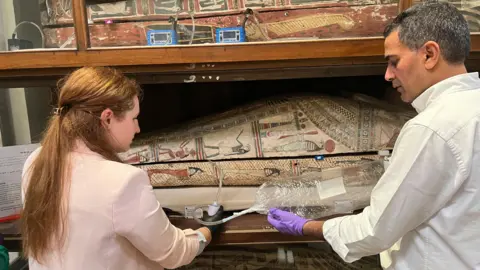
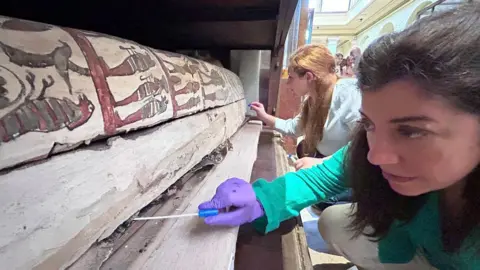
The authors of the academic study, published in the Journal of the American Chemical Society on Thursday, had to get the smell from inside the sarcophagus without interfering with the mummy inside.
The researchers, from UCL and the University of Ljubljana in Slovenia, did so by inserting a tiny tube so they were able measure the scent without taking any physical samples.
Dr Bembibre explained that heritage scientists are always trying to find “non-destructive” ways to discover new information.
 AP
APVisitors who smell the scents in the museums will be able to experience ancient Egypt and the mummification process from a totally different perspective.
Ally Louks, an English literature supervisor at the University of Cambridge who wrote her PhD thesis on the politics of smell, described this as a “really innovative” way to communicate history.
“To engage your nose produces a strong emotional and physical reaction,” she told the BBC.
“We know smells were essential to social, religious and personal practises [in ancient Egypt],” Dr Louks said.
Matija Strlič, another member of the study team, told the Associated Press the scents may even suggest what social class a mummy was from.
“We believe that this approach is potentially of huge interest to other types of museum collections,” he said.
As well as providing museum-goers with a new sensory insight into mummies, the discovery also presents a potential breakthrough for mummy conservationists.
The researchers used a technique called gas chromatography to separate the different smells inside the sarcophagus that combined to make its scent.
They found odours relating to the break-down of animal fats used in the embalming process, which could indicate the body is beginning to decompose.
Because of these findings, it will be possible to “practically intervene” in the conservation of the mummies, identifying how best to store and wrap the bodies, the research paper said.
“This is useful for conservators who care for this collection [as] we can ensure it reaches future generations,” Dr Bembibre said.


