


“AI is no longer a distant horizon – it is here, transforming daily life, the information space, and the global economy at breathtaking speed,” Mr. Guterres said at the Council’s high-level debate on the technology’s security implications for transforming warfare.
“The question is not whether AI will influence international peace and security, but how we will shape that influence.”
Used responsibly, the UN chief said, AI can help anticipate food insecurity, support de-mining operations, and identify outbreaks of violence before it spills out of control.
“But without guardrails, it can also be weaponised,” he cautioned, pointing to AI-enabled targeting in recent conflicts, cyberattacks on critical infrastructure, and deepfakes capable of fuelling polarisation or derailing diplomacy.
“The ability to fabricate and manipulate audio and video threatens information integrity, fuels polarisation and can trigger diplomatic crises…humanity’s fate cannot be left to an algorithm,” he stressed.
Decisions must rest with us
Mr. Guterres set out four priorities for governments: maintaining human control over the use of force, building coherent global regulatory frameworks, protecting information integrity, and closing what he called the “AI capacity gap” between rich and poor nations.
“I reiterate my call for a ban on lethal autonomous weapons systems operating without human control, with a view to concluding a legally binding instrument by next year,” he said.
He also insisted that decisions on nuclear weapons “must rest with humans – not machines.”
The Secretary-General highlighted steps already underway, including the creation of an independent scientific panel on AI and a new global dialogue on AI governance – due to take place in New York on Thursday.
“Together, these initiatives aim to connect science, policy and practice; provide every country a seat at the table; and reduce fragmentation,” he said.
A call to broaden access
Yejin Choi, Senior Fellow at Stanford University’s Institute for Human-Centered Artificial Intelligence, told the Security Council that current progress in AI is too concentrated among a handful of companies and countries.
“When only a few have the resources to build and benefit from AI, we leave the rest of the world waiting at the door,” she said.
“Let us expand what intelligence can be – and let everyone everywhere have a role in building it.”
AI must reinforce inclusion
Ms. Choi urged governments and international institutions to invest in alternative approaches beyond scaling ever-larger models, arguing that smaller, more adaptive systems could lower barriers to entry.
Let us expand what intelligence can be, and let everyone have a role in building it
– Professor Choi
She also pressed for stronger representation of linguistic and cultural diversity, noting that today’s leading AI models “underperform for many non-English languages and reflect narrow cultural assumptions.”
Act without delay
Secretary-General Guterres closed by warning the window for effective regulation is closing fast.
“From nuclear arms control to aviation safety, the international community has risen to the challenge of technologies that could destabilise our societies – by agreeing to rules, building institutions, and insisting on human dignity,” he said.
“The window is closing to shape AI – for peace, for justice, for humanity. We must act without delay.”
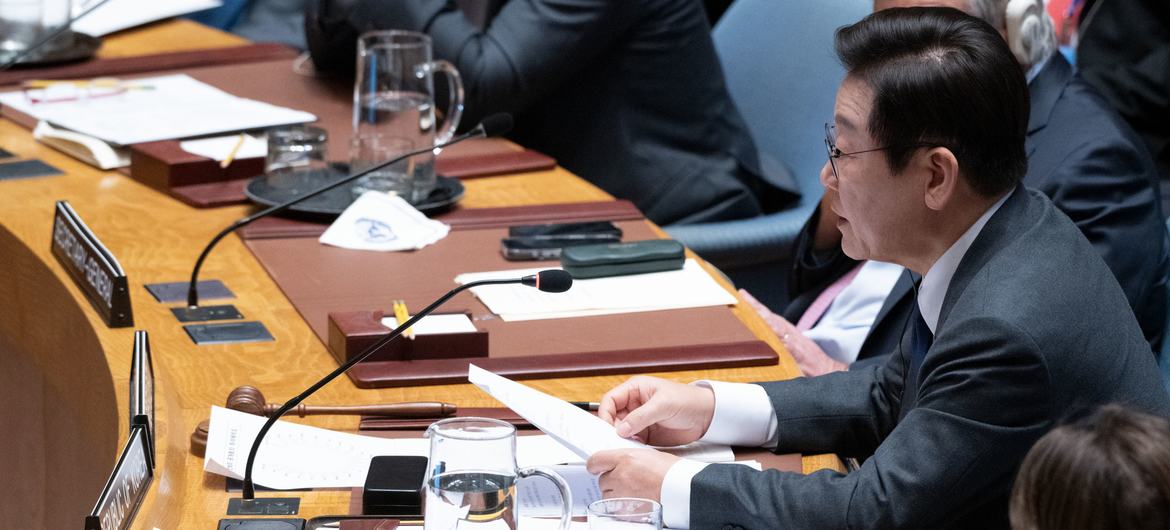
Lee Jae Myung, the President of the Republic of Korea, chairing the Security Council meeting.
The Security Council session was held on the margins of the ongoing high-level week of the General Assembly’s 80th session.
The meeting was convened by Republic of Korea (Council President for September) and attended by heads of states and governments, including Lee Jae Myung, the President of the Republic of Korea, who chaired the meeting.


