


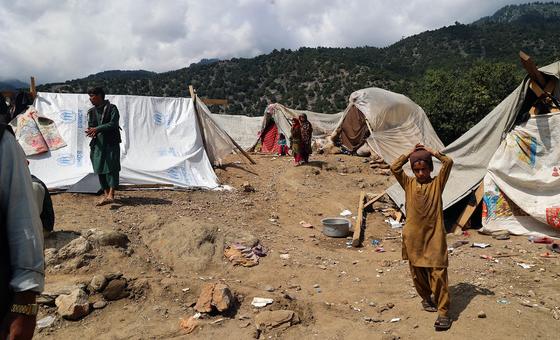
“While the major aftershocks have passed, or have mostly passed, women in affected areas are facing a long-term disaster without more urgent assistance,” said Susan Ferguson, UN Women Special Representative in Afghanistan.
One woman rescuer supported by the UN agency described “scrambling” along the sides of mountains, “dodging falling rocks every time there was an aftershock”, Ms. Ferguson told journalists in Geneva. “Another woman who joined these teams, again with our support, said there was no other channel for women to share their needs and concerns, as they are restricted from speaking to men.”
Fleeing with nothing
In the more than two weeks since a shallow 6.0 magnitude earthquake hit eastern Afghanistan, rescuers have battled extremely challenging terrain – often on foot – to reach the most remote communities in Kunar province.
At least 2,200 people were killed as houses built on steep hillsides collapsed on top of each other when the quake happened at around midnight on 31 August.
After meeting women survivors living in a basic tent in Chawkay district in central Kunar province, Ms. Ferguson said it was clear that they would soon need sturdier shelter, as temperatures start to drop.
“These women had fled their village in the middle of the night when the earthquake struck, walking for hours to find temporary shelter,” she said.
“They told me they’d lost their relatives, many still buried in the rubble. They lost their homes; they lost their livelihoods and their source of income. As one woman said to me, ‘now we have nothing.’’’
Ban on female workers
The humanitarian response to the disaster has been hampered by the Taliban leadership’s ban on Afghan women staff members and contractors from entering UN compounds in the capital, Kabul, effective since 7 September.
“The ban is impacting us because our women staff are not allowed to come to the office to work,” the UN Women representative said.
“However, women staff and women in the humanitarian response are still able to operate in the earthquake-affected sites. And this is really essential and has been recognised actually as essential.”
Women and girls accounted for more than half of those killed and injured in the disaster. They also make up 60 per cent of those still missing, while many survivors live in tents or out in the open, as witnessed by UN Women assessment teams.
Cultural chasm
Providing healthcare to survivors of the tragedy remains a priority – as does finding enough women to do this work, in line with culturally accepted practices. “What I heard from health workers and from some women was that there was a particular area in the earthquake-affected zone where there were cultural norms that meant that women themselves didn’t want men to touch them and that men also didn’t want to touch women as they were trying to rescue them,” Ms. Ferguson explained.
Destruction of basic infrastructure has heightened the threat of violence against women and girls as they are forced to walk further in search of a bathroom, or gather water, exposing them to the risk of violence and landmines.
“In everyday life, in this cultural context, these women already face an uphill battle every day to survive and support their families,” Ms. Ferguson said. “Now, in the disruption and chaos following the earthquake, these women will find it exponentially harder to feed their children and find a safe place to stay.”
Satellite images have revealed that more than 649,000 tonnes of debris – equivalent to 40,500 truckloads – still need to be cleared. According to the UN Development Programme (UNDP) which analysed the data at least 23,000 people may have been forced from their homes.


