


On Instagram, the storefront of a female-founded enterprise in Kabul looks like a world untouched by geopolitical upheaval.
The video reels shared by Marwa, the store’s owner who is in her early 20s, present a clean, organized gallery. Modern glass cases filled with traditional Afghan lapis lazuli, emerald, and rubellite jewelry sit alongside clips of women cutting raw stones and setting gems at workbenches.
“When I turned 17, I attended a course on jewelry making. Then I made my own business starting it with a small amount of money I had,” Marwa said.
Today, her creative enterprise has grown to employ some 20 people, spanning fine jewelry making, gemstone engraving, and custom apparel design.
“We don’t make much money currently, but we are doing okay,” Marwa told RFE/RL via WhatsApp, which was also used to interview the other women in this article. All of their names have been changed for security reasons.
Marwa is part of a generation of Afghan women entrepreneurs trying to build businesses despite mounting restrictions on their opportunities.
Since the Taliban returned to power in 2021, girls have been barred from secondary schools and women from universities. For some women, entrepreneurship has become one of the few ways to earn an income and create work for others.
Women have obtained business licenses, opened physical shops, and used social media to reach customers. Some have also received support from banks.
Yet running a business does not necessarily mean being free to expand it.
That tension is on display at the Imam Abu Hanifa National and International Exhibition, a major trade fair taking place in Kabul.
The seven-day event has brought together trade delegations and investors from more than 20 countries, with hundreds of exhibition stalls showcasing Afghan products and businesses, according to local media.
Women entrepreneurs have previously participated in exhibitions, including events with booths dedicated to women-owned businesses.
But several businesswomen told RFE/RL that they are no longer allowed to attend fairs where men are present.
Jobs For More Than 100 People
In northern Jowzjan Province, Zahra runs a carpet-weaving business.
Zahra, who is in her mid-20s, graduated with a law degree just as the Taliban returned to power.
Unable to pursue the future she had imagined, she used savings from her job as a teacher at a private school to start a business of her own.
In 2022, Zahra traveled through villages and met women weaving carpets under conditions she described as exploitative.
“They were very poor,” she says. “They only worked like slaves and would give their products to men in their families. They didn’t even know how much their carpet cost.”
Zahra offered them an alternative: paid work with salaries.
What began as an operation with a couple of dozen women has since grown to employ more than 100 people, including male workers who handle the physically demanding packing and transportation.
Because of strict travel mandates, Zahra cannot transport her goods or travel between districts without a “mahram,” a male guardian, such as her father or brother.
“Our problem is access to markets,” she says. “A man who has a similar business has more access to customers than a woman-owned business.”
Yet the human impact keeps her going. She recalls a widowed mother who had struggled with depression before joining the business.
“Her family told me that after working three months in my business, she no longer needed anti-depressants. She has found both a source of income and a place where she connected with other women.”
Secret Beauty Salon
Nafeesa, a Kabul-based entrepreneur in her late 20s, used to run a beauty salon, part of a once vibrant sector that employed thousands of Afghan women.
In 2023, the Taliban ordered beauty salons to close.
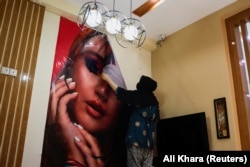
An Afghan beautician removes a poster in a beauty salon in Kabul after the Taliban ordered the closure of such outlets in 2023.
Today, Nafeesa secretly provides bridal makeup from the rented house where she lives in a working-class Kabul neighborhood.
She cannot advertise her services on social media and has no official business license.
Customers find her through word of mouth. Some come to her home for makeup; at other times, she travels to their homes to prepare brides and their relatives for weddings.
“Women wear makeup all over the world and it is not a political statement. It is not against religion,” Nafeesa told RFE/RL. “I don’t know why it is banned in our country.”
Shrinking Income
Muska, now in her mid-20s, spent years studying medicine before the university ban permanently locked her out of her future career.
With money from her parents, she and her sister launched a dressmaking business in Kabul that employs 15 to 20 women.
“Some customers bring their own fabric and order a dress. Some just come with a photo on their phone and tell us, ‘make me a dress like this.’ We find that type of fabric and make it for them,” Muska said.
Operating a physical store and an online catalog, Muska has built a relatively successful business.
Yet, an economic downturn and rising poverty have left other businesses struggling.
In a neighborhood in the Afghan capital, Nargis runs a tailoring shop employing six women.
Now in her late 30s, Nargis previously lived as a refugee in Pakistan, and said she became depressed after returning to Kabul and struggling to find work.
Today, Nargis’s shop creates everything from simple office wear to elaborate hand-embroidered bridal dresses.
“Taliban representatives check our business randomly and demand that we wear the hijab even inside our shop, where all employees and customers are women,” she said, referring to the head scarf the Taliban requires women to wear as part of a strict Islamic dress code.
For Nargis, however, the most pressing issue is economic. Orders have dropped sharply, and remaining customers often haggle over prices. Some months, she falls behind on rent and struggles to pay her employees’ wages.
Despite the financial strain, she and her staff are determined to keep the shop open, saying the work gives their lives a sense of purpose.
“But my main problem is a shortage of customers,” she said.


