

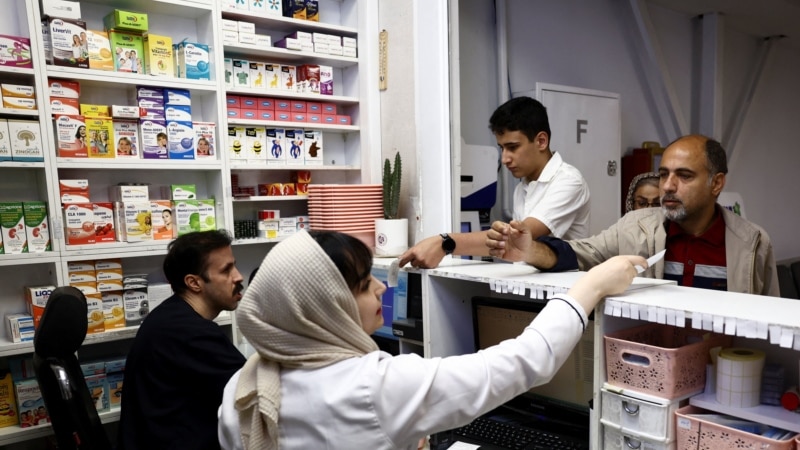
Iran’s worsening medicine shortages are pushing patients toward a growing black market, where essential drugs can be found at several times their official prices.
The Iranian Pharmacists Association says around 800 medicines are currently on the country’s shortage list. The shortages have been compounded by financial constraints, difficulties importing medicines and raw materials, and flight restrictions following the 12-day war with Israel in June 2025 and the ongoing conflict with the United States.
Mehdi Pirsalehi, head of Iran’s Food and Drug Administration, has cited financial difficulties such as a shortage of the foreign currency needed for imports as a major cause of the crisis.
For patients, the consequences can be severe.
A 45-year-old woman being treated for breast cancer told RFE/RL’s Radio Farda that pharmacies repeatedly said they were out of stock of the Iranian-version of Aromasin, a drug she must take daily. A 30-tablet pack officially costs 4 million rials (about $1.50). She paid 50 million rials (about $19) on the black market, 12.5 times the official price.
She also said she paid at least 30 million rials (about $11) per injection of Zometa, and that two of them turned out to be counterfeit and caused her complications. Like other people who spoke to RFE/RL’s Radio Farda, she asked that her name be withheld for security reasons.
A 39-year-old man being treated for lung cancer said he now spends 750 million rials (about $279) a month on Sandostatin LAR, which he obtains from pharmacies run by the Iranian Red Crescent Society. Last year, he spent 220 million rials (about $82), marking an increase of 241 percent.
According to the Iranian Statistics Center, the average monthly salary in Iran is around $400–500, with wages in cities such as Tehran seen at about double that level.
Radio Farda is barred from operating in Iran, and the accounts in this report could not be independently verified.
Sold Through Telegram
While pharmacies in Iran run short on supplies, Radio Farda found sellers advertising medicines through Telegram groups and other online channels. They were offering drugs for Parkinson’s disease, asthma, depression, diabetes and heart conditions.
One seller offered RhoGAM, an injection given to Rh-negative women during pregnancy or after miscarriage to prevent complications. The same seller also carried Symbicort, which is prescribed for asthma and chronic obstructive pulmonary disease, and nortriptyline, which used for depression and migraines.
Some sellers said flight restrictions imposed because of the war had made it harder to import medicines but that alternative routes remained open. One importer urged buyers to confirm availability first, then offered a long list of medicines for delivery by post.
Another seller, a woman, said she worked with her brother, who sources medicines “from wherever he can,” while she handles marketing and sales.
“You just place the order,” she said. “Selling medicine is not profitable at all. We only sell medicine so that we can survive.”
No Fixed Price
Prices on the black market vary widely and often far exceed pharmacy prices.
A seller in Isfahan offered Madopar, a Parkinson’s drug, for 20 million rials (about $7). At roughly the same time, a seller in Yazd quoted 72 million rials (about $27), more than three times as much. Estradiol valerate, an estrogen medicine, was offered for 40 million rials (about $15), compared with 6 million rials (about $2) at pharmacies.
Official prices are climbing, too. A spokesman for the Iranian Pharmacists Association told Iranian media recently that medicine prices had risen by an average of 30 to 70 percent this year. Some foreign-branded drugs had risen by as much as 300 percent.
For patients who can find their medicines, the question is increasingly whether they can afford them. For the sellers, as the woman who works with her brother put it, the trade is about getting by.
