

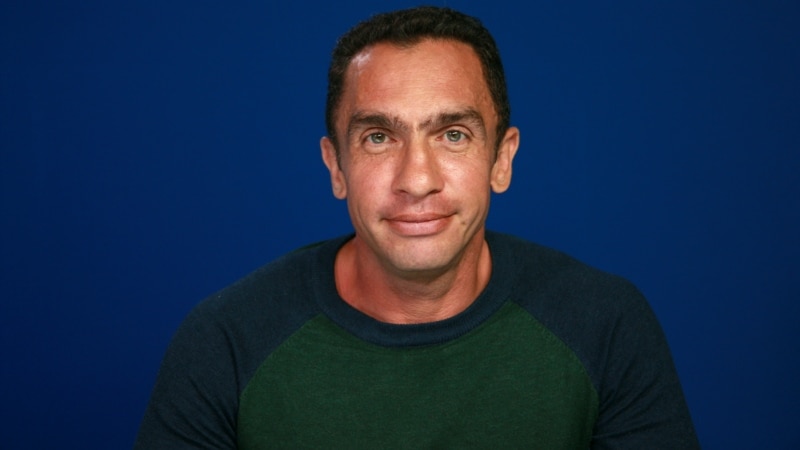
In a social media post on September 22, political scientist Aleksandr Kynev said evidence suggested the Kremlin-backed United Russia party received 20 to 30 percent of the votes cast in a Moscow suburb in the previous weekend’s parliamentary elections — far fewer than official results asserted.
Three days later, he was arrested — and three days after that, the rights-focused media outlet Slovo Zashchite cited an unnamed medical source in the prison system as saying that he had been severely beaten while being detained, with his shinbones fractured in two places. The source described it as torture.
The September 22 Telegram post was one of several online comments in which Kynev, a respected expert on Russian regional politics, pointed to evidence of fraud in the September 18-20 elections to the State Duma, in which United Russia was awarded a record-high majority and 349 of the lower chamber’s 450 seats.
He is now being held in custody, reportedly in the hospital at Moscow’s Matrosskaya Tishina jail, on charges that formally have nothing to do with his work or his comments. He is accused of attempting to sell a large amount of drugs — an allegation that supporters say is absurd — and could be sentenced to 20 years in prison if tried and convicted.
The arrest and reported beating of Kynev, 51, looks like a gruesome affirmation of concerns that with the first Duma elections held during the full-scale invasion of Ukraine in the rearview mirror, President Vladimir Putin’s government would once again step up a campaign of repression that has permeated Russia for over a decade.
“While he tried to observe the proprieties, he also strove to respect the integrity of the numbers. He had the courage to point out that the actual election results contradicted the picture painted by the authorities. And for that, they broke his legs,” political analyst Dmitry Oreshkin told RFE/RL’s Russian Service.
“That is the whole point of this ritual: Sit there and bow down, or better yet, keep your head down — otherwise we’ll rip it off,” Oreshkin said.
As Russia intensifies attacks on Ukraine, seeking to seize more territory in the east and batter the country into submission with assaults on cities and vital infrastructure nationwide, state authorities are also trying to erase dissent at a time when Russians are increasingly tired of the war and worried about the troubled economy.
In that atmosphere, Kynev was a relatively obvious target. A longtime chronicler of election fraud and a former department head at the independent Russian vote-monitoring organization Golos, which shut down in 2025 under pressure from the state, he was designated a “foreign agent” in February.
Furthermore, he has adamantly rejected the idea of leaving the country, a path many Kremlin opponents have taken to avoid potential prosecution or worse.
Kynev’s arrest “comes as surprise, of course, but to some degree it was to be expected,” Vladislav Inozemtsev, an economist and author who now lives outside Russia, wrote on Facebook.
“Terror directed not so much at the opposition per se, but at active citizens who are aware of the rights enshrined in the constitution — specifically voting rights in this case — has become the regime’s primary activity for the foreseeable future,” he wrote.
But there may be even more to it than that.
Some analysts say Kynev’s arrest is at least in part a product of a growing power struggle inside Putin’s ruling apparatus that, roughly speaking, pits emboldened security agencies against political operatives.
More specifically, experts see persistent competition between the emboldened Federal Security Service (FSB) and a faction in the Kremlin led by Sergei Kiriyenko, a senior official in the Presidential Administration who is Putin’s domestic policy czar.
“The case of Kynev marks a new milestone in the unfolding saga of the security services acting on their own initiative,” Tatyana Stanovaya, a senior fellow at the Carnegie Russia Eurasia Center, wrote on Telegram on September 28.
The suspicions of a connection to the under-the-carpet struggle within the Russian state stem largely from the fact that Kynev was widely seen as being associated with the New People party, a political group that is considered part of Russia’s “systemic opposition” — forces that are nominally in the opposition but are part of Putin’s power structures — and as a brainchild of Kiriyenko and his team.
Kynev “worked with the New People party and made no secret of his support for it during the elections. He was an “insider” for a party created and backed — albeit with numerous caveats — by the Kremlin’s domestic policy overseers,” Stanovaya wrote. “I wouldn’t be surprised if Kiriyenko and his team were unaware of the impending arrest; it is undoubtedly a blow to them.”
In the wake of the elections, “I believe Russia’s political system will become simpler and increasingly rigid. Authority over political and domestic affairs — previously held by the Presidential Administration — will shift toward the security services,” political analyst Ruslan Aisin told RFE/RL’s Russian Service.
“Consequently, figures like Kynev will no longer be viewed merely as outliers, but as outright enemies of the people,” he said.
“In effect, he stated that these elections were rigged and lacked legitimacy; he essentially challenged the entire system. Naturally, this deeply offended someone and sealed his fate. It seems Kiriyenko will have to accept that power is slipping from his hands to the men in uniform,” Aisin said.
Yevgeny Stupin, a politician and former member of the Moscow city legislature, suggested the motives behind Kynev’s arrest were more straightforward and followed a pattern seen in other cases against Russians who have been labeled foreign agents.
“I believe the persecution itself began because Aleksandr criticized this process that merely mimics an election,” Stupin told RFE/RL’s Russian Service.
After listing a citizen as a foreign agent, “the authorities allow a certain amount of time for the person to either leave the country or fall silent. If you don’t heed that signal, a repressive measure follows,” he said.
