


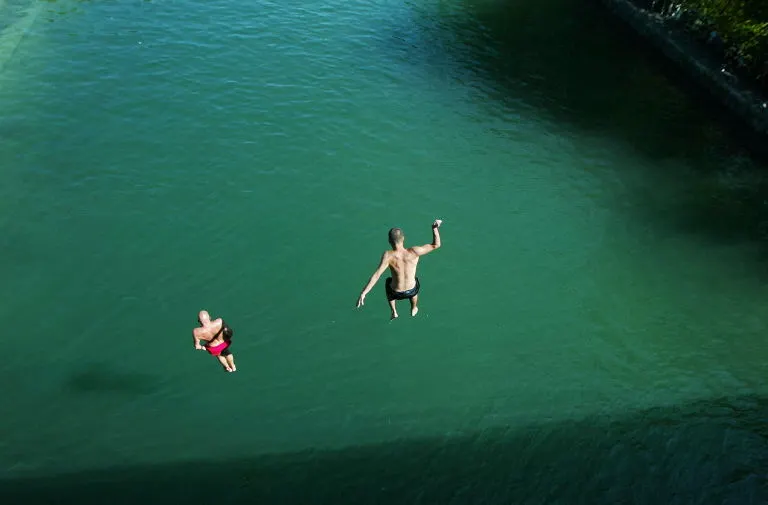
Several of Switzerland’s cities sit on perfectly swimmable rivers. In fact, some of these rivers provide not only fun swimming opportunities, but also a rather different way to get to work as journalist Amy Brooke can testify.
This is the case in Zurich’s Limmat river, Basel’s Rhine, and Bern’s Aar.
It may sound mad, but many people find floating to and from work more pleasant than using the more traditional forms of transport like buses or trams. And, unlike most things in this country, swimming in them is free.
Residents in Switzerland’s largest cities take advantage of the river currents to swim or float to work. Fewer locals swim to work than they say they do, but it does take place – and the fact that it’s even possible is something truly special. After all, how many other places in Europe can you go swap a business suit for a swimsuit so quickly?
(And no, they don’t arrive at the office dripping wet: they have a waterproof, rope-tied swimming bag in which they stow their day clothes and other belongings).
The disadvantage, of course, is that the current – which continues in the same direction consistently – means even strong swimmers will be unable to swim back.
But if you’re a strong swimmer and fancy switching up your commute (in one direction, at least), check out the best places to swim in each of these cities.
BERN – AAR RIVER
The bright blue Aar flows through Switzerland’s historic capital city. The 50-metre-wide river is one of the most established locations for wild swimming in the country with clear signage about where it’s safe to get in and out. This is very important as currents can be particularly strong on the Aar, so do take care.
Where to start
You can get in from a riverside swimming pool or anywhere you like the look of, really. You’ll see people walking in the opposite direction to the flow of the river and just getting in, but keep an eye out for the red bars – these clearly mark entry and exit points. You can grab onto them to help you get in and out.
For the most popular – and, according to the tourist office, safest – area, head for the Eichholz campsite. This is a couple of kilometres upstream of the free-to-enter Marzili freshwater pool. Enjoy the view of the parliament building as the river carries you back to the pool to get out. If you don’t want to use a waterproof bag, the pool has lockers where you can leave your stuff.
If you’re after an extra adrenaline surge, you can join the thrill-seekers jumping in from the low pedestrian bridge, Schönausteg. Just look out for any unsuspecting swimmers below before you take the plunge.
If you’re new to swimming to work or just looking for a more relaxed float, you might be better off starting from the Altenbergsteg pedestrian bridge because the current isn’t so strong there. People also do bungee surfing here!
If you take this route, your last chance to get out is at the Lorraine pool – look out for the graffiti-covered walls on your right hand side and the ‘last exit’ signs (in German, French and English). The area beyond this point is closed to swimmers as a little further downstream, there’s a weir that’s part of an old hydropower plant.
This one won’t take you to work (unless your office is at the starting point) as it’s a loop, but it’s your best bet for a slightly longer time – around 20 minutes – in the water. Take the number 21 bus to the Fährstrasse stop and then follow the Felsenau bridge to the right-hand bend, cross the road and turn left towards the river, passing under the bridge until you get to the Aar tunnel.
Temperature: The glacier-fed waters rarely exceed 21C even in summer. You can check daily temperatures here.
The gear: an orange or lilac Aarebag printed with the Bern bear mascot, or a similar waterproof bag you can take in the water, is a must. It also has a map printed on the back so you can see the entry and exit points.
The event: If you fancy taking part in a 350-metre swim when it’s a lot colder – ie November – you can give the Zibeleschwümme (or onion swim) a go. It’s always held before the annual onion market. You can find out more about it here.
Check out this map (in German) for clear info on where you can swim (or raft) in the area.
BASEL – RHINE RIVER
Floating down the Rhine is a glorious way to get a different perspective on the historic old town as you drift through the approximately two-kilometre swimmable area.
But it can still be dangerous: the Basel outpost of the Swiss Lifesaving Society (SLRG) says you shouldn’t tie your waterproof bag to your body. Use it as a pillow or a kickboard instead. You can find lots more safety tips and recommendations from them here (in English). The use of inflatables and jumping off bridges is also banned in Basel.
Check out this helpful map of the swimming area – it clearly shows the safe swimming areas in green. The BachApp is also well worth downloading for the lowdown on water temperature and levels, safety info and local events.
And if you’d like some trained people with you the first time you give it a go, the city’s sports office offer accompanied swims you can join every Tuesday in July and August. They run from the Tinguely art museum at 5.45pm. You can book your free place here.
READ ALSO: How to stay safe when swimming in Switzerland’s lakes and rivers this summer
Where to start:
One of the easiest – and most popular – places to get in to the water is at the Einstieg Rhyschwimme beach. This rocky area is just below the Tinguely museum on the Kleinbasel banks of the Rhine by the Schwarzwaldbrücke.
There are red buoys which separate the swimming area from the boats, but you still need to keep an eye out for where you’re going and when to get out, especially because the entry and exit points aren’t as clear as they are in Bern and some of the signage is just in German. Remember you’re sharing the space with boats, too, so keep an eye out for them and keep your distance.
You’ll float gently downstream for about 30 minutes under several bridges before you reach the last exit point – just before the Dreirosenbrücke where you can clamber up some concrete steps.
A word of warning: it’s not that easy to get out, so plan your exit in advance, if you can, so you don’t end up in Rotterdam! Also: water shoes are your friend.
If you’re a very strong swimmer, you can also get in between the Wettsteinbrücke and the Johanniterbrücke, but you’ll have a shorter time in the water there.
When they’re open in the summer months (May to September), the stilted bathing houses at Rheinbad Breite and St Johann also offer easier places for getting in and out of the water. And you can dry off on their decks, or shower and get changed there for a small charge.
Temperature: Temperatures are a bit warmer in the Rhine – at the time of writing, they were 23C. You can check daily temperatures here.
The gear: Bern has the Aarebag, but Basel has the cute fish-shaped Wickelfisch bag. And the SLRG have also developed this bright orange swim bag that can be transformed into a city bag.
The event: The traditional annual Rhein swim can attract around 5,000 people when the weather’s good. This year it takes place on Tuesday 13th August at 6pm, from Schaffhauserrheinweg to Leuengasse / Johanniterbrücke. It’s free to take part and you don’t need to book.
ZURICH – LIMMAT RIVER
Badi-Kultur or bathing culture is a big deal in Zurich, which is studded with open-air public bathing facilities or Badi – over 40 to be precise. Often in the form of wooden pontoon-like bathing platforms, they make it easy to get in and out whether you choose to step in gingerly or leap right in. Although technically, you can get in anywhere that’s safe – apart from the off-limits town centre.
The Flussbad at Oberer Letten, a channel of the Limmat, is a popular spot for floating down into the city. It has a 400-metre swimming channel and a very lively atmosphere, especially in the evenings. Handily, it’s very close to the main station for that commuting alternative, too.
Walk upstream to the Dynamo youth centre, get in and float back to the Oberer Letten steps. Or jump into the cool waters from the bridge across from the Marriott hotel.
For a more contained environment, try the Unterer Letten enclosed river pool – there’s a gate at the end to catch you if you miss the handrail. Or check out some of Zurich’s other open-air pools.
Temperature: currently between 20 and 24C. You can check daily updates (including on water levels) here.
The event: And if you want to swim in the part of the river where swimming’s normally banned – and take in historic sights, like the Swiss National Museum, the Wasserkirche, and more, from the river – you can take part in the city’s 58th Limmat swim on 17th August. The two-kilometre route goes from the Frauenbad swimming pool to the Oberer Letten pool.
What do you need?
Obviously if you’re swimming/floating to work, you’re going to need somewhere to store your stuff. The savvy Swiss have developed a series of cute waterproof bags, which you can get online and in most larger department stores. They keep everything dry, act like a floating device as you the current gently sweeps you along and make you easier to spot.
We’d also recommend wearing water shoes as it can be quite rocky getting out.
When’s the best time to go?
It depends on how you like your water temperature! It’s definitely chillier first thing, so maybe commute home (if the current’s flowing the right direction) when the sun’s had a chance to warm the water up. While there are hardy winter swimmers, this is definitely more of a summer activity for most people.
Safety first
Swimming in Switzerland’s rivers can be fun, but be aware that the currents can be very fast, so it’s only recommended for strong, experienced swimmers. There are often no lifeguards and the speed of the current can be a bit of a shock initially (I found it quite unnerving until I let the river just take me). So if you’re a nervous swimmer, it’s best avoided, not least because you’ll often be immediately out of your depth.
Make sure you check current conditions before you go in.
River waters can be COLD. If you’re not a regular cold-water swimmer, get in slowly to acclimatise yourself to the temperature and avoid cold water shock, which can be very dangerous.
If it’s your first time, it’s best to go with people who’ve done it before. Don’t swim on your own.
It’s beautiful floating down the river, but keep your wits about you. There can be other river traffic – like boats – and you don’t want to miss the exit points, either!
Talking of boats, keep your distance from them.
It should go without saying, but don’t drink alcohol and then hop in the water. Don’t swim immediately after eating either!
Remember there are no lifeguards, so swimming is at your own risk – make sure you’re a strong enough swimmer before you even think about getting in.
Avoid swimming straight after heavy rain because currents will be faster and water quality could be poorer. The BAFU website has a colour-coded map indicating which rivers and lakes are clean and which aren’t at any given moment.
And don’t forget to have fun and enjoy this unique way of getting from A to B.


