



A protest against the ‘Stargate’ data centre project in Saline, Michigan. Local residents fear higher electricity bills and reduced water supplies.
Jim West / Science Photo Library
Digital services and artificial intelligence require ever larger and more numerous data centres. Data explains why these facilities have become so controversial – including in Switzerland.


For decades, data centres powered the internet while remaining largely invisible to the public. But as they grow in number and size, especially to meet growing demand for AI services, they have begun to run into public opposition. Around the world, communities are increasingly concerned about the amount of electricity, water and land these facilities require.
Switzerland, one of the countries with the highest density of data centres in the world, is experiencing the same tensionsExternal link. Environmental activists recently set up a protest campExternal link near the site of a planned data centre in Beringen, in the canton of Schaffhausen.
Those concerns are not unfounded. According to a recent United Nations (UN) reportExternal link, by 2030 artificial intelligence (AI) could consume as much water as 1.3 billion people and require as much electricity each year as three times the annual consumption of Pakistan, Bangladesh and Nigeria combined.
Yet investment continues to surge. In 2025, the world’s largest technology companies spent an estimated $400 billion on data centres – more than total investment in Africa’s energy sector that year. According to the International Energy Agency (IEA)External link, spending is expected to exceed $700 billion in 2026.
In the United States, several states are considering restrictions or moratoriums on new projects, while opposition from local communities has contributed to the cancellation of numerous planned data centres. Similar debates have emerged in Ireland, the Netherlands, Germany and Brazil.
These five charts explain why data centres have become one of the most controversial digital infrastructure today – and why the debate has reached Switzerland.
1. Switzerland is already a data centre nation
There are more than 11,000 data centres around the world. By absolute numbers, the United States has by far the most, followed by the United Kingdom, Germany and China, according to the UNExternal link. But relative to its population, Switzerland ranks among the most densely equipped countries in the world, based on UN figures. The country has around 13 data centres per million people (compared to about 12 per million in the U.S.).
This concentration is no coincidence. Data centres require reliable electricity supplies, high-speed connectivity and political stability. Switzerland offers all three. Operators also benefit from proximity to major European markets and an electricity mix that is both cheap and low in carbon emissions.
More

More
Can Switzerland’s power grid keep up with its data centres?
The presence of major tech firms in the Zurich region is another driverExternal link of Switzerland’s data centre boom. And the country’s political neutrality and strong data-sovereignty rules attract companies seeking alternatives to storing data in the United States, China or the European Union.
Existing hubs, the IEA notes, continue to draw new investment. The result is a growing concentration of data centres in a handful of countries, like Switzerland.
2. AI is driving electricity demand up to record levels

Illustration: Kai Reusser, Swissinfo
Global electricity demand from data centres grew by 17% in the last year, nearly six times more than overall demand, the IEA estimates. By 2030, data centres’ energy consumption could more than double today’s level.
Artificial intelligence is one of the main drivers of this growth. According to the IEA, electricity consumption by AI servers alone is expected to triple by 2030. A single AI-optimised server rack can consume as much electricity as 65 households a year.
Training and operating large language models requires vast computing power. Researchers estimate that GPT-4 required tens of gigawatt-hours of electricity during training. And a typical AI-assisted search is estimated to require around ten times more electricity than a conventional web search, the UN reports.
Switzerland has so far been less exposed to this trend than some larger countries, as most existing data facilities primarily support cloud services rather than AI training. But projects linked to AI are growing: a supercomputer in Lugano is being used to train the Swiss LLM Apertus and a new high-performance AI computing installation recently opened in Basel.
Even if it is not officially dubbed an “AI” facility, plansExternal link for the controversial Beringen data centre say it will support high-density compute workloads, including AI.
The planned site – equivalent to roughly two and a half football fields – could consume electricity equal to 75% of the entire canton’s supply when operating at full capacity, according to an interpellationExternal link by Schaffhausen city councillor Maurus Pfalzgraf.
Other European countries are already grappling with the energy demands of data centres. In Ireland, new data centre connections in the Dublin area have been restricted for several years over concerns that they could overload the electricity grid and increase the risk of blackouts.
Irish politicians are now also considering measures such as a levy on data centres to help recover the costs they impose on the grid, which are ultimately passed on to households.
3. Switzerland’s data centre boom is being driven by hyperscalers
New facilities are becoming larger, more power-intensive and increasingly concentrated. A recent studyExternal link commissioned by the Swiss Federal Office of Energy (SFOE) indicated that electricity demand from Swiss data centres has risen almost 20% since 2019. In 2024 data centres represented 3.6% of total electricity consumption – almost as much as the Swiss Federal RailwaysExternal link needs to power every train in Switzerland for a year.
By the end of the decade, Swiss data centres could use more than 5% of the country’s electricity, according to the SFOE study – an increase equivalent to the annual consumption of around 180,000 households.
Nearly all of this increase is expected to come from the largest facilities, the so-called “hyperscalers” operated by technology giants such as Amazon, Microsoft, Google and Meta. Their electricity use in Switzerland is expected to almost double by 2030, while smaller and specialised data centres remain broadly stable.
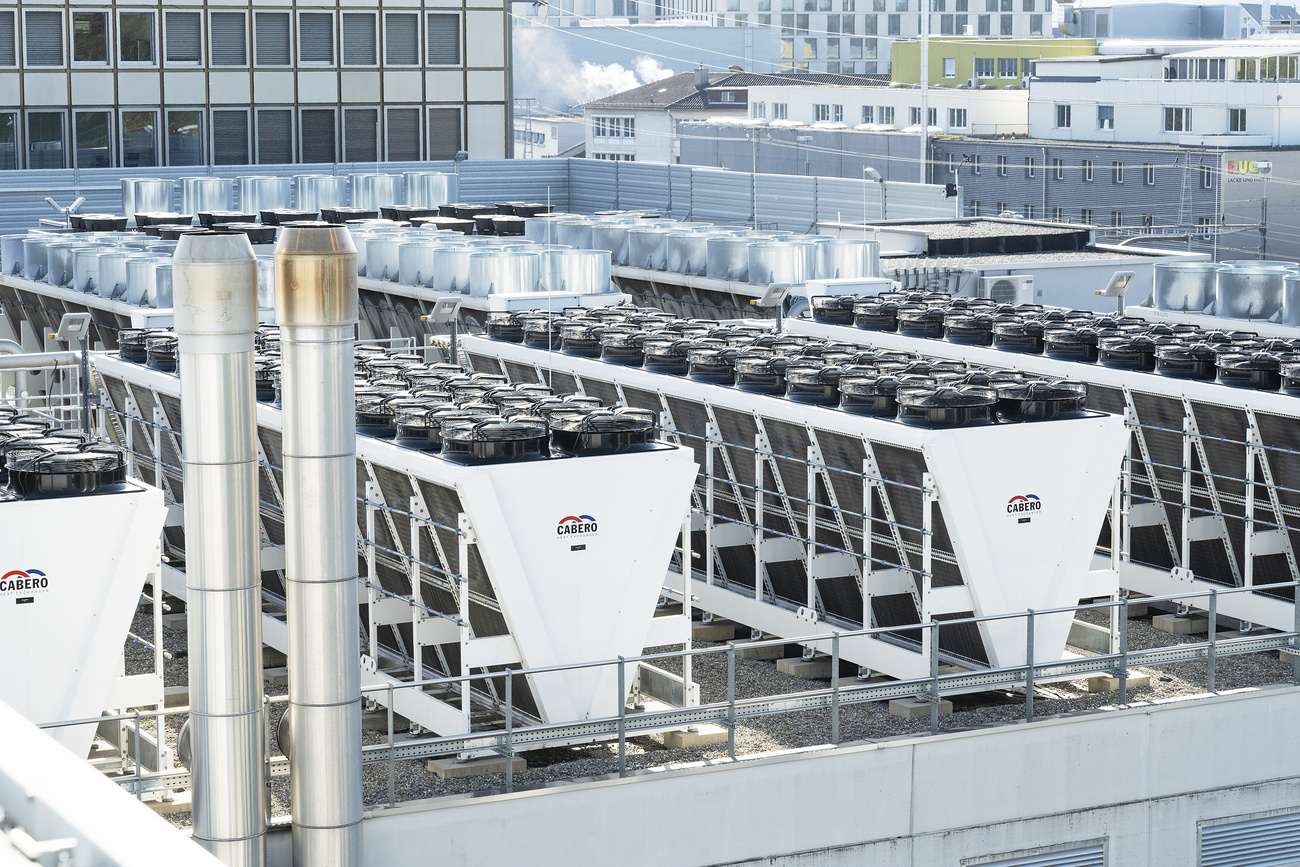
Data centres also have a significant water footprint, because facilities mostly use water for cooling and electricity generation often depends on water. In Switzerland, the Beringen data centre is expected to use 55,000m3 of water a year for cooling, similar to the average consumption of 1,000 people.
Globally, data centre electricity consumption in 2025 was associated with an estimated water footprint of 4.5 trillion litres. By 2030, the sector’s global water footprint could more than double, reaching a scale comparable to the basic annual water needs of all 1.3 billion inhabitants of Sub-Saharan Africa.
Communities around the world are already feeling the consequences of data centres’ need for water. In MexicoExternal link, a data centre boom promoted by the government has left residents facing water rationing and power cuts.
More
More
How AI data centres risk straining Switzerland’s water resources
Switzerland presents a paradox. Its electricity mix is among the cleanest in the world, thanks largely to hydropower. Yet this also gives the country one of the highest water footprints per unit of electricity – more than twice the global average, according to the UN.
Diverting water for electricity production can reduce flows in some river stretches. Reservoirs needed for hydropower production may lose substantial amounts of water through evaporation, particularly during hotter and drier periods, researchers say.
This means that even data centres that claim to have “zero water consumption” for cooling can have a water footprint through the electricity they use.
5. Switzerland’s data centres have lower emissions. That isn’t true elsewhere.
While data centres consume large amounts of energy, their climate impact depends heavily on how that electricity is produced. Here Switzerland stands out. It has one of the lowest carbon footprints due to its heavy reliance on hydropower and nuclear energy, neither of which emit CO2.
Globally, however, the picture is different. Despite large investments in renewables and low-carbon energy sources, overall emissions associated with data centre electricity consumption could more than double by 2030.
This means that the Swiss debate differs somewhat from discussions taking place in countries that still rely heavily on fossil fuels for power. In the US, diesel-powered data centre generators are associated with air pollution, respiratory symptoms and premature death, according to an analysis by The Washington PostExternal link.
As data centres continue to expand, the debate over their impact on natural resources and public health will likely follow suit.
Edited by Gabe Bullard/VdV/ac


