


If the hard-right’s anti-immigration bid is approved at the ballot box on June 14th, when would the Swiss government enact the initiative into new law?
Swiss voters will go to the polls on June 14th to have their say on an initiative that if passed demands that Switzerland’s population must remain under 10 million until 2050.
If it passes 9.5 million before then – the population is currently at around 9.1 million – then the government must take action to reduce immigration. And if the 10 million mark is passed before 2050 then the Swiss government will be forced to break its agreements with the EU, including free movement.
So whilst there are key dates there is no set timeline for when the Swiss government would have to take action by because it all depends on population growth.
However we do know that if the initiative passes certain things will have to happen on the legislative and executive level. And there are also time limits included in the initiative to give us an idea when, if the country’s population does pass the 10 million mark, the law will begin to take effect.
What would the immediate steps be?
If the ‘yes’ vote prevails, the process will be the same as it is each time a popular initiative is accepted at the ballot box.
Already the day after the vote – that is, on Monday, June 15th – the Federal Council will have to make plans towards future implementation.
But the text of the initiative will be integrated into the Constitution immediately after the vote.
At the same time, the Federal Council will instruct the Parliament to break down the broad constitutional mandate into specific, binding federal laws.
This phase typically involves months or even years of committee work and debates on how the policy should be executed.
And while some of these processes can be fairly quick (by Swiss standards), this particular one would take much longer, given the complexities and legal aspects of breaking or renegotiating international agreements that are part of this measure.
But when would the population cap actually be enforced?
Many are worried by the prospect of this initiative passing, but the effect of the new measure will not be immediate.
According to the original text of the SVP’s initiative, “the permanent resident population of Switzerland must not exceed ten million people before 2050″.
“From 2050 onwards, the Federal Council may, by ordinance, adjust this limit annually according to natural population growth,” the initiative says.
So the key is what might happen before 2050.
Official Swiss statistics indicate that the country’s population is on track to hit 10 million by the early 2040s. It would rise to 10.5 million by 2055.
So under the terms of the initiative Switzerland would have to begin breaking its landmark agreements with the EU from 2041 or 2042 – if projections are correct (see below).
Legally, Switzerland will have up to two years to terminate the free movement agreement once the 10-million population threshold is exceeded. So the real sea change to EU immigration to Switzerland could come about around 2043/2044 – again if projections are accurate.
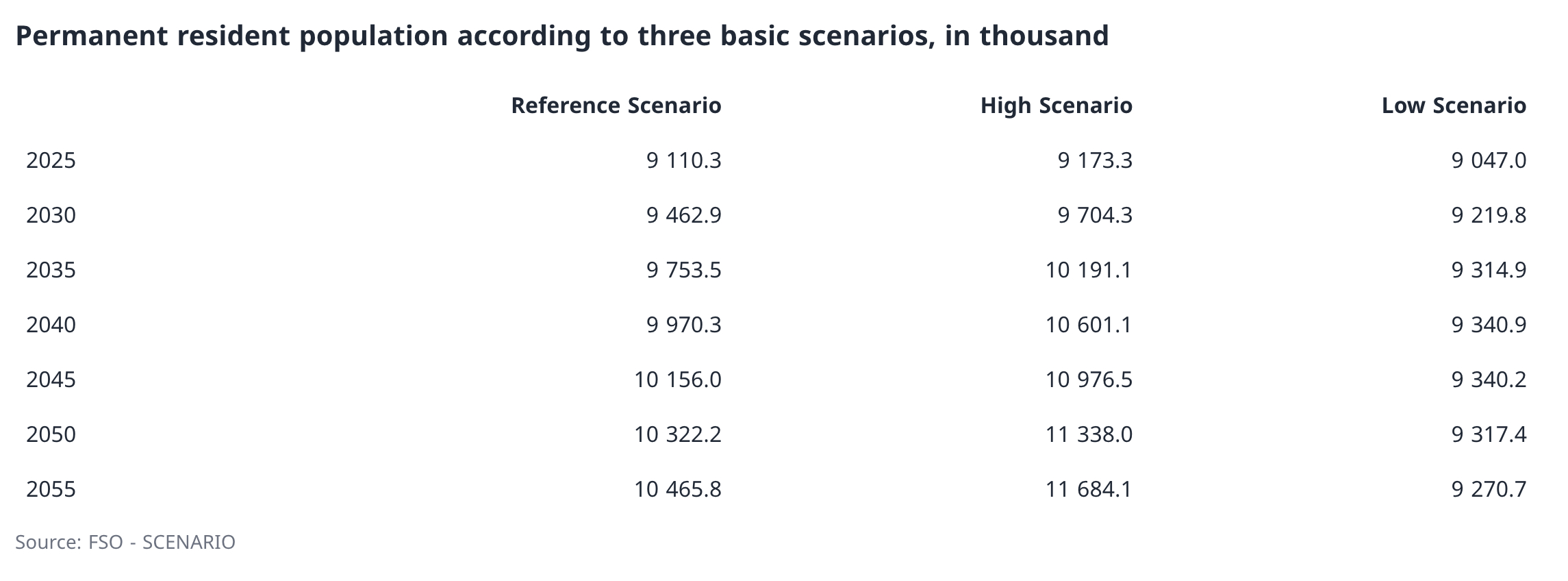
Image: FSO
The text also stipulates that if the permanent population exceeds the 9.5-million mark before 2050, the government will have to start limiting the influx of asylum seekers but also restrict or no longer allow, family reunification for EU workers – both measures aimed at stemming immigration flows.
The Federal Council would also need to invoke or negotiate exemptions and safeguard clauses in international agreements that contribute to population growth.
With current population at 9.1 million official government projections suggest Switzerland’s population would hit the 9.5 million mark in the early 2030s. So this is when relations with the EU will begin to get particularly fraught.
EU deputies have already said that the initiative “would jeopardise the currently good relations between Bern and Brussels” and cause “unnecessary” turmoil.”
But for the immediate future nothing will change dramatically if the referendum passes on June 14th.
As Cenni Najy, head of politics at the economic organisation Centre Patronal, told The Local, “in the first few years after the referendum, nothing will change. Immigrants from the European Union will continue to come to Switzerland.”
The partial impact will, therefore, be felt “in around five to six years, when the population reaches the 9.5 million mark,” he added.
So the full effect will only kick in if Switzerland’s population actually grows to 10 million within the next 24 years.
And it is an ‘if’.
According to demographer Hendrik Budliger, this threshold may never be reached, due to the combination of the aging population and steadily declining birth rates.
“Net immigration remains high today, but that doesn’t mean it will always be the case,” he said.


