


WASHINGTON — After 88 days of digital isolation, described by NetBlocks as the “longest nationwide Internet shutdown in modern history,” Iran has begun partially restoring Internet access as negotiations with Washington continue amid renewed military pressure in the Gulf.
To unpack what Tehran’s partial digital reopening means, and whether current talks can evolve into a sustainable cease-fire, RFE/RL spoke with Charles Dunne, a former senior US diplomat and national-security official who spent over 24 years in government service, including as director for Iraq at the National Security Council during the George W. Bush administration.
RFE/RL: Iran has partially restored global Internet access after 88 days of shutdown. From a strategic standpoint, does this reopening suggest the regime believes it has contained internal unrest, or is it more an economic concession aimed at preventing deeper commercial collapse?
Charles Dunne: It may be a little bit of both, but I read it primarily as an indication that the regime is feeling more confident at the moment in having weathered the US and Israeli onslaught. It came at the cost of great destruction to their military and to many civilian targets as well, but they have weathered it, and they did not see a massive uprising during this period against the government.
I think they also feel the negotiations are now probably moving in their direction. Everything is now on the table, including the future of their nuclear program, rather than the earlier calls for unconditional surrender. So I see this more as an indication that they are confident enough to restore some level of connectivity so people can see what’s going on. Much of the news may actually bolster the regime in the eyes of the population. At the same time, the economic impact of the shutdown has been considerable. Iranian businesses need Internet access in order to function, so that is certainly a factor as well.
RFE/RL: Iran’s economy remains under intense strain. If Tehran is reopening access partly to keep domestic commerce alive, how does that economic vulnerability affect its leverage in negotiations with Washington?
Dunne: The economic impacts are very severe for the average Iranian. Inflation is out of control, imports are tightly restricted, exports are constrained, and the rial is unstable. Ordinary people are suffering significantly.
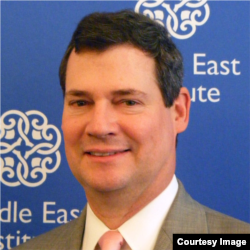
Charles Dunne
But in terms of the negotiations themselves, I think those economic concerns are secondary. The regime believes it has the population largely under control for now, and it appears willing to absorb severe economic consequences so long as it remains in power.
So I don’t think the leadership is overly focused on the economic plight of the average Iranian citizen when it comes to what they are offering at the negotiating table. Their priority is preserving the regime.
RFE/RL: The blackout initially helped shield a sweeping security crackdown during the US-Israeli strikes. What does this selective return of connectivity say about the regime’s confidence in its own stability?
Dunne: I think the regime is fairly confident at the moment. They are willing to reopen parts of the Internet because much of the international narrative now centers on Washington seeking a deal and searching for an off-ramp.
The Iranian leadership wants the public to see messaging that reinforces its position — namely, that Iran stood up to Israel and the United States and survived.
That does not minimize the deep popular discontent inside Iran. We’ve seen repeated waves of protests, including the most recent demonstrations that were violently suppressed in January. But, for now, the regime appears committed to using whatever force it believes is necessary to maintain control, and it thinks that strategy is working.
Strait Of Hormuz Central To Talks
RFE/RL: What progress has actually been made in negotiations? What is now on the table that was not before?
Dunne: The most important issue on the table now is the future of the Strait of Hormuz — whether it will remain open, who controls it, and who profits from it. Before the US and Israeli strikes, this was not even a central issue.
Now it has become one of the key reasons the Iranian regime feels more confident in the negotiations.
Meanwhile, other issues remain in flux, particularly the nuclear file. The United States is now willing to negotiate over Iran’s nuclear program again, with discussions reportedly framed around a 30-to-60-day timeline.
What is striking is that we have effectively returned to negotiations over the same core issues that were central to the 2015 nuclear deal. But at this stage, we are still mainly talking about talks. The details remain highly uncertain, and events could shift very quickly.
RFE/RL: Who currently holds the stronger position? Does either side appear to believe time is working in its favor?
Dunne: I personally believe Iran thinks time is on its side. From Tehran’s perspective, it has already absorbed a major military assault and survived politically.
Iranian leaders also understand the political pressures facing Washington. They believe the United States is under growing pressure to secure a deal rather than resume prolonged hostilities.
So rightly or wrongly, Tehran seems to believe that if it remains patient and is willing to endure additional pressure, it can emerge from negotiations in a relatively strong position.
RFE/RL: After the latest US strikes, what would a realistic framework for a sustainable cease-fire look like?
Dunne: It starts with the Strait of Hormuz. Iran would need to lift restrictions on shipping, and there would also need to be movement regarding restrictions affecting Iranian shipping.
The second major element is establishing a framework for future nuclear negotiations. There are still major disagreements over Iran’s enriched uranium stockpile, what happens to it, and under what conditions sanctions relief would occur.
If both sides can agree on those two elements — maritime stability and a framework for nuclear talks — then that could form the basis for a more durable cease-fire.
‘The Iranian People Have Been Forgotten’
RFE/RL: Washington has reportedly demanded that Tehran surrender its highly enriched uranium stockpile before major sanctions relief is offered. Does the current Iranian leadership have the political room internally to make such a concession?
Dunne: That’s a very important question because so much of the senior Iranian leadership that previously held authority in these matters was killed during the US-Israeli strikes.
The internal workings of the regime are now more opaque than they were even six months ago.
The nuclear program has long been tied to Iranian nationalism, both before and after the Islamic Revolution. Giving up enriched uranium would therefore be politically very difficult.
What Iranian officials have consistently said is that they do not want to surrender that stockpile. If they were ever to consider such a move, they would expect an enormous payoff in return — sanctions relief, access to frozen assets, and likely substantial economic incentives.
RFE/RL: From a military planning perspective, how difficult is it for the Pentagon to prepare for long-term operations when diplomatic signals continue to shift
Dunne: It’s extremely difficult because the strategic objectives themselves remain unclear. The Pentagon understands the broad contours of what it may need to prepare for, but there does not appear to be a tightly defined long-term framework.
At the same time, Iran has shown itself capable of widening the confrontation — threatening shipping routes, targeting economic infrastructure, and potentially involving allied groups elsewhere in the region.
That combination of political uncertainty and tactical unpredictability makes long-term planning much harder.
RFE/RL: What about Iranian society itself? After months of isolation, economic hardship, and wartime pressure, how resilient is Iranian civil society today
Dunne: In my view, the Iranian people themselves have largely been forgotten by policymakers on all sides. The Trump administration has made a number of invitations to the Iranian people simply to rise up and take over their government, but by and large the Iranian people themselves are an afterthought in everything the US has been saying and doing with respect to this crisis, which I think is a big mistake.
At the same time, Iranian society has proven remarkably resilient, even in the face of extreme regime violence. They have chosen time and time again to rise up and demonstrate their discontent.
The regime, of course, has used false imprisonment, sham trials, executions, closure of threatening civil society organizations — all of these tools in the authoritarian tool chest to shut them down, and it still hasn’t fully succeeded. So, quiet as the Iranian people seem to be right now, I expect to see more unrest in the future. We just simply can’t point to when exactly that’s going to happen, or what the circumstances are going to be that are going to provoke that.
RFE/RL: Finally, looking ahead over the coming months, what benchmarks would both Washington and Tehran need to meet in order to move from military confrontation toward a more stable diplomatic framework?
Dunne: First, there has to be safe international shipping through the Strait of Hormuz. That is fundamental to restoring some measure of stability in the Gulf.
Second, there needs to be an ongoing negotiating framework that is insulated from immediate military escalation. The nuclear issue is only one part of the broader relationship between the US and Iran.
But none of this is guaranteed. The level of mistrust remains extremely high, and both sides remain deeply skeptical of the other’s intentions. So while a framework for stability can be described, the situation itself remains highly unstable.


