


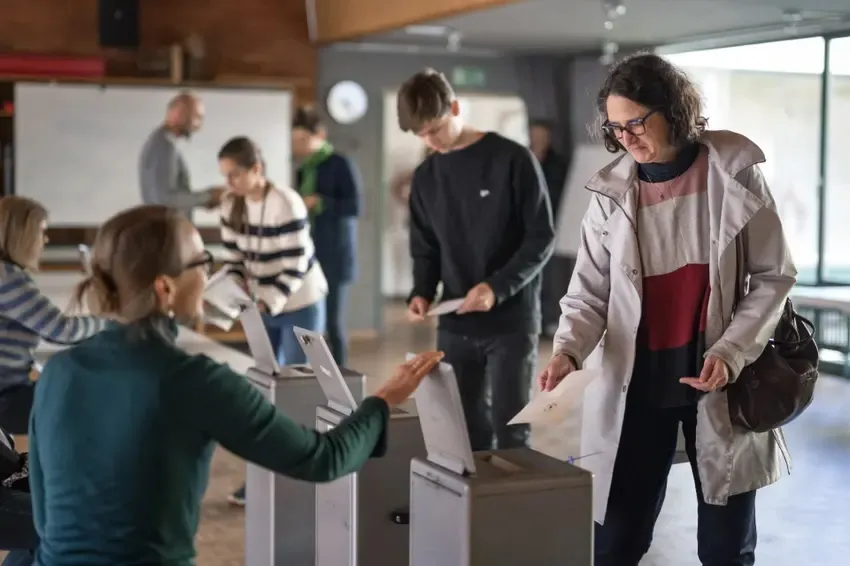
In local referendums held in November, voters in two cantons refused to give voting rights to their longterm foreign residents. The result was part of an established trend in Switzerland, to the frustration of many.
On November 30th 2025, the vast majority of voters in the cantons of Vaud and Appenzell-Ausserrhoden rejected the moves to grant cantonal voting rights to foreigners living in their areas.
In Vaud, 63.6 percent of voters refused to grant foreign nationals who have resided in Switzerland for at least 10 years and in Vaud for three, the right to vote and/or to be elected at the cantonal level.
And in Appenzell-Ausserrhoden, voters were called upon to decide whether to adopt a new constitution; included therein was a point of contention among residents: whether local foreigners should be allowed to vote.
In the end, 77.8 percent of voters approved the new cantonal constitution, but 72.8 percent opposed political rights for foreigners.
(However, both cantons allow foreigners to vote on municipal issues – read more about this below).
Not the first time
These two results are hardly exceptional because efforts to ban foreigners from voting have failed in the past – either by referendum or legislative decisions.
For instance, in 2023, Zurich parliament had turned down a proposal by city officials to grant local voting rights to non-Swiss passport holders.
And in 2022, the State Political Commission of the National Council decided that foreigners resident in Switzerland will not be allowed to vote on a federal level.
Only a few cantons have broken the mould by allowing their foreign residents to vote.
Advertisement
Neuchâtel and Jura are the only ones to give longtime foreign residents the right to vote on cantonal level.
Fribourg, Vaud, Neuchâtel and Jura allow non-citizens to vote, elect officials, and stand for election at communal level. Conditions vary from one canton to another, but in most cases a certain length of stay and/or a residence permit are required.
Geneva, which has the largest foreign population in Switzerland (45 percent), grants foreigners voting rights at communal level, but they can’t run for office.
Basel-City, Graubünden, and Appenzell Ausserrhoden have authorised their communes to introduce the right to vote, the right to elect and the right to be elected.
But few of the communes have actually introduced these measures.
In Graubünden, only 10 of the canton’s 208 municipalities are allowing foreigners to vote: Bever, Bonaduz, Calfreise, Cazis, Conters im Prättigau, Fideris, Lüen, Masein, Portein, and Schnaus.
Only three of Appenzell Ausserrhoden’s 20 municipalities — Wald, Speicher, and Trogen — granted voting rights to non-citizens.
READ ALSO: Where in Switzerland do foreigners have the right to vote?
Advertisement
‘Redefine foreigners as Swiss’
Many opinions have been given over the years about how to extend political rights to Switzerland’s foreign population.
But that is not an easy task.
“Because of the onerous, lengthy and expensive naturalisation procedure, people remain technically foreign for much too long, in many cases for life” – which means they can never have their say in political matters,” she said.
At the very least, O’Dea said, “Switzerland could initiate a citizenship recruitment drive to make sure all the people who could be Swiss under the current rules are encouraged to come into the fold through naturalisation.”
O’Dea believes the frequent votes against giving foreigners voting rights are motivated by fear and the Swiss authorities should be more concerned by the impact of so many being disenfranchised.
“It is incredible how complacent Switzerland is about the fact that one in four residents does not have the right to vote. There is no action plan to address the issue, and no great concern about the moral implications of this exclusion or the impact on social cohesion,” she said.
READ ALSO: Switzerland’s denial of voting rights to foreigners motivated by fear
Advertisement
‘Their country, their rules’
After The Local published the article about Vaud and Appenzell-Ausserrhoden refusing to grant their foreign residents cantonal voting rights, over 100 readers offered their own opinions on this topic on our Facebook forum – overwhelmingly supporting Switzerland’s stance.
One said the outcome of the cantonal referendums was justified because Switzerland is a sovereign country and can make whatever rules it wants. “Their country, their laws. Don’t like it, don’t move to Switzerland – it’s that simple.”
“If you want the right to vote, apply for Swiss citizenship,” another person said. “There is a big difference between being a resident and citizen.”
And, as yet another reader pointed out, “Why should foreigners vote on Swiss laws? I am a foreigner in Switzerland and don’t see why we should vote.”
In fact, many forum users share this opinion: “That’s how it should be. Voting is a privilege, right, and duty reserved for citizens.”
But views expressed on Facebook, where anyone can comment, often differ from those expressed by members of The Local Switzerland.
Advertisement
Voting, yes, but not immediately
In a survey The Local conducted among its readers several years ago, most respondents said they should have the right to vote in Switzerland, but only after several years of residency.
The largest share of respondents – 37 percent – indicated that five years would be the most appropriate time to wait. A further 15.2 percent indicated that a two-year wait would be their preferred time period before voting.
Almost one quarter of respondents (23.9 percent) told us that the current time period of ten years (i.e. the minimum time frame to wait for citizenship) was the appropriate period.
The vast majority – 63.8 percent – said that not having the right to vote had not influenced their life in Switzerland.
A number of others, however, disagreed, with several responses indicating that the democratic deficit had made them less inclined to engage in politics.
As one noted: “I would be more interested in local affairs if I could vote because I would have to engage more with local culture to gain the knowledge to make a decision”.
But as another reader pointed out, “you must become fully integrated in the system before you can vote to change it.”
So what are your views on voting rights for foreigners in Switzerland? Let us know in the comments section below.


