

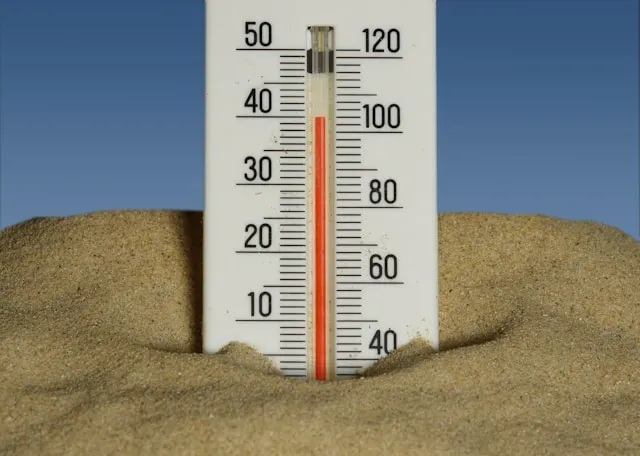
With the rain and cooler temperatures in Switzerland right now, we may soon forget just how hot the summer of 2026 has been. But meteorologists say we should expect even more intense heatwaves and droughts.
Switzerland broke the record for its hottest-ever June day on June 28th, with the temperature rising to 39C in Basel.
The rest of the summer has also been scorching and extremely dry, with mercury reaching mid to high 30s and persistent drought impacting agriculture, nature, water supply, and even the price of petrol.
And Swiss meteorologists say we haven’t yet experienced the hottest and driest summers.
What lies ahead
Experts say heatwaves are forecast to become more frequent, hotter and last longer in the future, due to climate change caused by the burning of fossil fuels.
Switzerland will not be spared.
We already know that the climate crisis is hitting Switzerland particularly hard, with the country warming faster than most others on earth.
The reason is that Switzerland is landlocked so it doesn’t benefit from the buffering effect of the oceans, which are able to absorb large amounts of heat.
Additionally, the altitude and morphology of the Alps also play and important role in accelerating global warming.
READ MORE: Why is Switzerland warming faster than most countries in the world?
And the bad news, the report pointed out, is that the warming process has not yet reached its peak, continuing to accelerate instead.
‘More extreme’ summers
According to a new report by MeteoSwiss federal meteorological institute, “The current trend towards dry summers will intensify in the future.”
This development can be attributed to both a continued decline in average summer rainfall and to more rapid soil drying caused by warmer, drier air.
This is their forecast:
- The combination of declining summer precipitation, higher temperatures and increased evaporation leads to increased soil drying in summer. Since the early 1980s, a decline in soil moisture of around 5 to 10 percent has been observed in Switzerland.
- In future, the current trend towards dry summers will intensify. With global warming of 3C compared to pre-industrial levels, a summer drought that occurred once every ten years in the current climate (1991–2020) would occur three times more frequently.
- With global warming of 3C, the number of days with a high weather-related forest fire danger will increase, for example from 18 to 44 days per year at the station Sion.
“On average, summers will be drier, and summers that are already dry will become even more extreme,” MeteoSwiss pointed out.
Just how much hotter will it get?
Assuming a 3C-increase (which corresponds to generally accepted global warming levels – “the summer of 2026 would be considered average, even falling on the cooler end of the projection range,” MeteoSwiss said.
Under this model, average temperature in Switzerland is likely to go up by between 2.4C and 5.1C – meaning that they would exceed the current highest temperature of 39C, to reach 41.4C to 44.1C.
In terms of drought, ” in a world that is 3C warmer, summer rainfall would be around 350 mm, compared to an average of 420 mm between 1991 and 2020,” the institute said.
The figures for this summer are not yet known as the current rain hasn’t been ‘counted yet,’ but it is likely to be around 360mm
More intense heat and drought will have serious consequences.
“Increasing drought will have repercussions, notably on the risk of forest fires,” the meteorological institute reported.
“Over the past 60 years, the potential for the ignition and spread of forest fires has already risen in Switzerland. But with even hotter and drier summers expected in the future, the weather-related risk of forest fires will continue to increase,” it added.
What is being done do prepare for this hotter and drier future?
On a political front, the deputies will, during upcoming parliamentary sessions, debate the heatwave, drought, and water management for future summers.
Teachers’ associations are also mobilising, calling for measures to address the need for cooler classrooms, and pointing out that school buildings “need to adapt to the climate realities of the 21st century.”
This change could already be underway: a number of elected officials are now speaking in favour of more lenient rules for obtaining AC units.
Though they want hospitals, schools, retirement homes, as well as other public buildings to have priority over private dwellings, the growing focus now is – according to one Geneva official – on not “demonising” air conditioning, as it “meets a legitimate need for those who suffer greatly from the heat.”
READ MORE: Swiss lawmakers warm up to easing of air conditioning rules
