


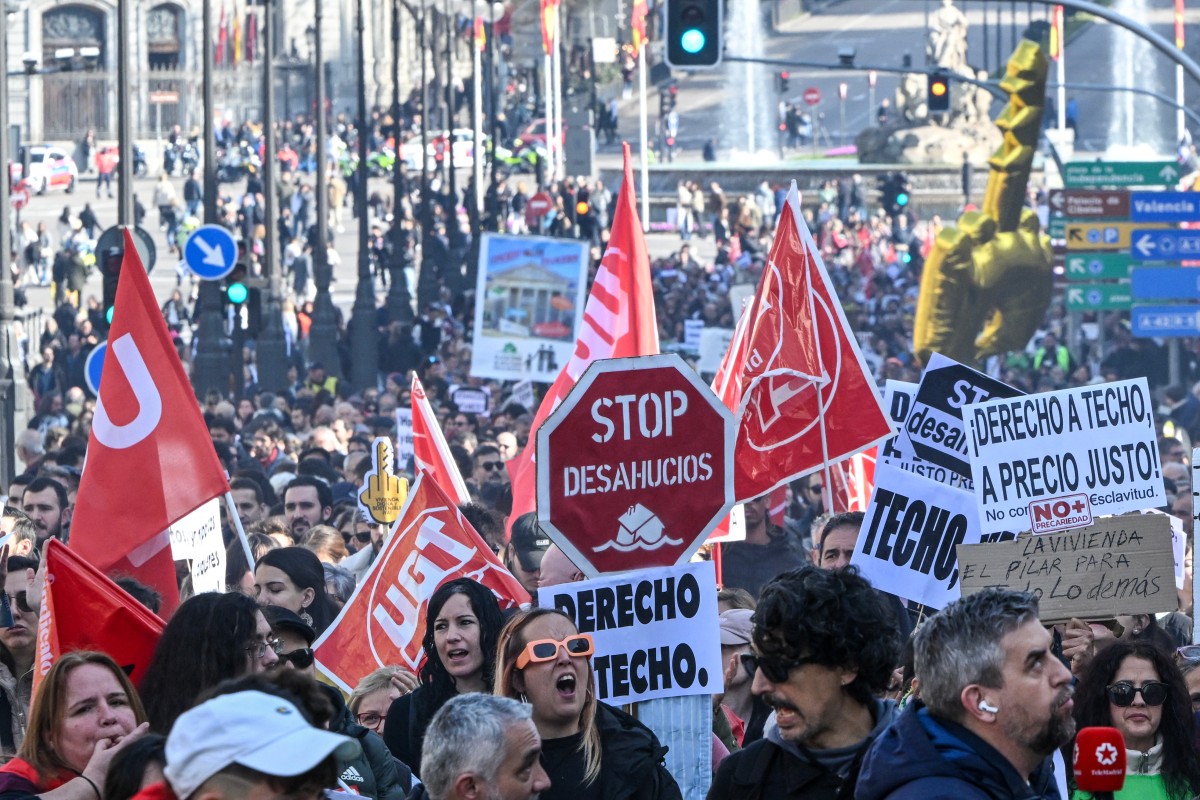
On Saturday April 5th, tens of thousands of citizens across 40 cities in Spain will take to the streets to demand more effective measures to combat the country’s housing crisis.
Under the slogan “Let’s end the housing business” (Acabemos con el negocio de la vivienda), tens of thousands of Spaniards struggling to pay their rents or afford to buy a property will rally in Spain this Saturday to call for change.
In Madrid, the march will begin at Atocha at 12pm, while in Barcelona the rally will start at Plaza Espanya at 6pm.
Valencia’s protest will start at 6.30pm in the Town Hall Square, in Palma de Mallorca it will kick off at midday from Plaça Espanya and in Málaga it’ll begin at 11.30pm in Plaza de la Merced.
Nearly all of Spain’s major provincial capitals and major cities will join the call for decent and affordable housing.
These include Alicante, Albacete, Cuenca, Seville, Granada, Cádiz, El Puerto de Santa María, Jerez, Tarifa, Almería, Murcia, Badajoz, Cáceres, Guadalajara, Castellón, Valladolid, Salamanca, Zaragoza, Logroño, Burgos, San Sebastián, Santander, Gijón, A Coruña, Santiago, Vigo, Ourense, Las Palmas de Gran Canaria, Ibiza, San Isidro in Tenerife, Puerto del Rosario in Fuerteventura and Mahón in Menorca.
Advertisement
Organisers are demanding an immediate drop in rents, that something be done with the more than 3.8 million empty homes in Spain, that eviction companies be outlawed and that vulnerable families cannot be evicted if they don’t have alternative housing, and lastly that the country’s housing protest movement not be silenced.
READ MORE: Why landlords in Spain leave their flats empty rather than rent long-term
Rents in Spain have increased by 78 percent in the last decade according to recent data by leading property website Fotocasa, and property prices by at least a third.
Spain’s Tenants’ Union, one of dozens of groups and unions that have called the mass protests, have said that “exorbitant rents are the main cause of impoverishment of the working class and a barrier to accessing housing,” adding that a small “rent-seeking” minority is enriching itself at the expense of “economically suffocating a large part of society.”
In January, Spain’s Prime Minister Pedro Sánchez presented a raft of measures aimed at addressing the housing crisis, including a proposed ban or supertax on non-resident non-EU buyers.
LISTED: Spain’s 12 new measures to combat the housing crisis
Some of these measures need parliamentary approval before coming into force, while others don’t.
Spain’s Socialist-led government has already attempted to control the rise in prices by putting rent caps in place for existing tenants and banning prices from increasing in ‘stressed rental markets’, the latter being up to regional governments to decide whether to implement.
Advertisement
PSOE’s amended Housing Law has been criticised by many who argue it’s had the adverse effect of reducing stock and thus bumping up prices, as many landlords are taking their properties off the market due to these price controls and rent caps, no longer considering renting to long-term tenants remunerative.
READ ALSO: Rent caps in Spain convince vulture funds to leave (but there’s a catch)
April 5th’s nationwide protests could be the biggest rallies related to housing rights in recent memory in Spain.
In 2024, there were numerous protests across the country but they were held on different dates in different cities, and the focus was sometimes more on mass tourism than it was on Spain’s housing crisis.
In truth, the messaging has often been mixed due to the fact that some of the places where rents and property prices have risen the most are also those where tourism numbers have spiked in recent years.
There’s a growing sense among many Spaniards that they’re being priced out of their own cities, as more affluent foreigners can more easily afford Spanish rents and properties, and highly profitable tourist lets in residential buildings have become extremely common.
READ ALSO: Is there a solution to Spain’s housing crisis? Here’s what the experts say


