


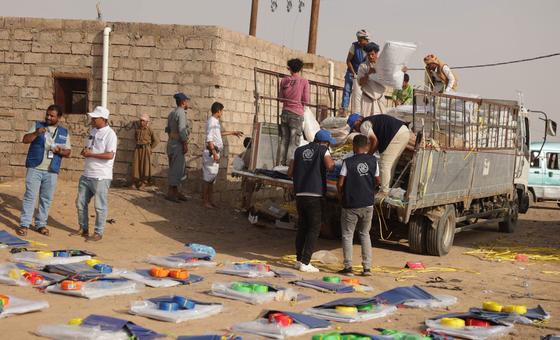
Yemen remains trapped in a prolonged political, humanitarian and development crisis, after enduring years of conflict between government forces and Houthi rebels, with populations in the south of the country now facing a growing food insecurity crisis.
A partial update released Monday by the UN-backed Integrated Food Security Phase Classification (IPC) system – which ranks food insecurity from Phase 1 to famine conditions, or Phase 5 – paints a grim picture.
Starting in May 2025, around 4.95 million people have been facing crisis-level food insecurity or worse (Phase 3+), including 1.5 million facing emergency-level food insecurity (Phase 4).
These numbers mark an increase of 370,000 people suffering from severe food insecurity compared to the period from November 2024 to February 2025.
Further deterioration
The UN World Food Programme (WFP) warned that “looking ahead, the situation [was] expected to deteriorate further,” with 420,000 people potentially falling into crisis-level food insecurity or worse.
This would bring the total number of severely food-insecure people in southern governorate areas to 5.38 million – more than half the population.
Multiple compounded crises – such as sustained economic decline, currency depreciation in southern governorates, conflict, and increasingly severe weather – are driving food insecurity in Yemen.
High-risk areas
Amid Yemen’s growing food crisis, humanitarian agencies including WFP, the UN Children’s Fund (UNICEF), and the Food and Agriculture Organization (FAO) are reorienting their efforts towards high-risk areas, delivering integrated support across food security, nutrition, sanitation, health, and protection to maximise life-saving impact.
“The fact that more and more people in Yemen don’t know where their next meal will come from is extremely concerning at a time when we are experiencing unprecedented funding challenges,” said Siemon Hollema, Deputy Country Director of WFP in Yemen.
Immediate support needed
WFP, UNICEF and FAO are urgently calling for sustained and large-scale humanitarian and livelihood assistance to prevent communities from falling deeper into food insecurity, and to ensure that the UN “can continue to serve the most vulnerable families that have nowhere else to turn,” he said.
Internally displaced persons, low-income rural households, and vulnerable children are particularly affected, and are now facing increased vulnerability, as approximately 2.4 million children under the age of five and 1.5 million pregnant and lactating women are currently suffering from acute malnutrition.
The situation is dire, but with urgent support, “we can revitalise local food production, safeguard livelihoods, and move from crisis to resilience building, ensuring efficiency and impact,” said FAO Representative in Yemen, Dr. Hussain Gadain.


