


The UN’s principal judicial body ruled that States have an obligation to protect the environment from greenhouse gas (GHG) emissions and act with due diligence and cooperation to fulfill this obligation.
This includes the obligation under the Paris Agreement on climate change to limit global warming to 1.5°C above pre-industrial levels.
The Court further ruled that if States breach these obligations, they incur legal responsibility and may be required to cease the wrongful conduct, offer guarantees of non-repetition and make full reparation depending on the circumstances.
‘A victory for our planet’
UN Secretary-General António Guterres issued a video message welcoming the historic decision, which came a day after he delivered a special address to Member States on the unstoppable global shift to renewable energy.
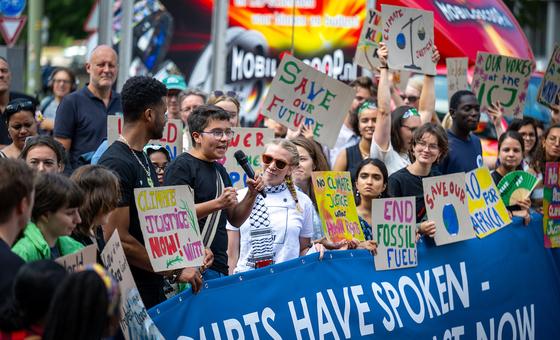
“This is a victory for our planet, for climate justice and for the power of young people to make a difference,” he said.
Reasoning of the Court
The Court used Member States’ commitments to both environmental and human rights treaties to justify this decision.
Firstly, Member States are parties to a variety of environmental treaties, including ozone layer treaties, the Biodiversity Convention, the Kyoto Protocol, the Paris Agreement and many more, which oblige them to protect the environment for people worldwide and in future generations.
But, also because “a clean, healthy and sustainable environment is a precondition for the enjoyment of many human rights,” since Member States are parties to numerous human rights treaties, including the Universal Declaration of Human Rights, they are required to guarantee the enjoyment of such rights by addressing climate change.
Case background
In September 2021, the Pacific Island State of Vanuatu announced that it would seek an advisory opinion from the Court on climate change. This initiative was inspired by the youth group Pacific Island Students Fighting Climate Change, which underscored the need to act to address climate change, particularly in small island States.
After the country lobbied other UN Member States to support this initiative in the General Assembly, on 29 March 2023, it adopted a resolution requesting an advisory opinion from the ICJ on two questions: (1) What are the obligations of States under international law to ensure the protection of the environment? and (2) What are the legal consequences for States under these obligations when they cause harm to the environment?
The UN Charter allows the General Assembly or the Security Council to request the ICJ to provide an advisory opinion. Even though advisory opinions are not binding, they carry significant legal and moral authority and help clarify and develop international law by defining States’ legal obligations.
This is the largest case ever seen by the ICJ, evident by the number of written statements (91) and States that participated in oral proceedings (97).
The ‘World Court’
The ICJ, informally known as the “World Court”, settles legal disputes between UN Member States and gives advisory opinions on legal questions that have been referred to it by UN organs and agencies.
It is one of the six main organs of the UN alongside the General Assembly, the Security Council, the Economic and Social Council (ECOSOC), the Trusteeship Council and the Secretariat and is the only one not based in New York.


