Michael Hermann says unease about too many foreigners has shifted to concerns about the overburdened infrastructure.
Keystone
Switzerland is a country of emigration, but at the same time it has a high level of immigration. This is typical of an open, globalised country, says political analyst Michael Hermann in an interview.

SWI swissinfo.ch: Have you ever felt like emigrating?
Michael Hermann: I emigrated from a rural area in canton Bern to Zurich, to the city. For me, it really was like emigrating, and arriving in Zurich isn’t that easy. But now I’ve built up my social capital here and I don’t want to gamble it away.
SWI: So no home sickness?
M.H.: No, I’m not leaving here.
Michael Hermann is the founder and director of the opinion research institute Sotomo.
He studied geography, economics and history and teaches at the Institute of Geography at the University of Zurich.
Hermann published the atlas of political landscapes in Switzerland and developed the political spider profiles, the Smart Spider.
SWI: Switzerland is a popular country for immigration. Does that show that it’s doing a lot right?
M.H.: Yes, but it’s also right geographically. The jewels were there: this landscape, great mountains, beautiful lakes. Switzerland has no natural resources, it had to work for a lot of things itself. That was its advantage. Countries that could help themselves to their raw materials often lag behind today. But Switzerland’s liberal, civic-minded culture also made it an attractive place to live and work. Today, this has a magnetic effect on many people who don’t live here, but who recognise that there is potential here.
SWI: What’s the price of this success?
M.H.: A lot of people arrive in a short space of time. That brings challenges with it. Our infrastructure is under strain, not only the transport infrastructure, but also the housing infrastructure and the natural areas where people can relax. This leads to a defensive attitude. People think that we don’t live in Manhattan here, but in a country with rural roots. Many people wonder where this is all leading. There are these growing pains, they are real. But the costs of immigration are seen much more directly than the benefits.
More

More
How countries are managing immigration between economic needs and social tensions
SWI: What are the benefits?
M.H.: A look back helps. After the end of the Cold War, Switzerland found itself in an economic slowdown. Since the mid-noughties, however, it has been extremely robust – also in comparison to its neighbours: good growth and enough money in the state coffers to expand the infrastructure. Even in times of crisis, it remains stable.
And the beginning of this robust phase coincides with the time when increased immigration began – not only the immigration of unskilled labour, but also of highly qualified workers. The fact that people are coming here and want to make a difference is creating an enormous dynamic. They help us, especially when we ourselves are perhaps a little more comfortable.
More
In Switzerland, migration isn’t just inbound

SWI: But emigration has also increased enormously. So Switzerland is a country of both immigration and emigration. Isn’t that unusual?
M.H.: It’s not a contradiction. A country of immigration is an open country. And this openness goes in two directions. Of course, more people come here than leave. But the Swiss economy is strong, you have money, a recognised education, you can also emigrate. Then there’s the generation of pensioners who can buy less with a pension in Switzerland than in Spain or another country with a low cost of living. This makes emigration after retirement attractive. This can be criticised because these pensions are not spent in Switzerland. But emigrants don’t use any infrastructure either.

Michael Hermann.
Keystone / Michael Buholzer
SWI: They leave and create space here?
M.H.: Exactly. But emigration has its price. If you leave, you give up the contacts and social networks that make life easier. So there are good reasons to stay here.
SWI: Do you factor in social capital when you think about emigration and immigration?
M.H.: Definitely. Think about people who come from a refugee context, perhaps a doctor from Sudan. They have to start at the bottom again. These people lose a lot: from their reputation to their networks.
Incidentally, the housing issue is also a question of social networks: immigration means there are more people in the housing market. However, locals often have advantages over immigrants, simply because they are networked. When I look around at people in my circle, most of them find a flat through word of mouth.
People who immigrate, whether expats or not, have no such networks and have to look around on the housing market. They pay significantly higher rents because they have to take what’s on the market.
SWI: They therefore drive up prices.
M.H.: But you also have to realise that their landlords are often investors who invest pension fund assets. Migrants therefore also pay and secure our pensions, while Swiss people often live in existing property with lower rents or in owner-occupied property. All property owners and heirs – most of whom are Swiss nationals – also benefit: their properties become more valuable.
SWI: Depending on the location…
M.H.: Sure, but this dynamic has already spread to large parts of the country.
SWI: So you’re also saying that the whole country is being gentrified?
M.H.: The term gentrification has negative connotations. But it actually describes a revaluation. We all want prosperity and a good income. Our country is becoming socially better off, we are living better. That’s not a negative thing. It’s inevitable that certain things will become more expensive, especially housing, because living space cannot be increased so easily, especially in Switzerland with its many building objections.
The situation is different when it comes to jobs. The big concern at the beginning of the free movement of people was that there would be more unemployment. People feared that they would take away our jobs. The opposite has happened, because these people are revitalising the economy, because new companies are coming, because they are creating jobs.
More
More
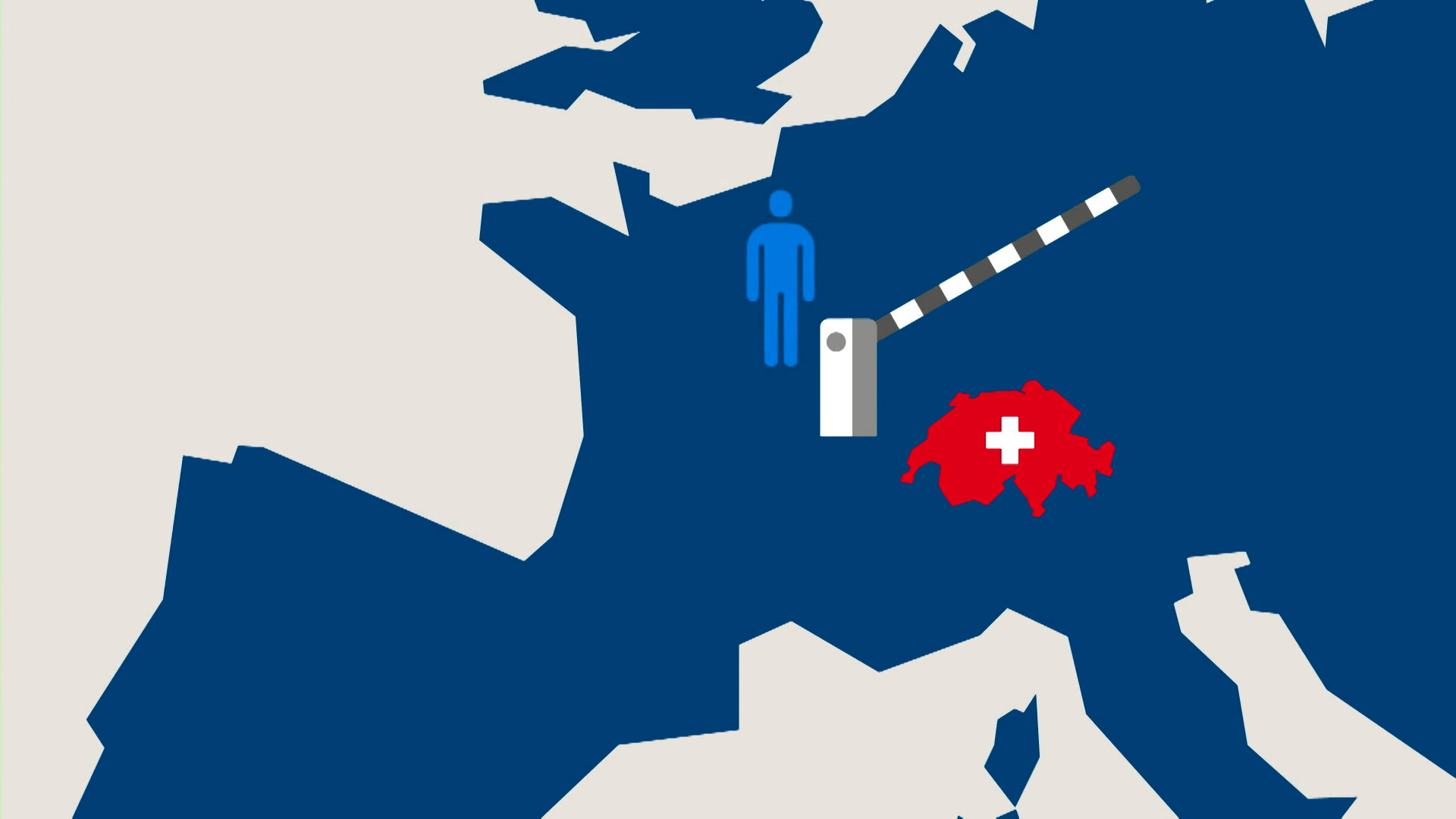
Putting the brakes on immigration in Switzerland
SWI: You describe immigration as the engine of prosperity. Consequently, we need immigration to maintain it. Where does that end?
M.H.: In the long term, I’m not worried about too much immigration. The world’s population will shrink in the foreseeable future, and then at a rapid pace. The birth rate among Swiss women is already below 1.3 children. This means that without immigration, more than a third of the population would disappear per generation.
If you look at eastern Germany, where the population is already shrinking, you can see the challenges: too little money, you have to cut back on schools, you no longer have public transport. Shrinking processes are more difficult to manage than periods of growth. And even if we don’t shrink, there’s still a lack of dynamism in some areas: inns are closing in the countryside and village centres are dying out. A stagnating region worries me more than a growing one.
SWI: Many things are in a state of upheaval and the right-wing Swiss People’s Party is capitalising on people feeling alienated in their own country, saying it’s no longer our Switzerland. You conduct opinion polls: is this feeling measurable?
M.H.: Yes, but it has also shifted. In the 1970s it was the Italians; in the 1990s it was the so-called Yugos, refugees from the Balkan wars. Then it was the Germans who made us feel foreign. Almost nobody talks about them anymore. Now it’s the expats.
Our surveys also show another shift: the classic fear of the 1970s of being inundated by foreigners has become less important. Most people believe that Switzerland benefits culturally from immigration. The unease has shifted to concerns about the overburdened infrastructure. As a result, the issue no longer thrives solely in the national-conservative, rural milieu; there are also many urban left-wingers who feel under pressure.
SWI: This urban middle class, which now feels that it can no longer afford to move house and can no longer buy a house as a family, is becoming immobile. Is this opening up a gap in residential mobility?
M.H.: There is indeed a risk of a vicious circle. Older people in particular often live in a house that is too big and don’t move because a smaller flat would be more expensive. As a result, the available space is increasingly underutilised. At the same time, the Swiss have never been particularly mobile. We have analysed this. People move out shortly after the age of 20, to work or to study. Then they move again between 30 and 45, because they start a family – and then often never again. That’s very Swiss.
More
More
No house generation: the impossibility of buying property in Switzerland
SWI: But there is the dream of mobility. The SRF emigration programme Auf und davon (Up and Away) is now in its 16th season and continues to fascinate viewers. How do you explain that?
M.H.: It’s easy to follow these dreams, which certainly exist, from the comfort of your sofa. A big trip is a dream of many people in Switzerland, as we know from surveys. This has to do with the small size of the country. In Switzerland, you quickly reach a border. As a result, what happens on the other side of the border is close to us. We’re traditionally an open country that has produced many people who have also gone abroad as guest workers and built something up there, such as Louis Chevrolet.
More
More
Up and Away – a new beginning
SWI: That has changed. Today, people go for two or three years, for one phase of their career. Is that typical of a globalised country?
M.H.: It’s a typical movement pattern for a very rich country with very well-educated people. And what you’re describing is nothing other than expats. We produce expats in other countries, in the US, in Dubai or Singapore. They stay there for a few years but don’t really pack up their tents here and will never fully integrate.
SWI: And when they return to Switzerland, do they bring even more internationality here?
M.H.: We’re a globalised country. Even if we try to curb it, this genie won’t go back into the bottle.
Edited by Samuel Jaberg. Translated from German by DeepL/ts