


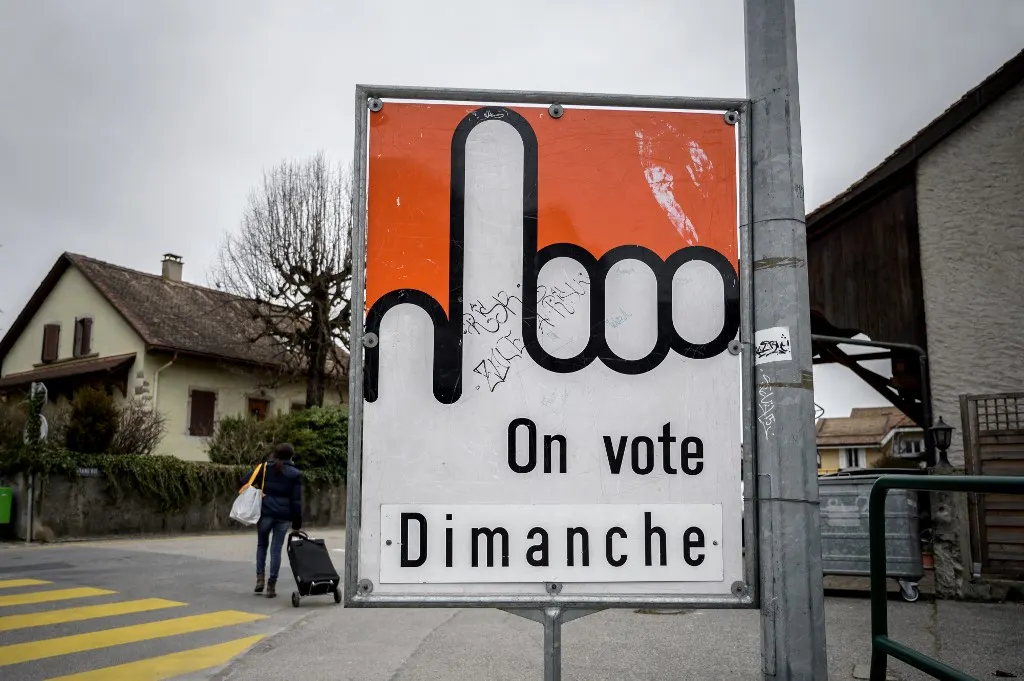
On June 14th, Swiss voters will have their say on a highly controversial move seeking to drastically curb immigration to Switzerland. But will certain foreign nationals be able to cast their votes as well?
The contentious issue, the ‘No to 10 million’ initiative instigated by the populist Swiss People’s Party (SVP) , is calling for a cap on immigration from the European Union.
The proposal seeks to drastically reduce the influx of foreigners to Switzerland, so that the country’s population doesn’t exceed the 10-million mark, which the SVP says will overburden key infrastructure, such as housing, public transport, the health system, and schools.
Its initiative stipulates that “Switzerland’s permanent resident population must not exceed ten million people before 2050. From 2050 onwards, the Federal Council may adjust this limit annually.”
Currently, the country’s population stands at just over 9 million, including nearly 2.5 million foreign nationals – that is, over 27 percent of the population.
READ MORE: What exactly does the Swiss ‘no to 10 million’ anti-immigration proposal aim to do?
Will foreign nationals be able to cast their votes as well?
Before we answer, know this: though it may seem that foreign nationals would be directly impacted by this proposal, the ones who are already living in Switzerland on a B or C permit will not be directly affected by the outcome one way or another. In other words they still have a future in Switzerland.
Instead, the initiative targets future immigrants – in other words, those who would want to come to Switzerland if the initiative is accepted and the new law goes into effect.
Advertisement
Swiss only
The answer for who can vote is fairly simple. Only Swiss citizens are allowed to participate in federal votes, as is the case in most countries.
This includes citizens who live in Switzerland, as well as those who reside abroad while maintaining their Swiss nationality – approximately 800,000 individuals.
What about C-permit holders?
Though these foreigners, who have the permanent residence status, enjoy almost the same rights as Swiss nationals, ‘almost‘ is the key word here: they cannot vote in national referendums or elections.
There is of course one group of foreign residents who will be able to cast a vote in the anti-referendum initiative: dual nationals.
Once a foreigner becomes naturalised – that is, becomes Swiss while still maintaining the passport of their country of origin – they can vote.
That’s because they are, for all legal intents and purposes, Swiss citizens, even though their home countries may also claim them as their own.
So yes, dual nationals will be able to vote on June 14th.
Advertisement
How many dual nationals in Switzerland will be eligible to vote then?
In 2024, 21 percent of Swiss citizens were dual nationals (but as this is the last official data released, it is possible that this number is higher now).
In real numbers that is 1 147 400 people.
That’s how many are eligible to vote, but whether they all will is another matter.
The most common second nationality among dual nationals was Italian, followed by French, German and then Portuguese.
Geneva is the canton with the most dual nationals living there (just under 50 percent) followed by Vaud and Ticino.
Among the population of dual nationals, 65 percent obtained Swiss nationality through naturalisation, whereas 35 percent acquired it at birth.
READ ALSO: How many dual nationals are in Switzerland and where are they all?
Advertisement
Does this mean that foreigners in Switzerland have no say whatsoever in political matters?
They can’t vote in any federal referendums or elections.
Some cantons and municipalities, however, give them the right to cast their ballots in local ones.
The Swiss-French cantons and municipalities are ahead of their German-speaking counterparts in regard to voting rights.
Jura and Neuchâtel are the only ones who have granted foreign nationals to vote (but not stand for elections) on a cantonal level.
Fribourg, Vaud, Neuchâtel and Jura allow non-citizens to vote, elect officials, and stand for election at communal level. Conditions vary from one to another, but in most cases a certain length of stay and/or a residence permit are required.
Geneva, which has the largest foreign population in Switzerland (45 percent), grants foreigners voting rights at communal level, but they can’t run for office.
Advertisement
Basel-City, Graubünden, and Appenzell Ausserrhoden have authorised their communes to introduce the right to vote to foreigners, the right to elect and the right to be elected.
But few of the communes have actually introduced these measures.
In Graubünden, only 10 of the canton’s 208 municipalities are allowing foreigners to vote: Bever, Bonaduz, Calfreise, Cazis, Conters im Prättigau, Fideris, Lüen, Masein, Portein, and Schnaus.
Only three of Appenzell Ausserrhoden’s 20 municipalities — Wald, Speicher, and Trogen — granted voting rights to non-citizens.
Advertisement
However, even in places where they are allowed to vote, many foreign nationals forego this right.
A study by the University of Neuchâtel showed that voter turnout among the foreign population is significantly lower than among Swiss citizens.
There are many reasons behind the low turnout.
Daniel Kübler, professor of political science at the University of Zurich, explained that low participation is common when political rights are newly extended, as time is needed to develop a sense of identification with those rights.
Kübler described it as “a very long-term effect that has to do with political socialisation”.
READ MORE: Is it fair foreign residents don’t have more say in Switzerland?


