


You might want to think twice about tying the knot or having kids if you’re a woman in Switzerland as a new report shows that married women with children earn significantly less than their male counterparts.
The findings echo an international report published earlier this year, which found that Switzerland was not a great country for women to work in, not least because of the ongoing gender pay gap.
According to a report published by the Federal Council on Wednesday, married women with children working in both private and public sectors earned 21 percent less than married men with children in 2022.
Child-free married women earned 16 percent less than married men, while the gender pay gap stood at 1.3 percent for single people.
But there is some good news for those with children as parenthood actually boosts earnings for both sexes, especially for those in middle to senior management positions: men with children earned 21.4 percent more than child-free men, but the difference was just 6.6 percent for women.
READ ALSO: Why is Switzerland such a bad country for working women?
Age and career seniority also influence the gender pay gap.
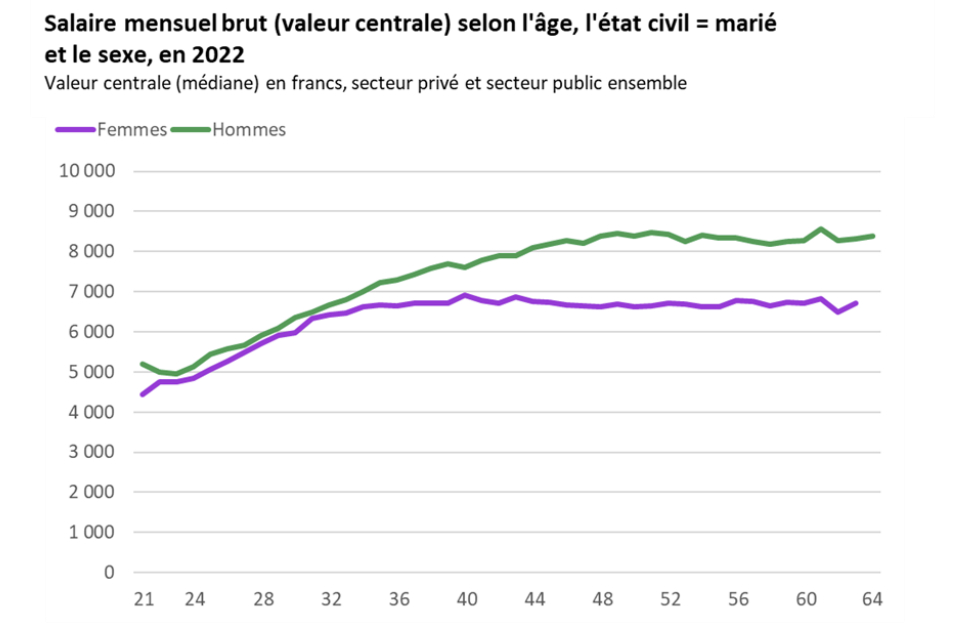
Married women under 30 earned 6.6 percent less than their male peers, rising to 12.6 percent for those aged 30-49, and 19.7 percent for women aged 50 and over.
You can see in the below graph that married women’s salaries (purple line) remain almost unchanged between the ages of 30-49 and 50 and over.
Graphics: FSO
The report also noted that the higher women climb the career ladder, the greater the pay gap – and the fewer women there are in senior roles.
Women in senior positions earned 14.7 percent less than men doing a similar job, and 5.7 percent less in non-management roles.
Advertisement
Employment patterns matter, too.
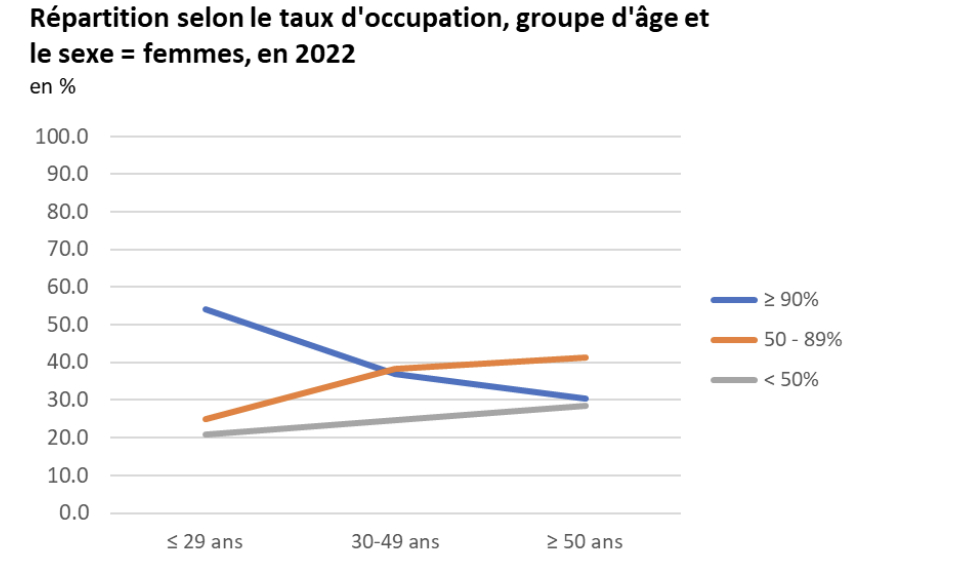
Women working between 50 and 90 percent of full-time hours earn better over time than those working full time or less than 50 percent, according to the report and as shown in the below graph (the blue line shows the downwards trend among women working at least 90 percent of full-time hours).
Graphics: FSO
OPINION: Has anything improved for women in Switzerland in recent years?
The reverse is true for men who earn more the more hours they work, with advancing age making little difference.
Women working full time earn a full 11 percent less than male colleagues, while the gap drops to 1.2 percent for women working under 50 percent of full-time hours.
The share of women working full time also declines with age, from 54.1 percent for women under 30 to 30.3 percent for those aged 50 and over.
Men, by contrast, work full time in larger numbers, with 81.7 percent in the 30-49 age group, dropping to 78.4 percent for workers aged 50 and over.
The gender pay gap can be explained, in part, by individual characteristics, such as job role or field of activity, but nearly half (48.2 percent) of the gap remains unexplained, suggesting that discrimination or other unmeasured factors may still be at play.
Switzerland’s Federal Statistical Office conducts this wage analysis every two years. While equality between the sexes – including in pay – has been enshrined in Swiss law since 1981, the figures show there’s still a long way to go.


