


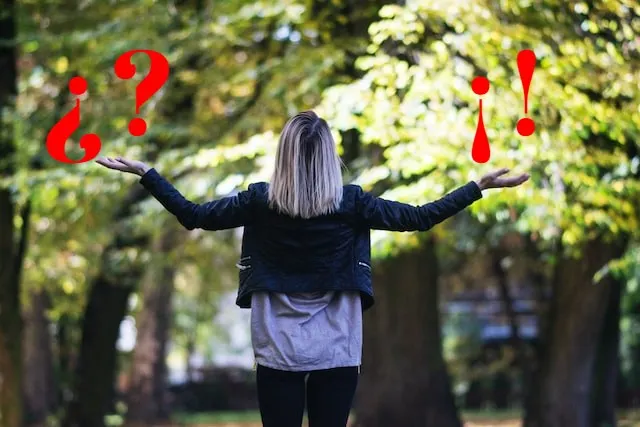
Spanish is the only language in the world which puts an ‘upside down’ exclamation mark (¡) or question mark (¿) at the start of a sentence. ¿Por qué? (why?), we ask.
Most historians agree that exclamation marks were first used in Latin manuscripts and that the question mark was introduced by the Carolingians, a French dynasty that dominated Western Europe between the 8th and 10th centuries.
In both cases, these symbols used to either emphasise or ask were included only at the end of sentences.
Advertisement
So why is it that in written Spanish, a question or exclamation mark is added at the start of the sentence as well as at the end?
The first official reference of this linguistic idiosyncrasy was in the second edition of the Spanish Royal Academy’s book of spelling and grammar, published in 1754.
Spanish academics concluded that having a question mark at the end of a sentence wasn’t enough – especially when it came to long sentences – and that a ¿ should be added at the very start as well.
“There are periods or long clauses in which the question mark placed at the end is not enough and it is necessary from the beginning to indicate the meaning and interrogative tone with which it should be read,” reads the minutes of the meeting held in 1753 about why the “novelty” of a question mark was “convenient” in Spanish.
Initially this rule of adding an inverted question mark was only applicable to long sentences, but over the years linguists realised that it was often difficult to determine when a sentence should be considered short or long, and that people ended up interpreting the rule at will.
So in 1870, Spain’s Royal Academy ruled that initial signos de interrogación should be added to all applicable cases, regardless of the length of sentences.
The exclamation point, which was included in the Spanish grammar books later on in the 18th century, was officially considered to be a two-symbol rule in 1884.
In fact, it was only in 2014 when it officially stopped being referred to as a signo de admiración (admiration point) and became known as signo de exclamación (exclamation point).
Nowadays, Spain’s Royal Academy – known as la RAE – is clear that the correct punctuation in Spanish should always be an exclamation or question mark at the start of a sentence if there is one at the end, and that mimicking what happens in other languages such as English where it only goes at the end is incorrect.
That applies regardless of whether the question or exclamation stands on its own – ¡Adiós! (Bye!) or ¿Cómo te llamas? (What’s your name?), or they’re a period within a sentence, such as Me acabo de despertar, ¿qué hora es? (I’ve just woken up, what time is it?).
Could it be that the often flowery and long-winded nature of written Spanish contributed to this orthographic uniqueness? We certainly think so!


