


Switzerland has once again topped the list of the most popular countries in Europe for Germans to move to. What makes it such a draw?
We updated this story in September 2025.
Most Germans who leave the country to move to another part of Europe end up in Switzerland.
And the latest official stats show the number of Germans emigrating to their Alpine neighbour is increasing.
A total of 323,600 Germans were resident in the neighbouring country at the start of 2024, according to the new figures from the German Federal Statistical Office released on September 10th 2025. That’s an increase of 2.4 percent from the previous year, and 10.7 percent more than a decade ago.
“The number of Germans living in Switzerland has been increasing for years,” researchers at the office said.
Switzerland is followed by Austria and Spain as the most popular destinations for Germans.
So what makes Switzerland such a draw?
Freedom of movement (and proximity)
Germany is a part of the European Union (EU) which makes moving around to live and work across the continent easier.
Of course, Switzerland is not part of the EU. But it is in the European Free Trade Association (EFTA) and is further connected to the EU through the EEA (European Economic Area).
Due to the Free Movement of Persons Agreement (AFMP), nationals of EU/EFTA countries get almost unlimited access to Switzerland, as well as sweeping rights and benefits, which include being able to change jobs and move from one canton to another.
EU/EFTA citizens do not need a visa to enter Switzerland, but they do need to register and apply for a Swiss residence permit if they want to live there for more than three months.
Advertisement
There are stricter rules and quotas for people from countries outside the EU/EFTA area who want to move to Switzerland.
Switzerland is also one of nine countries to share a border with Germany, so Germans don’t have to venture far (although they will have to pay with Swiss francs rather than euros when they arrive).
The table below shows the number of Germans (in thousands) residing in other European countries in 2024.
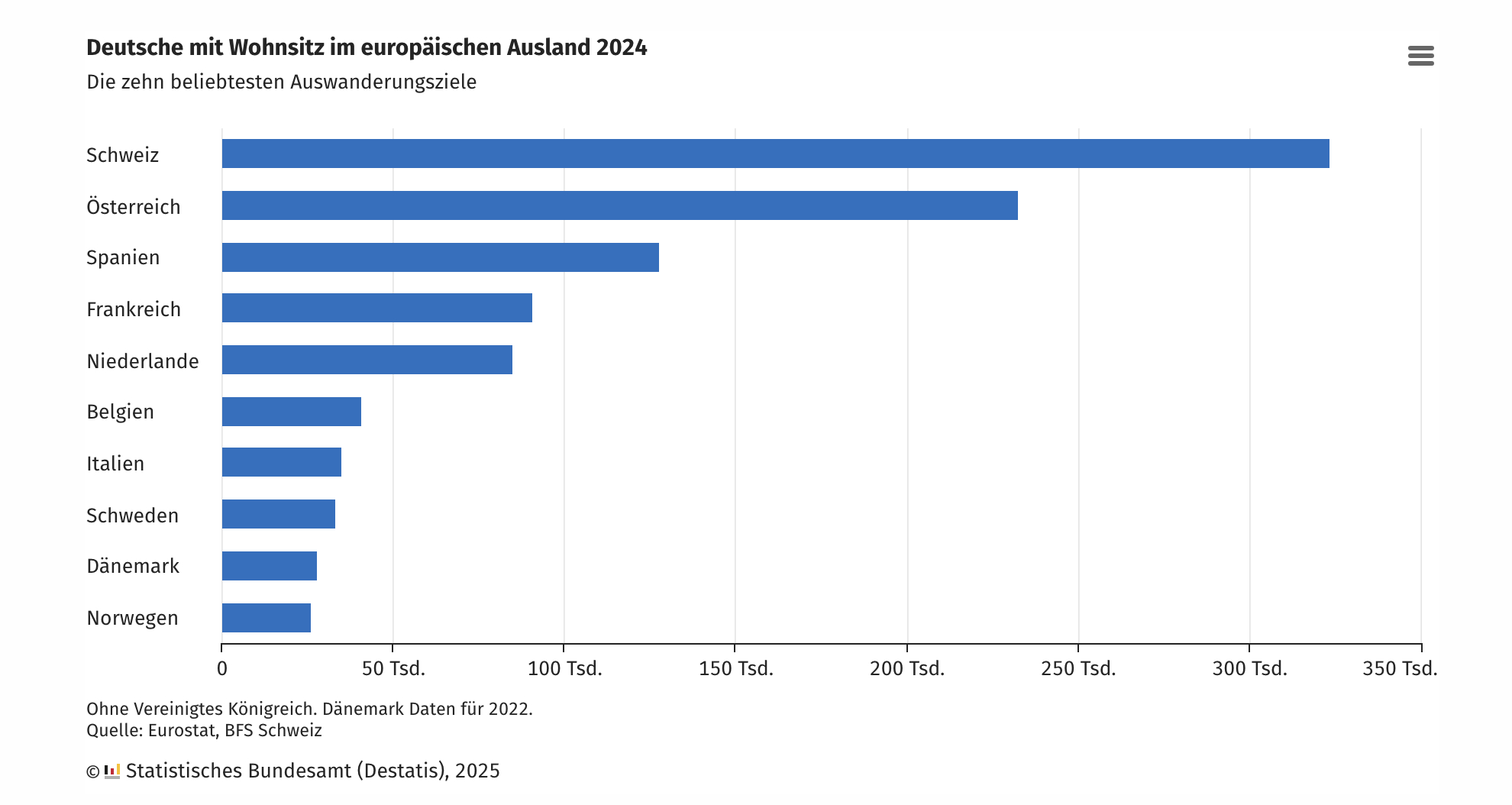
Screenshot: Federal Statistical Office.
Language similarities
Another reason why many Germans choose to move to Switzerland is because of the reduced language barrier. German is one of four national languages spoken there.
Around 62.6 percent of residents in Switzerland speak Swiss-German across various cantons, such as Zurich, Zug and Basel-City.
Four cantons – Bern, Fribourg, Valais and Graubünden – as well as the city of Biel/Bienne (in canton Bern) are bilingual, with French and German being the main languages used.
However, one thing to watch out for is that those coming from Germany may struggle to understand the notoriously tricky Swiss-German dialects. The good thing is that most people are happy to switch to Hochdeutsch (high German) if needed.
READ ALSO: Just how good are the Swiss at speaking the country’s different languages?
Higher wages
Germans may opt for Switzerland is because of the higher wages.
In 2023, the gross median monthly wage (before tax) in Switzerland was 6,788 CHF, according to finance firm Rister, which is equal to around €7,200.

A wallet with Swiss francs. Photo: Pixabay
According to career portal Stepstone’s 2024 report, the median gross salary in Germany is around €3,645 monthly.
Taxes in Switzerland also tend to be lower than many other European countries (including Germany), making it a magnet for the world’s wealthiest people.
However, the cost of living is high, with major Swiss cities like Geneva, Zurich and Basel regularly being ranked among the most expensive in the world.
READ ALSO: Do wages in Switzerland make up for the high cost of living?
Advertisement
Stunning nature
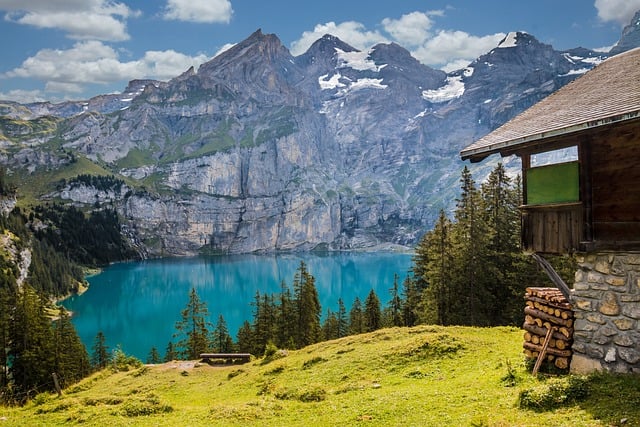
Switzerland’s Alpine mountains and lakes are unrivalled, attracting visitors from all over the world.
As Germans are generally keen to be outside exploring, this side of Switzerland is no doubt a big attraction.
READ ALSO: What’s behind the German love of hiking?
But it’s not all about yodelling and cute Alpine huts. The reality of living in Swiss cities is similar to most urban developments.
A benefit to living in dinky Switzerland, however, is that you’ll never be too far from nature.
What other countries are most popular with Germans?
Austria is the second most popular destination for Germans moving abroad, according to the stats.
At the start of 2024, 232,729 German citizens were living in the Alpine nation. That’s an increase of 3.4 percent, or just over 7,700 people, compared to the previous year – a stronger rise than in Switzerland.
Advertisement
Over the past decade, the German population in Austria has grown by 41.2 percent, or nearly 68,000 people.
“What both countries have in common is that geographical proximity and the lack of language barriers make it easier for Germans to relocate,” the Federal Statistical Office said.
Spain ranks third among European destinations, making it the most popular option outside the German-speaking world. At the beginning of 2024, around 128,000 Germans were living there, an increase of 1.8 percent (just under 2,300 people) from the previous year.
After years of decline between 2014 and 2021, the number of Germans in Spain has been rising again since 2022. Still, at the start of 2024 there were 9.8 percent fewer Germans – almost 13,900 fewer – than a decade earlier.


