


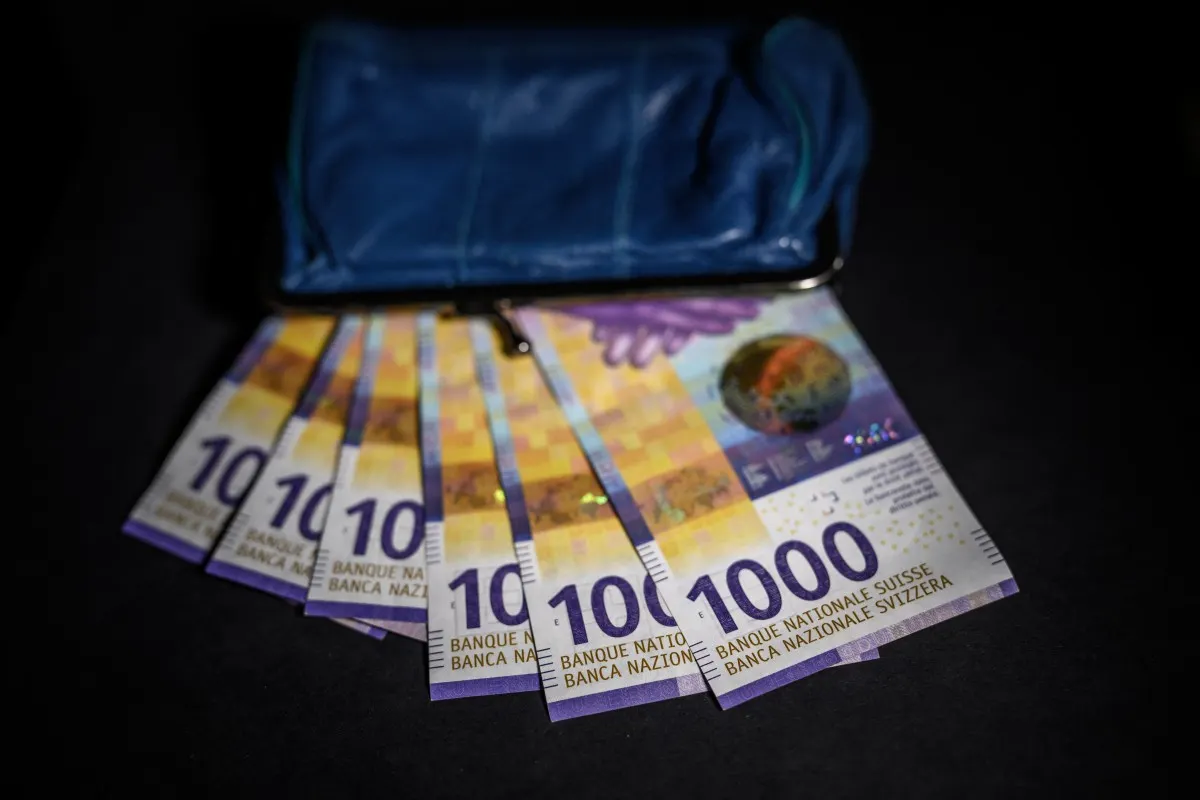
Year after year, the Federal Council announces deficits in Switzerland’s budget and stresses the importance of curbing public spending. But is this actually the whole picture?
In a trend observed for many years, Swiss government talks about more or less significant holes in the public budget, as well as the necessity to tighten its belt.
It then goes on to cut the funding (or eliminate it altogether) for various projects and programmes.
Take 2025, for example.
As recently reported by RTS public broadcaster, the Federal Council had estimated its deficit at 815 million francs, but in its final balance sheet, it recorded a surplus of 259 million francs – a difference of more than one billion francs between its forecasts and reality.
Accidentally or on purpose?
Experts say that the money-savvy members of the Federal Council – which include the ministers of both Finance and Economy – systematically overestimate the government’s public deficits, while underestimating its revenues.
And they do it intentionally.
They are not, however, driven by the desire to deceive the public.
Instead, at least part of the reason for this recurring pattern of “concealing” the truth can be attributed to culture and mentality: the Swiss are cautious and risk-averse by nature, and they also don’t like to brag.
According to Fabrizio Mazzonna, director of the Institute of Political Economy in Lugano, the government is acting “out of prudence”.
It is also possible that certain federal departments “do not fully utilise the funds allocated during the year”, resulting in a surplus (and that is another typically Swiss trait – spending wisely).
Advertisement
Pushing the brake
But there is another reason as well.
The “prudence” that Mazzonna referred to also largely rests on the debt brake, a constitutional principle that requires the Swiss government not to spend more than it earns.
“If there is a law prohibiting deficits, one is forced to be more pessimistic in one’s budget forecasts,” he pointed out. “This rule mandates avoiding structural deficits and reflects a political climate where deficits are perceived as a sign of mismanagement.”
Therefore, “prudence and political culture thus reinforce each other,” Mazzonna added.
READ MORE: What is Switzerland’s debt brake and how does it affect residents?
Advertisement
And this is where Switzerland excels
Compared to other European countries, “Switzerland stands out with one of the lowest levels of public debt,” Mazzonna said.
“This is the fruit of a very rigorous political approach, shared across the entire political spectrum.”


