


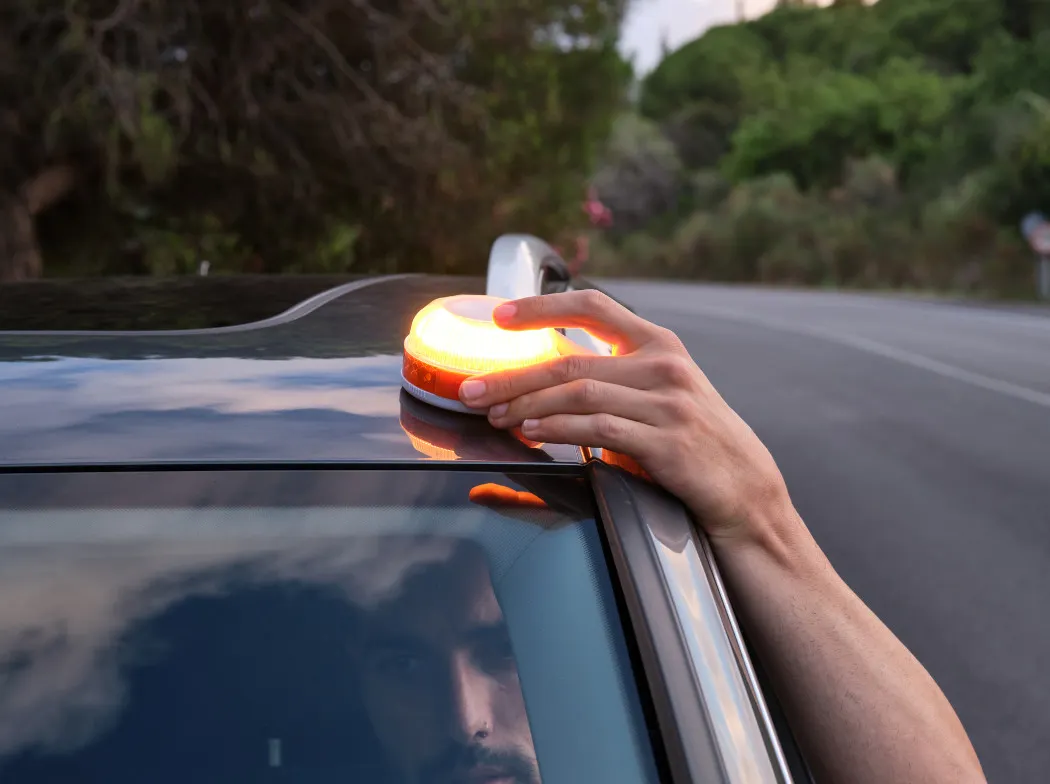
The new v-16 hazard light, which all drivers in Spain must have from next year, has been causing controversy, particularly due to its mandatory geolocation feature. Here’s what you need to know about it.
Starting on January 1st 2026, all vehicles in Spain will have to carry a V-16 emergency light, to be used in the event of a breakdown or road accident.
The current warning triangles will no longer be allowed from next year, so everyone must purchase a V-16.
In order to be approved by Spain’s DGT traffic authority, they must have several important features including transmitting your geolocation in real time to Spain’s DGT traffic authority and an LED light bright enough to be seen from 1,000 metres away and at 360 degrees.
One of the most controversial and talked-about points of this emergency light is its built-in geolocation device. Because the SIM card will be connected to the DGT platform in real time, many believe this means they will be under constant surveillance from the traffic authority. They think that the DGT may use it to track vehicles and issue fines accordingly.
READ ALSO: Spain’s V16 light – Everything drivers need to know
In response to the rumours, the Spanish Data Protection Agency (AEPD) has issued a statement debunking the myth and explaining how geolocation in the V-16 lights will work.
“While it is not activated, the beacon does not transmit any data,” the AEPD said in a statement. This means the V16 signal only appears in the DGT system around 100 seconds after the driver presses the light, thus turning on the device.
“The beacon emits a signal while it is switched on and stops when it is switched off, without generating movement logs or continuously transmitting data.” Therefore, there is no way to use the information it emits to issue fines, the AEDP clarified.
READ ALSO – Driving in Spain: Which V-16 emergency light should you buy?
Advertisement
Head of Telematics at the DGT, Monserrat Estaca, also explained in an interview with Spanish newspaper 20 Minutos that: “The person who acquires the beacon does not have to give their personal data to any administration when acquiring it, so the Directorate General of Traffic (DGT) would not know who has bought the device.”
This essentially means that the signal is completely anonymous and the traffic authority is only aware that a breakdown or accident has occurred at that point on the road, but they don’t know who is sending it.
The only way in which the DGT will use this geolocation data is to display the incident on roadside panels and in the navigation system, so that other drivers know to be aware.
It is not yet clear whether the information will be displayed platforms like Google Maps.
It’s important to remember though that the V-16 light is not used as an emergency alert system. This means drivers still need to call emergency services in case of an accident or a breakdown company or insurer if their car is no longer working.
READ ALSO: Police slam new compulsory V-16 emergency light for drivers in Spain


