
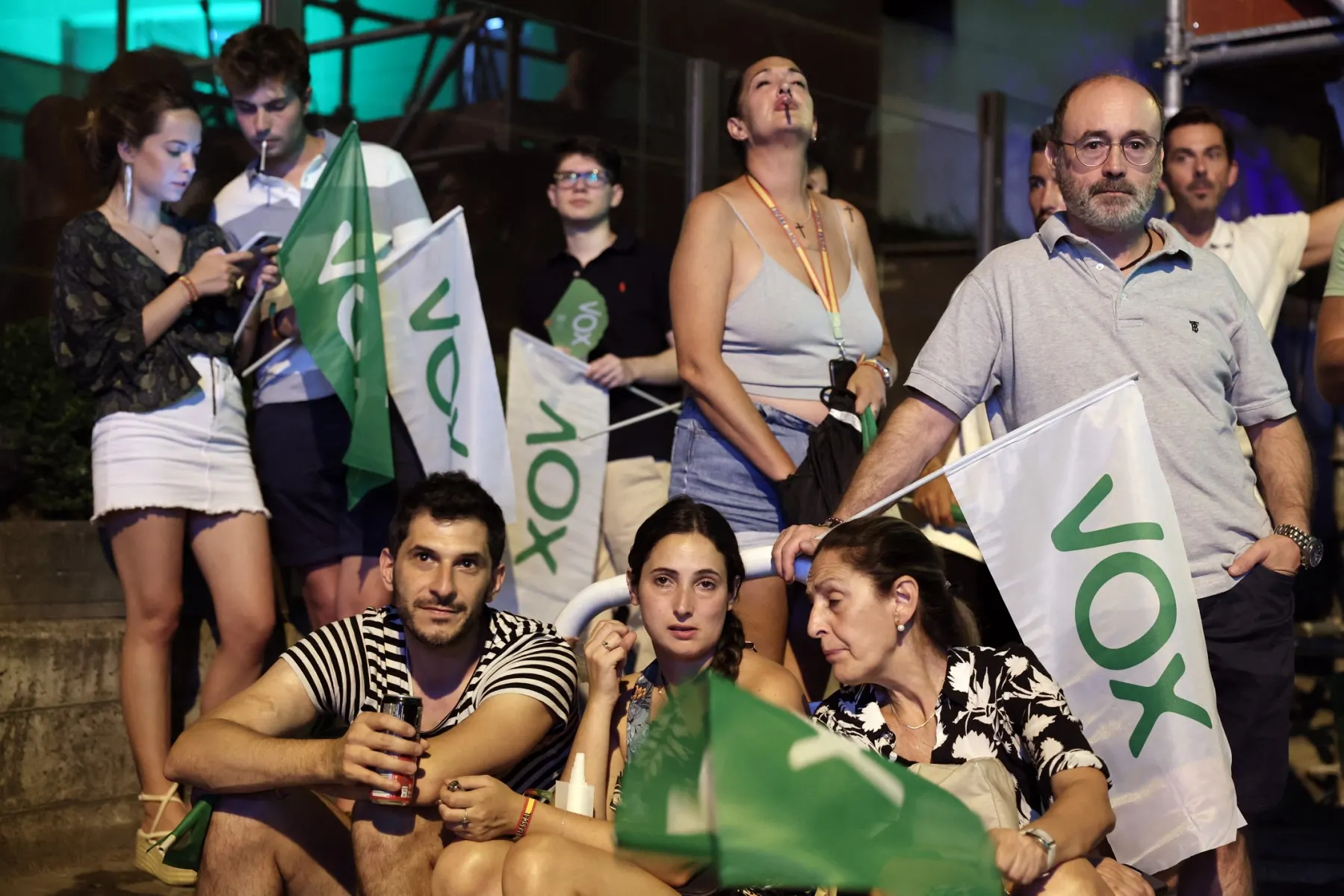
The quiet migration of voters on the Spanish right is getting little media attention but could reshape the future of Spain, new data suggests. What is convincing longstanding PP voters to shift further right?
Polls have suggested for some time that Prime Minister Pedro Sánchez’s Socialist-lead government will likely lose the next election, slated for 2027.
They’ve also consistently shown the far-right Vox party climbing in the polls. State pollsters CIS recently predicted that Vox would achieve an 18.9 percent vote share, its highest on record, something that adds to the sense of change and ‘end-of-cycle- feel in Spanish politics.
READ ALSO: Is Vox’s rise in Spain due to anti-immigration or other reasons?
Sánchez has vowed to fight for re-election, but faced with mounting corruption allegations in his inner-circle and a sense of momentum building on the Spanish right, especially following recent regional elections, most political pundits in Spain see him on the way out of La Moncloa.
Polling data suggests that the Spanish right-wing bloc — the centre-right People’s Party and far-right Vox — would between them win a governable majority.
But within that, pollsters are observing a pattern: PP voters increasingly shifting to Vox. Though this might not affect the balance of left versus right blocs overall, it does reveal something about the internal politics of the Spanish right.
This comes as PP leader Alberto Núñez Feijóo stated recently that he would be open to striking deals with Vox party to pass key legislation if he becomes Prime Minister, raising the real possibility of the PP entering a coalition with the far-right, whether formally or informally, when the next election comes.
Vox has in recent years stepped up its anti-migrant rhetoric, calling for the deportation of millions of immigrants and banning Islamic events in public spaces at a local level, something the PP has been forced to respond to for fear of being outflanked.
Looking at the latest polls, they all broadly paint the same picture regardless of methodology, sample size or political bias: a notable portion of the PP’s electorate is migrating to Vox in what analysis for Agenda Publica has deemed “a persistent, widespread and silent manner.”
Advertisement
Which Spanish voters are shifting rightward?
This is not a sudden phenomenon but rather a steady trend that has existed since the last general election in Spain, in the summer of 2023.
In a recent 40dB poll, 15.6 percent of those who voted for the PP in 2023 said they would vote for Vox today. Cluster17 puts the figure at 16 percent, Opina360 a little lower at 13.9 percent.
And the direction of travel seems to be one way, with little evidence (ranges between 0-3 percent) of voters going from Vox to the PP.
State pollsters CIS, although sometimes criticised for favouring the government of the day, in this case Sánchez’s PSOE, have outlined some of the demographic and structural reasons behind the shift.
Among men, one in five who voted for the PP in the last election would now vote for Vox (21.6 percent). Among young adults aged 25 to 34, it rises to 32 percent.
READ ALSO: Why do many young people in Spain think life was better under Franco?
Interestingly, the shift begins to decline among voters from the age of 65 and practically disappears among those over 75 (0.8 percent), suggesting those in Spain with memory of dictatorship are unlikely to vote for the far right.
Among those who rank themselves number 7 and 8 on the ideological scale (going from left to right), the figure climbs to 26 percent and 30 percent respectively.
In short: many of these switchers are traditional, centre-right voters who for decades made up the PP’s core vote.
Advertisement
What explains this shift?
There are several plausible explanations.
One could be the perceived weakness of PP leader Alberto Núñez Feijóo, who despite the endless scandals engulfing the Sánchez government, has failed to break through as the clear alternative.
“The fact is that for almost 12 months now, Abascal has been the preferred leader on the right and the second most popular at the national level,” Anna López Ortega, political scientist at the University of Valencia, recently told the Huffington Post.
Feijóo is often criticised for being an uninspiring, slightly flat performer, something that emphasises Vox’s sense of insurgency.
Similarly, Vox’s rise also represents a breakdown of Spain’s traditional two party system. Vox, viewed by many as a protest vote, is a way of punishing the old model of Spanish politics that includes not only the PSOE but the PP too.
Vox presents itself as an alternative and is simultaneously benefiting from political loyalty and alienation. Ortega states that “the second element that helps us understand why Vox continues to grow and rebuild the right-wing bloc is loyalty. Vox is the party that has the most loyal voters, specifically men under 35, new voters and abstainers,” she explained.
Political apathy also plays a role, she added, with Vox capitalising on non-voters: “19 percent of people who did not vote on [the 2023 general election on} 23 June would now vote for Vox, and this is not a trend, it has already become structural.”
Advertisement
With Vox’s rise in the polls, the PP has responded with increasingly hard-line rhetoric on immigration and cultural issues.
Increasing cooperation between the two parties meant that a Vox bill to ban the burqa and niqab was debated in the Spanish parliament this week.
The PP has also bolstered its immigration platform, promising a points-based system, more deportations, and integration requirements for citizenship and residency, among other measures, if elected.
READ ALSO: The 10 migration laws that will impact foreigners if Spain’s PP reaches power
However, for many political observers, this logic is flawed.
Can the PP, especially as one of Spain’s two traditional parties, especially fronted by an uncharismatic leader like Feijóo, really ‘Out Vox’ Abascal’s party on issues like immigration and crime?
For the many voters in Spain concerned about the issues, the question is – why vote for the PP when Vox exists?