


Members of Switzerland’s Young Socialists party, who were behind the recent inheritance tax proposal, make their aims clear in Bern, February 2025.
Keystone / Peter Klaunzer
The idea of clamping down on the rich often enjoys large public support. In practice, it rarely succeeds – even when citizens can vote directly on it. Why not?

Inequality is unpopular in the European Union (EU). Across the 27-country bloc, 65% of people would support a tax on the wealthiest 0.001%, a 2024 EurobarometerExternal link survey found. But last year, an effort to kickstart such an idea fell flat when an EU-wide “Citizens Initiative” didn’t even make it past the signature-collection stage. Out of 450 million Europeans, just 370,000 signed up – far short of the one million needed.
In Switzerland, where direct democracy is well-oiled, calls to “tax the rich” are more likely to pass this hurdle. In recent years, left-wing initiatives to tax capital gains (2021), scrap lump-sum tax deals (2014), or cap executive pay (2013) have all made it to a public ballot. The latest, a proposal for a 50% levy on big inheritances, gathered 130,000 signatures – in a country of 9 million – to force a public vote on Sunday.
Public support tends to stop there. All the proposals mentioned above failed; the inheritance tax idea was rejected by a hefty 78%, a decade after a similar proposal also flopped. And while this might not come as a political shock, it does raise a “puzzle”, says Patrick Emmenegger, a political scientist at the University of St Gallen. Surveys also show a majority of Swiss are not happy about the growing wealth gap between rich and poor – why doesn’t this translate at the ballot box?
>> Inheritance tax and civic duty – how the Swiss voted on Sunday, November 30, 2025:
More

More
Swiss voters massively reject inheritance tax, civic duty proposals
Nice idea, negative effects
While many voters sympathise with the thought of taxing the rich, they back down when debates get specific, Emmenegger explains. Focus groups in Germany have found that “opponents of taxation stick to their position during debates, while initial supporters become less keen when faced with the other side’s arguments”, he says. In Switzerland, this ebbing of initial enthusiasm is a classic pattern in vote campaigns, and not just on tax issues.
As for the arguments involved, it depends what type of “rich tax” is up for debate – does it target wealth, inheritance, capital gains or something else? Details also matter: the 2015 Swiss inheritance tax initiative proposed a 20% levy on estates over CHF2 million ($2.48 million); the 2025 proposal sought 50% for amounts over CHF50 million – a level deemed “close to expropriation” by Finance Minister Karin Keller-Sutter. There’s also what to do with the new revenue: boost pensions (2015) or save the climate (2025)?
Meanwhile in Switzerland, there’s also the issue of federalism: the 26 cantons retain wide fiscal sovereignty and are touchy about national-level proposals for new taxes – especially if it’s something they already levy, like inheritance or wealth taxes. And finally there are the classic trickle-down arguments, or calls not to tackle the wrong problem: “inequality in opulence is better than equality in squalor”, philosopher Olivier Massin wroteExternal link.
Fears of economic fallout
But whatever type of tax is in question, one key factor usually drives voter reluctance: concerns about economic fallout. Even if just a tiny minority would be directly affected by a new tax, there’s always the spectre of this minority fleeing the country, taking their wealth and investments with them. Indeed, worries about negative effects on business and jobs were the most important factor that doomed the 2015 inheritance tax, Emmenegger has writtenExternal link.
Whether such fears are justified is harder to say. Some things are easier to quantify than others. For example, the top 1% in Switzerland now hold 42% of private wealthExternal link, up from 30% a few decades ago; they also account for 40% of Swiss income and wealth tax intake. But how many would flee if a new tax was passed – and what effect would an exodus have on state revenue? In the recent campaign, the government warned of potential losses of up to CHF3.6 billion a year; the economist Marius Brülhart estimatedExternal link the net result could be tax intakes ranging from a CHF700 million loss to a CHF300 million gain.
‘Shaky projections’
Such “shaky projections”, as the Neue Zürcher Zeitung (NZZ) newspaper put it, were stoked by public threats by rich individuals to leave in case of a yes vote. This tactic was labelled a “campaign of fear” by the president of the Young Socialists, Mirjam Hostetmann. But it was effective: the big-budget “no” campaign dominated in terms of advertising and setting the tone, with media coverage being largely negative about the tax, a study foundExternal link.
As for the uncertainty around the economic impact, this also discourages risk-taking by voters, Emmenegger says. “Sticking to the status quo means you at least know what you get – and in Switzerland, the status quo isn’t terrible.”
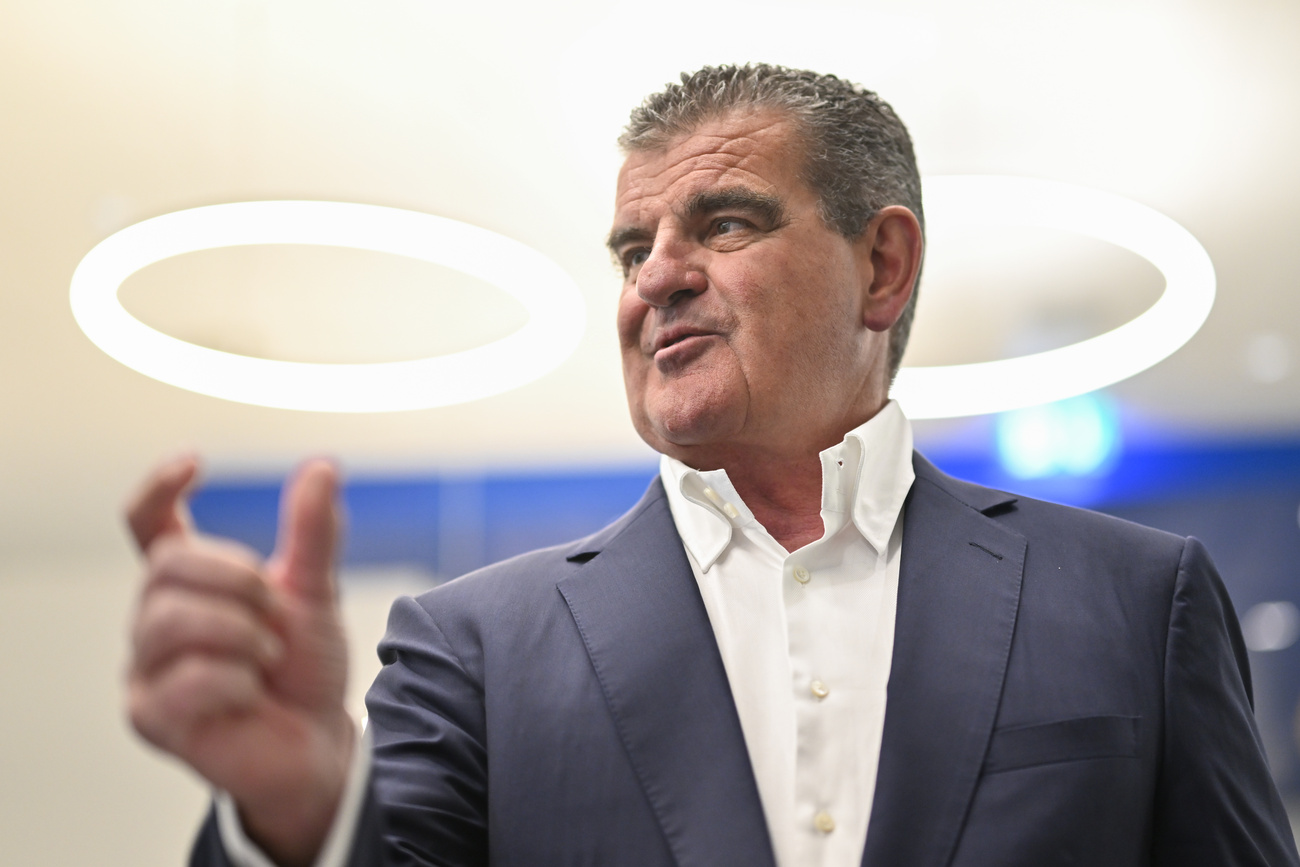
Will he stay or will he go? Stadler rail’s Peter Spuhler caused a storm in mid-2024 when he said the inheritance tax would force him to emigrate. He decided to stay.
Keystone / Gian Ehrenzeller
From wealth taxes to VAT – and back?
Meanwhile a decent status quo might not be fertile ground for calls to “tax the rich” in the first place. In the late 19th and 20th century, wealth taxes were more likely to emerge due to big economic shocks – after a war, for example – than to concerns about inequality, findsExternal link Laura Seelkopf, a public policy professor at the Ludwig Maximilian University of Munich. The origins of inheritance taxes are also pragmatic: centuries ago, with most people too poor to pay taxes, levying the bequests of the moneyed classes was a solid source of state revenue.
Things changed as tax systems modernised in the second half of the 20th century, Seelkopf explains. With post-war peace and prosperity, more workers began earning – and spending – enough to contribute via income tax or VAT; at the same time, “corporate taxes went down, capital gains taxes were split off from income tax, and wealth and inheritance taxes started to disappear”. In 1990, 12 OECD countries levied wealth; today, only three do.
In the 21st century, things could be shifting again, at least at the political level, where wealth taxation has made a “spectacular comeback”, Seelkopf writes. As ageing populations, climate change and defence spending raise new fiscal challenges, many countries – including Switzerland – are on the hunt for new sources of income. In this context, while she’s not expecting any “major overhauls” of tax systems, progressive taxation could become appealing again – “simply because that’s where the money is”.
Mixed bag of international approaches
Yet while calls to “tax the rich” have been sparking political and media debates, it’s not just in Switzerland that a concrete translation into policy has been less spectacular.
In France, the “Zucman tax” – named after the economist who championed it – attracted big attention this year. But while the proposal – a 2% levy on assets over €100 million (CHF93 million) – was backed by 86% of citizens (according to an IFOP poll commissioned by the French SocialistsExternal link) it didn’t work politically: not even a watered-down version passed in parliament. France has history here: in 2014, it dropped a “supertax” on high incomes after wealthy individuals moved away; Emmanuel Macron ditched a previous wealth tax in 2017.
Elsewhere, there are mixed trends. Some countries are tightening things for the rich: Norway hikedExternal link its wealth tax rate, Spain consolidatedExternal link its one, the UK is now taxingExternal link offshore assets, while Japan has been debatingExternal link taxes on investment gains. Others are keen to woo the rich: Italy has had a lump-sum tax scheme since 2017, while Donald Trump’s “One Big Beautiful Bill” contains various tax advantages for the wealthy. China, which is accountable to its citizens in non-electoral ways, has begun taxingExternal link overseas investment gains.
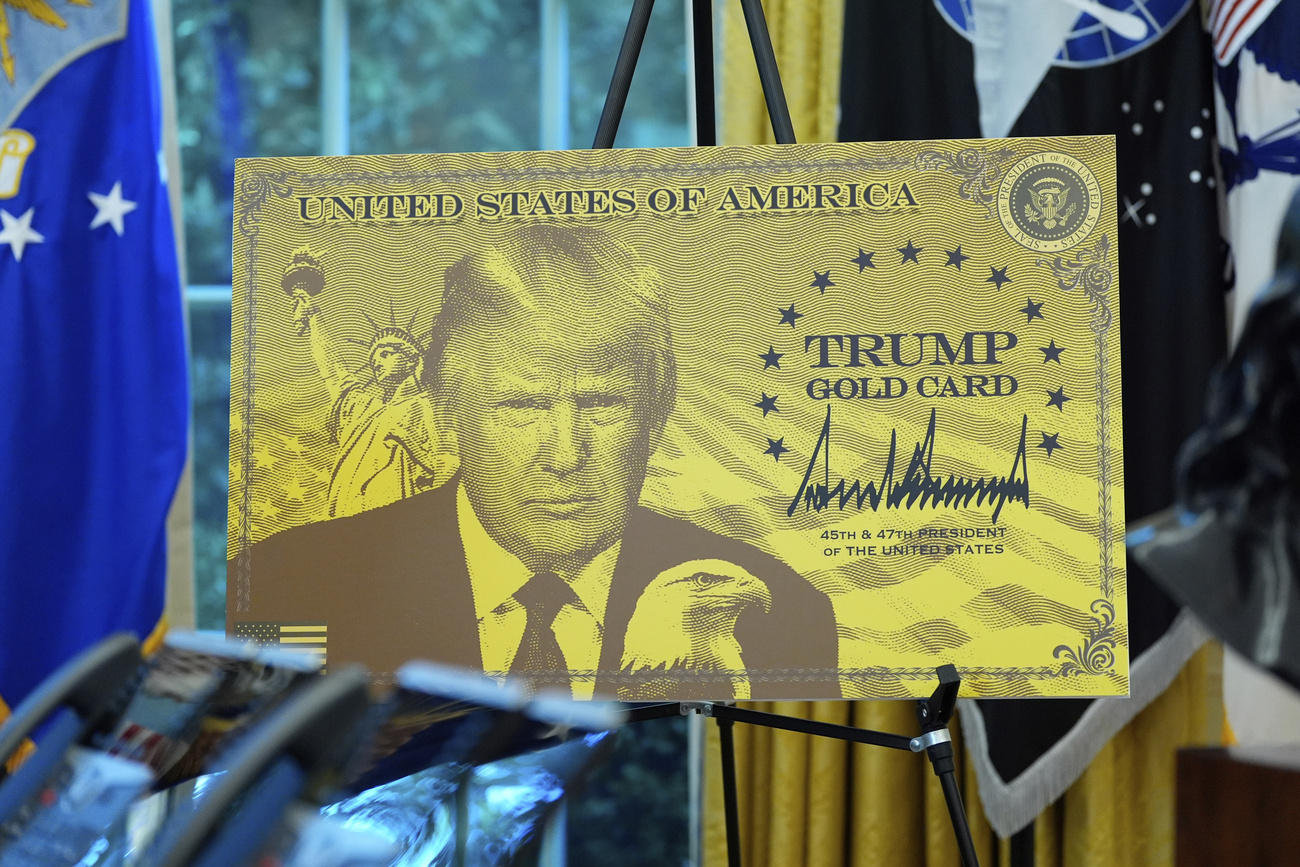
Wealth magnet? A “gold card” proposed by US President Donald Trump plans to offer fast-track residency to those who donate $1 million to the US government.
Copyright 2025 The Associated Press. All Rights Reserved
The G20 and multilateralism
Faced with the mishmash of approaches, some say a coordinated global approach is needed. Given the mobility of capital, and of rich individuals, it could be argued that “world-wide inequality is all that matters from a normative standpoint”, three Swiss economists have writtenExternal link. Yet multilateralism is facing challenges, especially since Donald Trump’s re-election. Last year, the G20 referred to a global version of Zucman’s wealth tax; this year, the summit was boycotted by the US.
“I don’t have much hope that a wealth tax will be adopted at the global level in a near future,” says Alice Pirlot, an international law professor at the Graduate Institute in Geneva.
Swiss authorities are meanwhile less keen on a global wealth tax, the NZZ reported last yearExternal link. On this score, the country is already an outlier: along with Spain and Norway it’s one of only three OECD states still to retain such a levy. “It’s also the only country with a functioning wealth tax that yields significant revenue – this is recognised internationally,” University of Zurich economist Florian Scheuer toldExternal link the Tages–Anzeiger.
Edited by Benjamin von Wyl/sb


