


A certain level of proficiency in one of Switzerland’s national languages is a must before foreigners can obtain a work permit or citizenship. But some immigrants are exempted from this obligation.
One of the key requirements that foreign nationals must fulfil to receive a B permit, upgrade it to the C permit, or apply for naturalisation, is the knowledge of the national language of the canton where they reside.
According to the State Secretariat for Migration (SEM), “knowledge of a national language is a basic requirement for the successful integration into working and social life.”
Therefore, “all persons applying for family reunification, a residence or permanent residence permit, or regular or early naturalisation, must prove their knowledge of a national language.”
What does this process entail?
In 2019, the government introduced new language proficiency rules for permits as well as citizenship.
Each of the levels was set by SEM in accordance with the Common European Framework of Reference (CEFR), a definition of different oral and written language levels created by the Council of Europe.
This is what SEM’s requirements look like, with the rules for spoken proficiency higher than for written ones.
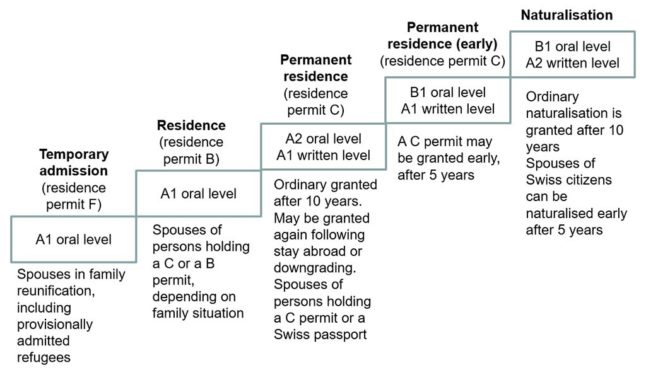
SEM
This is what different levels mean:
A1 A2 : Beginners
B1 B2 : Intermediate
C1 C2 : Advanced
These rules apply to all foreign nationals coming to live and work in Switzerland, but the law provides for some exemptions as well.
Advertisement
Who is exempted from these requirements?
Nationals of neighbour countries
If you come from Germany, France, Italy, Austria, or Liechtenstein, you don’t have to prove your language skills — provided you settle in a language-appropriate canton.
But if, for instance, you are a German national who is going to work in a French-speaking canton such as Geneva, then you must prove the required level of proficiency in French.
You were born in Switzerland
If you were born in the country to non-Swiss parents (so are not a Swiss citizen), but have lived your entire life here and have gone through the compulsory Swiss school system, you are exempted from complying with the language rules.
Learned the language at school
Those who have completed compulsory schooling (at least three years) or upper secondary or tertiary education in a Swiss national language are also exempt.
Advertisement
Minor children
Language rules are also waved for children under the age of 18 who come to Switzerland as part of family reunification.
Inability to learn
If the applicant is unable to meet the language requirements or can only do so with difficulty, an exemption may be granted.
This may be because of personal circumstances such as a physical or mental disability, learning difficulties, or a serious or chronic illness.
The person must submit proof of their inability to meet the language requirements.
Advertisement
Are there any other exceptions?
Those are the official government rules, but there are some ‘grey areas’ as well – that is, situations when permits are given out though the language requirements are not as strictly applied – if at all.
A little known (except to the financially astute) and rarely used Article 30 of the Federal Aliens Act sets out exemptions from the regular, strict admission requirements.
It enables foreigners from third nations to move to Switzerland — but only if they are sufficiently wealthy to live here without having to work or resort to welfare benefits.
The law states that in cases of “important public interests” – that is, plenty of money in state coffers – cantons can grant citizens of third countries permissions to settle on their territories with a B residence permit.
These are the so-called “golden visas”, a term used to describe residency based on investment in local economy.
In 2024 Switzerland issued 496 such permits.
While this may not be a huge number, it was 92 more individuals than in 2023.
In such cases, financial aspect is more important to Swiss authorities than language proficiency.
READ ALSO: How many wealthy foreigners get one of Switzerland’s golden visas?


