



 Getty Images
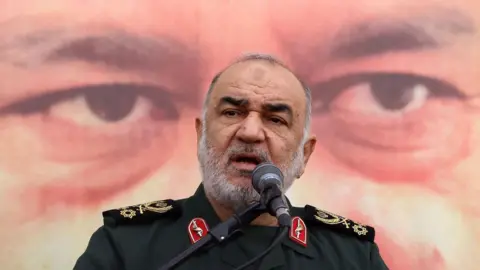
Hossein Salami, commander of Iran’s Islamic Revolutionary Guard Corps (IRGC), was killed in Israel’s strikes early on Friday, the most senior Iranian leader to die in the attacks.
Salami, who was 65, was known for taking a hardline stance against Iran’s rivals, including Israel and the US. Just last month, he had warned that Tehran would “open the gates of hell” if attacked by either country.
Israel launched widescale strikes against Iran, saying it targeted nuclear facilities, ballistic missile factories and military commanders, despite US President Donald Trump warning its ally against scuppering talks on a potential nuclear deal.
Tehran has warned that Israel and the US – which denies being involved – will pay a “heavy price” for the attacks, raising concerns that this will lead an already fragile region into full-scale war.
Israel’s strikes also killed Mohammad Bagheri, Chief of Staff of the country’s armed forces, Gholamali Rashid, the deputy commander of the Iranian armed forces, and several nuclear scientists.
Just a day before the strikes, Salami had said that Iran was “fully ready for any scenarios, situations, and circumstances”.
“The enemy thinks it can fight Iran the same way it fights defenceless Palestinians who are under an Israeli siege,” he said. “We are war-tested and experienced.”
Salami first joined the Revolutionary Guards – a powerful branch of the Iranian armed forces – in 1980 during the Iran-Iraq war and became deputy commander in 2009, then commander a decade later.
Since the 2000s, he has been sanctioned by the UN Security Council and the US for his involvement in Iran’s nuclear and military programmes.
Salami had boasted of Iran’s military capabilities, at one point declaring that the country was “on the verge of becoming a world power”.
He had welcomed the prospect of military conflict with Israel and the US. Following an Israeli strike against Iranian targets in Syria in 2019, Salami vowed to “wipe the Zionist regime” off the political map.
Following another strike in April last year on the Iranian embassy in Syria, which killed seven members of the Revolutionary Guards including two generals, Salami issued a similar warning: “Our brave men will punish the Zionist regime.”
Iran and Israel were allies until a 1979 revolution in Iran, which brought in a regime that has used opposing Israel as a key part of its ideology.
The Iranian regime today does not recognise Israel’s right to exist. The country’s supreme leader, Ayatollah Ali Khamenei, has called Israel a “cancerous tumour” that “will undoubtedly be uprooted and destroyed”.
Israel says Tehran’s rhetoric makes Iran an existential threat. Israel and its allies have also criticised Iran’s build-up of proxy forces in the region, including the Lebanese Shia militant group Hezbollah that are sworn to Israel’s destruction.
Salami and other senior officers of the Revolutionary Guards routinely advise Iran’s supreme leader.
Who are Iran’s Revolutionary Guards?
Iran’s clerical leader set up the Islamic Revolution Guard Corps 40 years ago to defend the country’s Islamic system and to provide a counterweight to the regular armed forces, which they did not trust.
With more than 190,000 active personnel and boasting of its own ground, navy and air forces, the Revolutionary Guards is one of the country’s most powerful – and most feared – military and political groups.
While Iran’s army guards the country’s territory, the Revolutionary Guards was set up to protect the regime itself.
As the group reports directly to the supreme leader, its power is not easily checked by other institutions.
It oversees Iran’s strategic weapons and controls the paramilitary Basij Resistance Force, which has often been used to suppress domestic dissent.
The Revolutionary Guards is also thought to control around a third of Iran’s economy through a series of subsidiaries and trusts. It also holds billions of dollars in construction and engineering contracts.
Elsewhere in the Middle East, the group exerts influence by providing money, weapons, technology, training and advice to allied governments.
Some of the Revolutionary Guards’ most elite members operate its shadowy overseas operations arm, the Quds Force, which has ties with armed groups in the region, including Afghanistan, Iraq, Lebanon, the Palestinian territories, and Yemen.
Former Revolutionary Guards officers continue to occupy influential positions in government, parliament and other political bodies. They include former President Mahmoud Ahmadinejad and former parliamentary speaker Ali Larijani.
Additional reporting by Koh Ewe and Raffi Berg

