


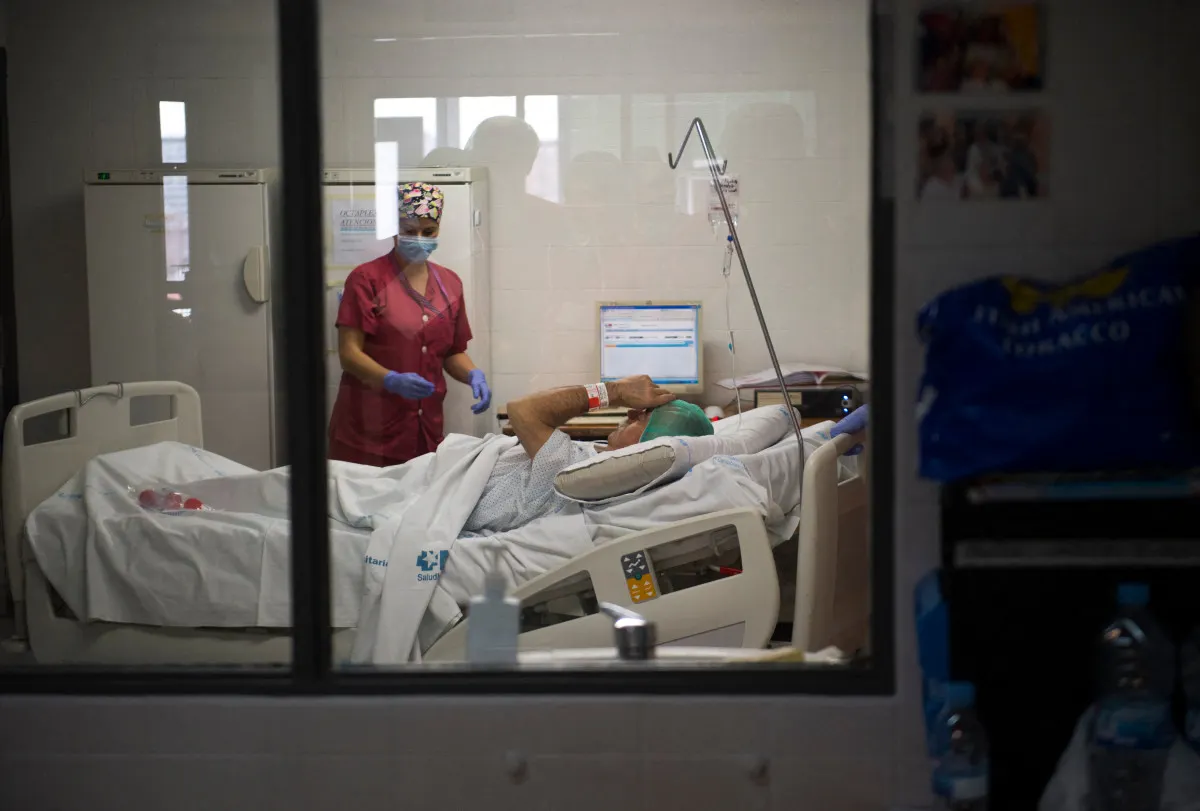
Spain on Tuesday announced it will guarantee free healthcare for more foreigners in the country. Who gets access to the public system now? What documents will they have to show? And does it include cover for Brits and EU citizens?
Although Spain has a free public healthcare system, it’s not always been clear who is actually covered.
There are even contradictions in Spanish law. According to Organic Law (Ley Orgánica 4/2000, de 11 de enero), all foreigners in Spain (legally resident or undocumented) have the right to public healthcare in Spain.
On the other hand, Spain’s General Health Law (14/1986 of April 25, Article 1.2) states that All Spaniards and foreign citizens who have established their residence in the national territory are entitled to the right to health protection and healthcare.
Technically, only those that pay have paid into the social security system are covered under public healthcare.
Advertisement
In practice, whether people who aren’t ‘on the system’ are seen at public hospitals has often depended on the rules in the region, municipality or even hospital.
In some cases, doctors have been willing to help unregistered migrants for free, in other scenarios they’ve asked for co-payment before being treated.
In 2012, Spain’s then-governing conservative PP approved a law in order to exclude migrants without legal residency from accessing public healthcare.
This was reversed by the Socialists when they came to power in 2018, but in recent years administrative barriers have continued to limit access to public healthcare for some population groups.
On March 10th 2026, the Spanish government sought to fireproof free healthcare to undocumented migrants and other people not officially covered by the public health system. So what does this mean?
What exactly has been approved?
Spain’s leftist government has approved a new regulation governing the procedure for recognising the right to healthcare and public-funded treatment for foreign nationals residing in Spain without legal residency.
It is the “effective consolidation of the principle of universality of the National Health System,” according to the official government press release.
The Health Ministry states that “the main objective of this regulation is to establish a uniform and effective procedure throughout the country for recognising the right to health of unregistered and unauthorised foreign nationals. This regulation aims to guarantee equity and prevent inequalities within this group, enabling better disease control through primary care and a more efficient use of public resources.”
What will they have to show to access free public healthcare?
The law states that recognition of the right to public healthcare will be granted through “a declaration of responsibility confirming that they do not have health coverage through other means”.
According to Spanish daily El Diario, for undocumented migrants this means swearing they don’t have social security coverage in another country, or private insurance, or a valid visa in Spain.
Advertisement
Will any other documents be required?
According to Spain’s Health Ministry, residence can be proven with the padrón registration certificate or, failing that, with documentation such as school certificates, utility bills or social services reports.
Such documents should serve to prove their “effective residence in Spain (…) for at least three months.”
“The application activates a provisional document that allows access to healthcare from the first moment and sets a maximum period of three months to resolve the case,” the ministry explains.
Does the bill give healthcare access to other people apart from undocumented migrants in Spain?
Yes. The law now extends protection to Spanish citizens by birth residing abroad and their immediate family members during temporary stays in Spain. Until now, this right was limited to pensioners or workers.
Given that the Spanish government isn’t looking to cover foreigners living in Spain who have other health coverage, this suggests that those on Spanish visas such the non-lucrative visa – which require private cover – would not be able to now access free public healthcare through the new measure.
However, non-EU nationals who’ve never registered as residents in Spain such as ‘under-the-radar’ Brits should now be able to get access to Spain’s sanidad pública (public healthcare).
EU citizens in Spain who don’t have health coverage available in their country of origin will also now be able to access public healthcare in Spain if they meet the requirements.
Advertisement
Why has Spain chosen to do this?
The new rules on universal healthcare go hand in hand with the recently announced blanket regularisation of more than 500,000 undocumented migrants in Spain.
The government’s approach is that these people, who are overwhelmingly of a working age and are working in the black, might as well be contributing to the social security pot and in return having access to public healthcare and other welfare rights.
In short, give them residency papers, a work permit and public healthcare access.
NGOs have also spoken out about the vulnerable situation in which undocumented migrants find themselves vis-à-vis healthcare, and that 2018 reforms didn’t guarantee their access to public hospitals because of wrongful interpretations of the rules in many municipalities.
“This makes the right to healthcare a reality,” Mauricio Valiente, Director General of the Spanish Commission for Refugee Aid (CEAR), told Spanish news agency Efe.
“Our public healthcare system was born from the idea that health is a common good ,” Spain’s Health Minister Mónica said on X.
“And when we take care of everyone’s health, we also take care of the cohesion, coexistence, and dignity of the entire society.”
What about free public healthcare for children and pregnant women?
Spain has always maintained that it will treat children and pregnant women for free and this new legislation again reiterates this by saying that there will be “special protection” for minors under 18 and pregnant women (including during childbirth and postpartum) and that they will be guaranteed comprehensive care.
Are these changes definitely going ahead?
Yes. The measure was approved by royal decree by the Spanish Cabinet, allowing it to bypass parliament, where Socialist Prime Minister Pedro Sánchez’s coalition government lacks a majority.
READ ALSO: How to get healthcare as a tourist in Spain


