


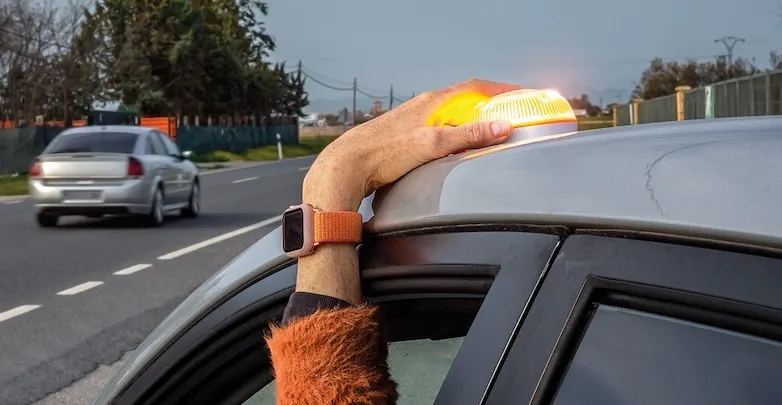
From the start of 2026, new V-16 emergency lights will be mandatory for drivers in Spain, but which are the best ones to buy and how do you know which ones meet the requirements?
From January 1st, 2026, passenger vehicles in Spain will be required to use a V-16 emergency light in the event of a breakdown or road accident.
it is due to officially replace the standard warning triangles next year, meaning most of Spain’s 28 million drivers must purchasing one by the start of next year.
If you drive in Spain, you have four months in which to decide which type of V-16 light you want to buy and have it ready in your car ready for the start of next year.
There are several important features they must have, including transmitting your geolocation in real time to Spain’s DGT traffic authority and an LED light bright enough to be seen from 1,000 metres away and at 360 degrees.
READ MORE: Everything drivers need to know about Spain’s V16 light
Advertisement
Inevitably, lots of companies are taking advantage of the looming deadline, and many of these lights are being sold even though they don’t meet the exact requirements and aren’t entirely legal.
Spain’s chief consumer watchdog OCU has in fact warned people that there are websites selling devices whose “external appearance is similar to that of approved lights, showing them as V16 models approved by the DGT, but that don’t feature the necessary elements such as geolocation, IoT (Internet of Things), or SIM card valid for 12 years or more”.
According to OCU, most approved lights cost between €40 and €50, which includes the SIM. If you see prices a lot less than this, it should signal a red flag, particularly if it’s advertised for under €20.
The safest way to check that the model you’re going to buy meets the requirements that will be introduced next year is to visit the DGT website, where you’ll find a list of approved devices. This page is updated regularly with new ones that come onto the market.
Advertisement
There are also several sold on Amazon that meet the requirements and are legal these include:
SOOS Luz
The SOOS light costs around €45 on Amazon and is DGT-approved with a SIM and paid data until 2038. The V16 beacon also has 3.0 geolocation. It offers maximum visibility from 1km away. It’s also designed to be weather-resistant and includes three AAA batteries.
Hepoluz
The Hepoluz currently costs around €39 on Amazon. It has approved geolocation with IoT eSIM connectivity and DGT 2026 certification. It has built-in eSIM connectivity included up to 2038. 3 x LR06 AA batteries are included. It’s also wind and water resistant.
ITAL – Neoway
This V16 emergency light is for cars and has a magnetic mounting, as well as the mandatory signalling beacon. It has geolocation approved by the DGT. The sim service is with Orange and offers up to 13 years of coverage.
Advertisement
Faselight
The Faselight costs €46 on Amazon and DGT approved with a geo-locator. It is orange in colour which helps locate it in low-light conditions. The light is visible from 1 km away and 360º. It is also equipped with NB-IoT Telefónica connectivity. The sim has a Telefónica Tech data plan valid for more than 12 years.
PMK GRUPO Luz
This option may be good if you live in northern Spain where it may get windier and colder than in the south or Mediterranean coast. It’s designed to withstand wind gusts of up to 80 kilometres per hour thanks to its strong magnetic base. It can also operate in temperatures up to 50C as and low as -10C. It is DGT-approved with geolocation.
Advertisement
Not everyone is happy with the new legislation, however. Spain’s Unified Association of Civil Guard Police have criticised the effectiveness of these new lights.
They claim that they’re not useful on roads with a high number of bends as oncoming drivers don’t get the pre-warning that a triangle provides. Furthermore, they stress that the V-16 lights are not bright or visible enough during daytime hours, rendering them useless.
Nevertheless, it will be obligatory to have one on your car, so you must comply or risk an €80 fine.
READ ALSO: Police slam new compulsory V-16 emergency light for drivers in Spain


