


When it comes to time spent on public transport or in traffic jams or the cost of a monthly travel pass, not all cities in Switzerland are equal. In some places commuters find it easier and cheaper to get to work.
Three longest commutes in Switzerland
As a study from the Federal Statistical Office (FSO) indicates, there are differences in how efficient public transport is in various Swiss cities.
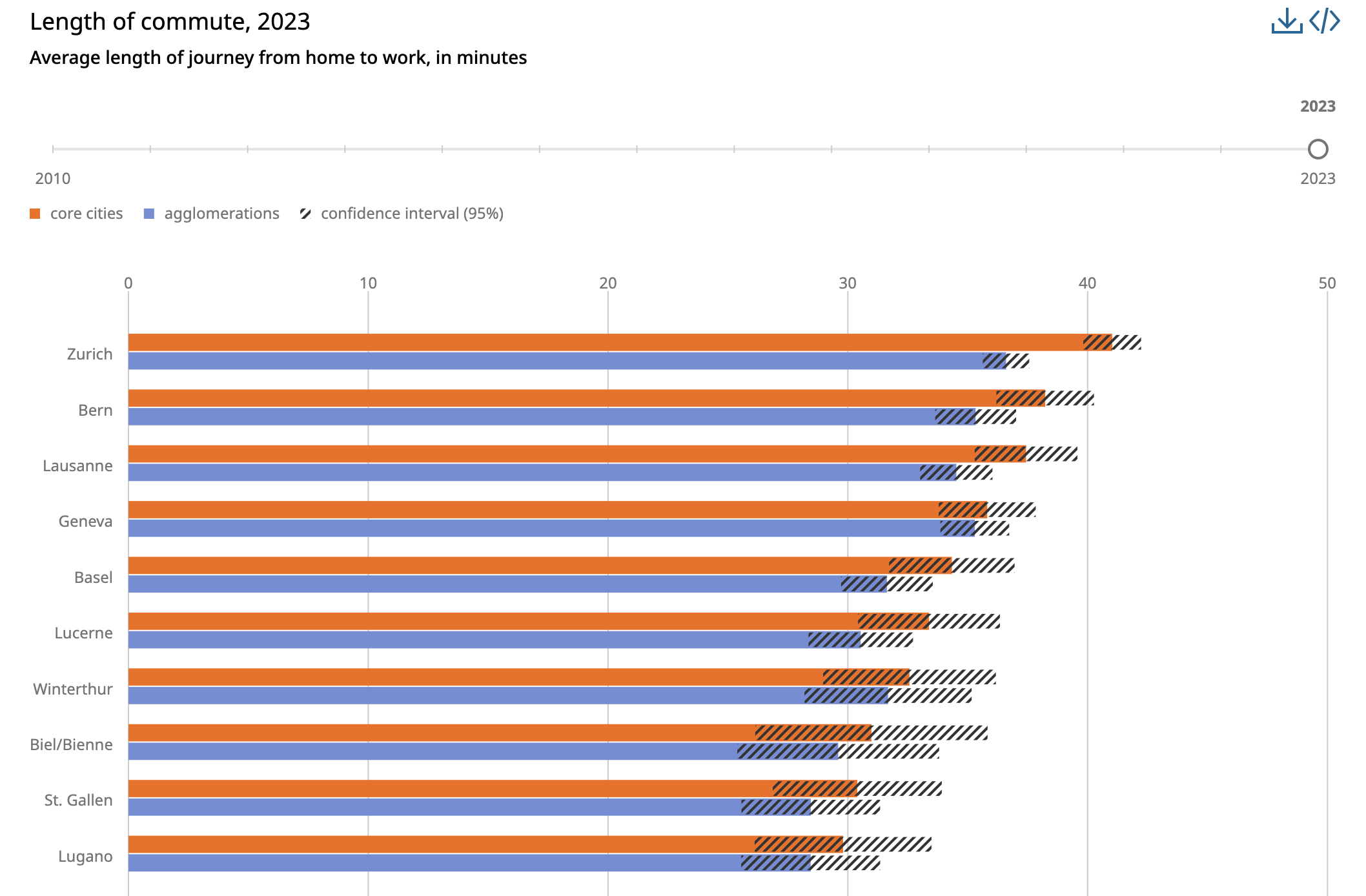
Residents of Zurich, both city and adjacent areas, spend the most time to travel between home and work, whether by public transport or their own vehicle.
In minutes, those living in the city of Zurich spend the longest (41.02 minutes) for the commute, while residents of surrounding areas need 36.69 minutes for travel to get to work.
People in Bern spend slightly less time on the road: 38.23 minutes, versus 35.33 minutes for those living in the city’s agglomeration.
Lausanne is in the third place – a 37.43-minute commute for city dwellers, and 34.52 for those living outside town.
The shortest commute is in Lugano: 29.80 minutes from the city and 28.45 from suburbs.
This chart shows the 10 largest cities in Switzerland and how long the commute from home and work, and vice versa, takes.
Source: FSO
Next: Where are public transport tickets cheapest and most expensive?
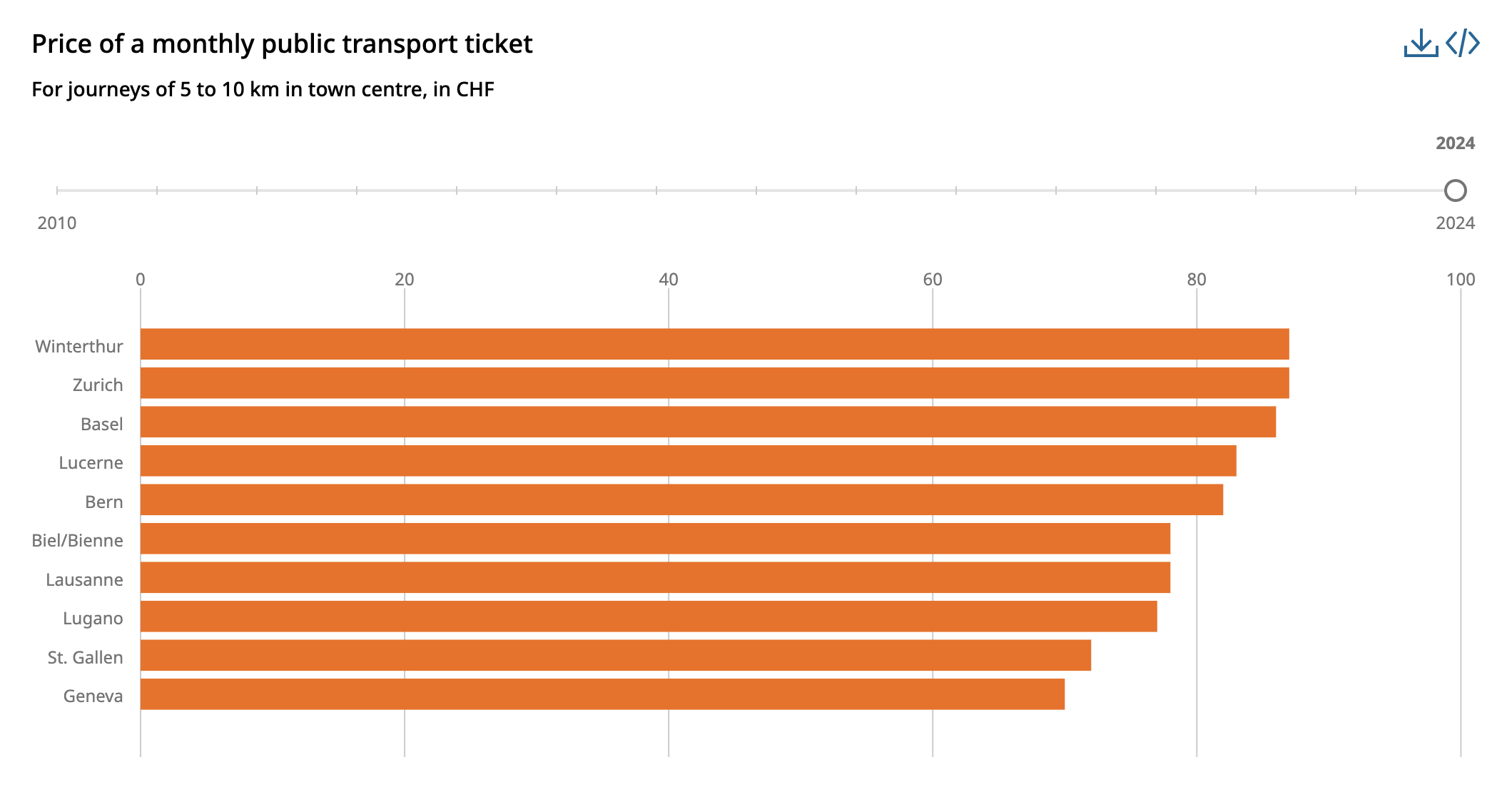
The prices of a monthly public transport ticket for journeys of 5 to 10 km in town centre are the steepest in Winterthur and Zurich, where they cost 87 francs in 2024.
They were only slightly less expensive in Basel (86 francs), followed by Lucerne (83).
However, it is Geneva that fares the best in terms of…fares: 70 francs a month.
Source: Alliance Swiss pass / FSO
Advertisement
The best served cities for pubic transport
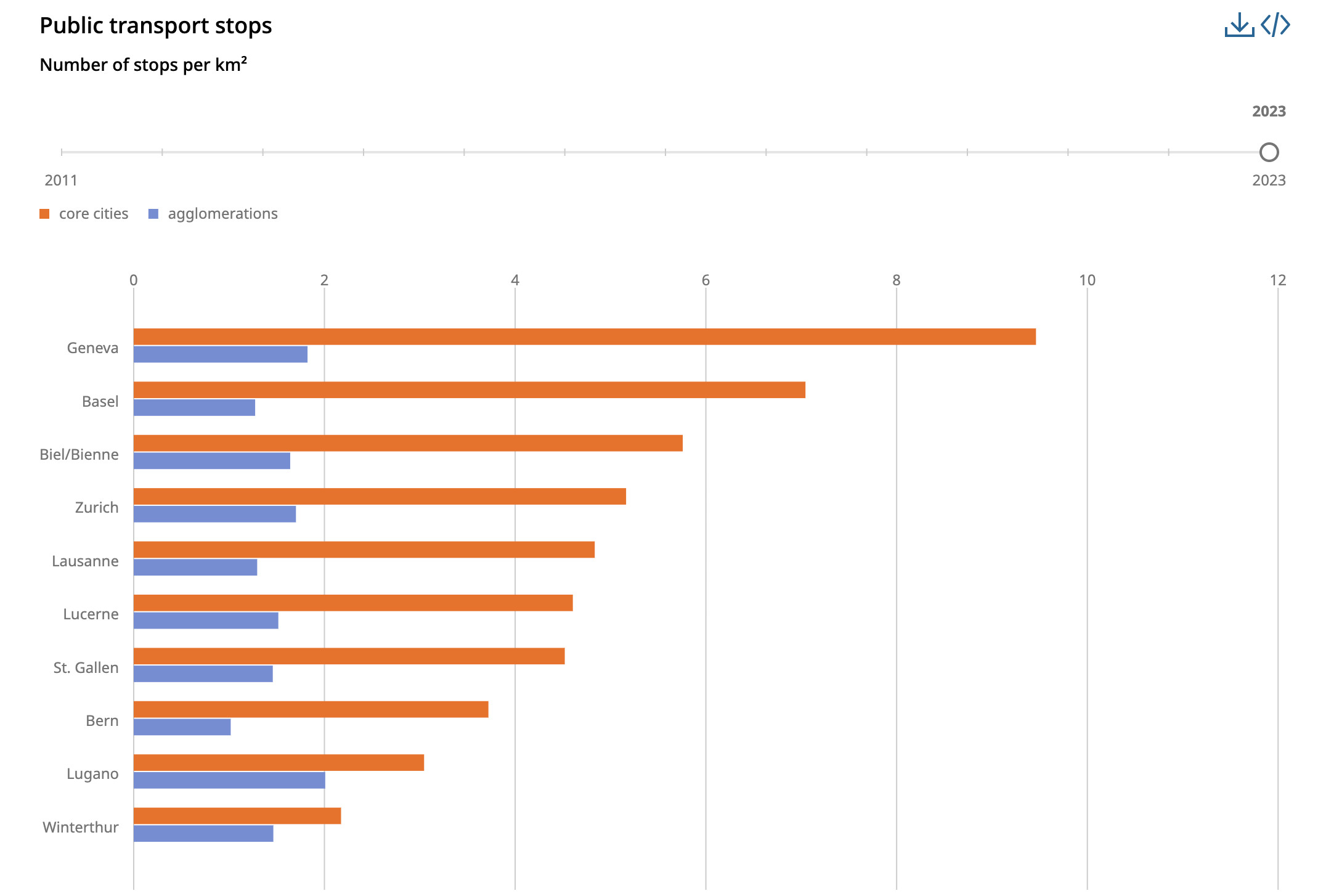
According to FSO, “a well-developed public transportation network, connecting residential and employment areas, increases freedom to choose means of transport and may minimise the impact of private motorised transport in the city.”
However, there is a huge difference between cities and agglomerations.
In this regard, the city of Geneva is at the top of the chart, with 9.46 stops per square km, though this number is only 1.82 in its suburbs.
In the second place, but well below Geneva, is Basel: 7.04 stops per square km in the city, and 1,27 in surrounding areas.
Next, Biel/Bienne’s density is 5.76 stops in the urban area and 1.65 outside the city.
Zurich is fourth: 5.16 and 1.70
In the last place we find Winterthur, with 2.17 stops per square km in the city and 1.46 outside.
Sources: FSO – AREA, ARE – HAFAS
(Interestingly, a city can have a low density of public transport, but still boast an efficient and speedy buses and trams – read more about this below).
How do people in biggest Swiss cities commute to work?
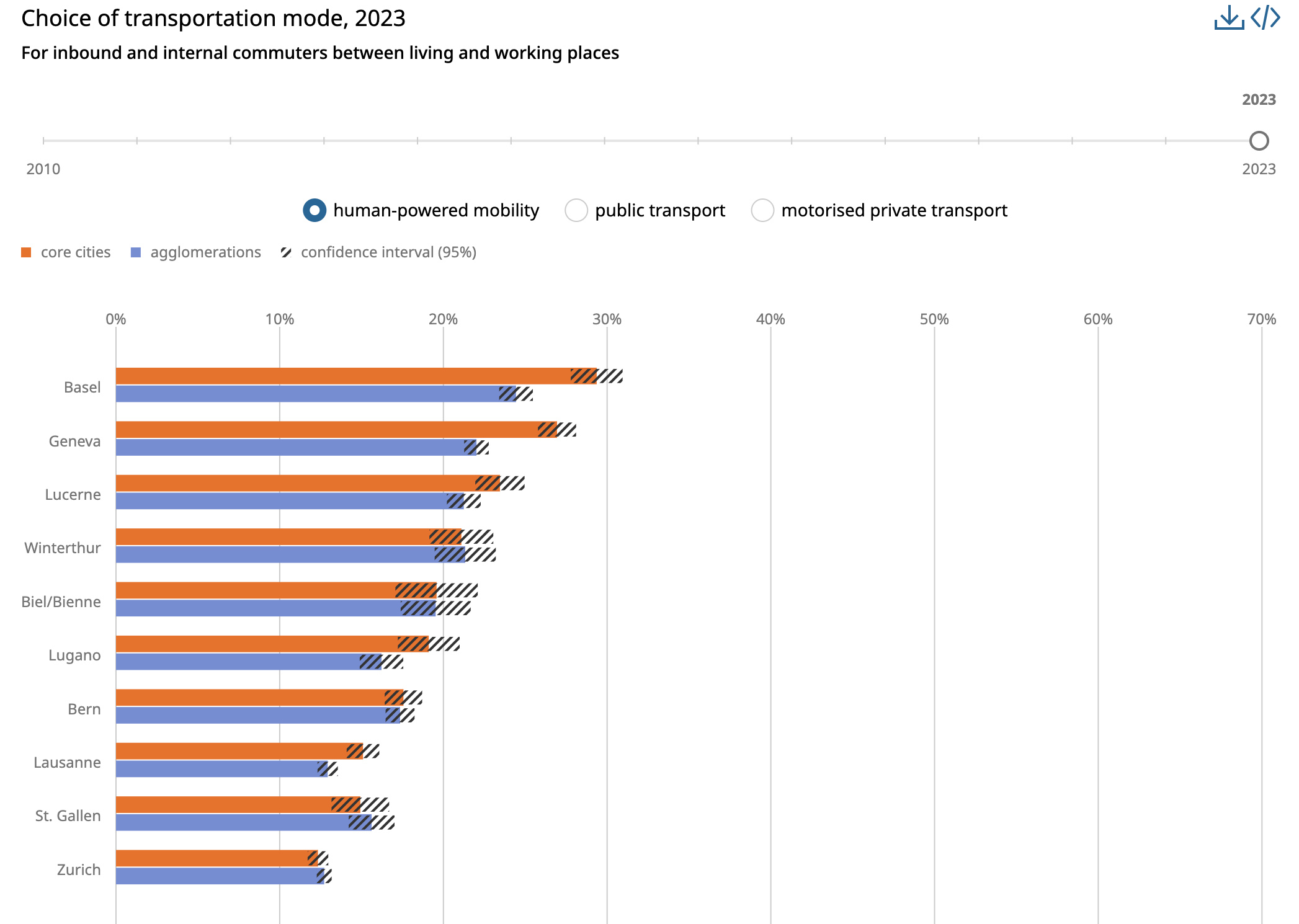
Most people use public transport to get to work, with Zurich in top spot in this category: 68.52 percent of city dwellers and 48.43 percent of those living in the agglomeration choose buses and trams.
Next is Bern (57.02/45.25), and Geneva (53.92/46.07).
In Lugano, however, only 29.62 percent of city residents and 22.25 of those living in surrounding areas use public transport for this purpose.
This is what the corresponding chart looks like:
Source: FSO / RS
But that’s not all:
There are other ways of ‘measuring’ the efficacy of the public transport system, and one such analysis was carried out in 2024 by the Avenir Suisse think-tank.
The organisation had randomly selected 100,000 public transport journeys in the largest Swiss cities.
The departure and arrival addresses were also randomly chosen, and the fastest route was calculated on Google Maps, taking into account the journey to the bus stop, waiting times, and possible connections.
Its goal was to see how fast public transportation gets commuters from point A to point B within a given city – a sign of the system’s efficiency.
It found that he top cities in terms of the speed of their trams and /or buses are:
St. Gallen, where the speed of travel is 9.3 km/h.
Next is Biel/Bienne (9.2 km/h), Lucerne (8.8), Zurich (8.6), Bern (8.5), and Winterthur (8.3).
On the other hand, Geneva has the slowest public traffic network of Switzerland’s largest cities, where commuters travel at the pace of 7.2 km/hour, followed by Lausanne and Lugano (7.7), and Basel (7.8).
Advertisement
And that brings us to the subject of which cities are best and worst for travelling by car?
The answers to this question are provided by another study.
In its 2024 data, Tom Tom, a company specialising in navigation systems, maps, and traffic, revealed the slowest-moving traffic, covering 387 cities around the world – including in Switzerland.
Two Swiss cities had scored poorly in terms of congestion and bottlenecks on its roads.
Not surprisingly, they are the country’s tow largest municipalities: Zurich and Geneva.
In Zurich, it takes 26 minutes to cover the distance of 10 km in the city centre. Motorists spend about 94 hours in traffic each year.
In Geneva, it also takes drivers 26 minutes to get through 10 km, though they spend even longer – 111 hours – stuck in traffic.
READ ALSO: Why has traffic in Geneva become a nightmare for residents?
However, the situation is slightly better, in terms of traffic jams, for commuters in Lausanne and Bern, because these cities are smaller than Zurich and Geneva, as is the size of their downtowns and bottlenecks forming there.


