


In the seven days since the 39-percent US trade tariffs were announced, the normally placid Swiss political landscape has been shaken to its core.
Up until August 1st, the Swiss government was confident that its behind-the-scenes negotiations with the Trump Administration would bear fruit and that Swiss imports to the United States would not be heavily taxed.
The Swiss thought the original 31-percent customs duties that had originally been announced in April were too high and wanted them lowered.
So when the updated 39-percent tariffs were made known just as Switzerland celebrated its National Day, the shock and incomprehension were palpable — especially since duties levied on the EU are much lower at 15 percent.
Why did Switzerland get the worst tariff deal in Europe?
The reason cited by Trump was the trade deficit between the US and Switzerland.
The trade balance was heavily in Switzerland’s favour at 40 billion francs, which Trump didn’t like at all.
But even though this is factually correct, Swiss media reported the obvious flaw in this thinking — that is, Trump has ignored the two countries’ significantly different market sizes.
Proportionally, the 9 million people who live in Switzerland spend significantly more per capita on US products than the more than 340 million Americans spend on Swiss products.
At the end of the day, however, making a deal with Switzerland isn’t a high priority for Trump, as Switzerland accounts for only 1.3 percent of US imports.
Advertisement
What happened next?
Not surprisingly, the country’s economic circles — especially the companies that rely heavily on exports to the USA such as the pharma and watch industries, among others — began to assess their potential losses.
In the worst-case scenario, “tens of thousands of jobs could be lost in Switzerland,” according to Urs Furrer, head of the Swiss Trade Association.
The reason is simple: if fewer Americans are able to buy Swiss goods that will become significantly more expensive, profits will stagnate, and companies in these at-risk industries will likely lay off some of their workforce.
This would impact wages as well: companies no longer finding a lucrative sales outlet for their products in the United States — and are no longer generating profits in that country — could be obliged to put salary increases on hold.
This would mean no pay raises and stagnating salaries.
Overall, Switzerland’s famously strong economy could shrink as a result of high customs, according to the Swiss Economic Institute (KOF).
But the scenario could get even worse.
“If Swiss pharmaceutical products were to be taxed at a rate of 39 percent too [they aren’t for the moment], there would be a real risk that Switzerland will enter a recession.” KOF’s economists pointed out.
Advertisement
What has the Swiss government done in a way of ‘damage control?’
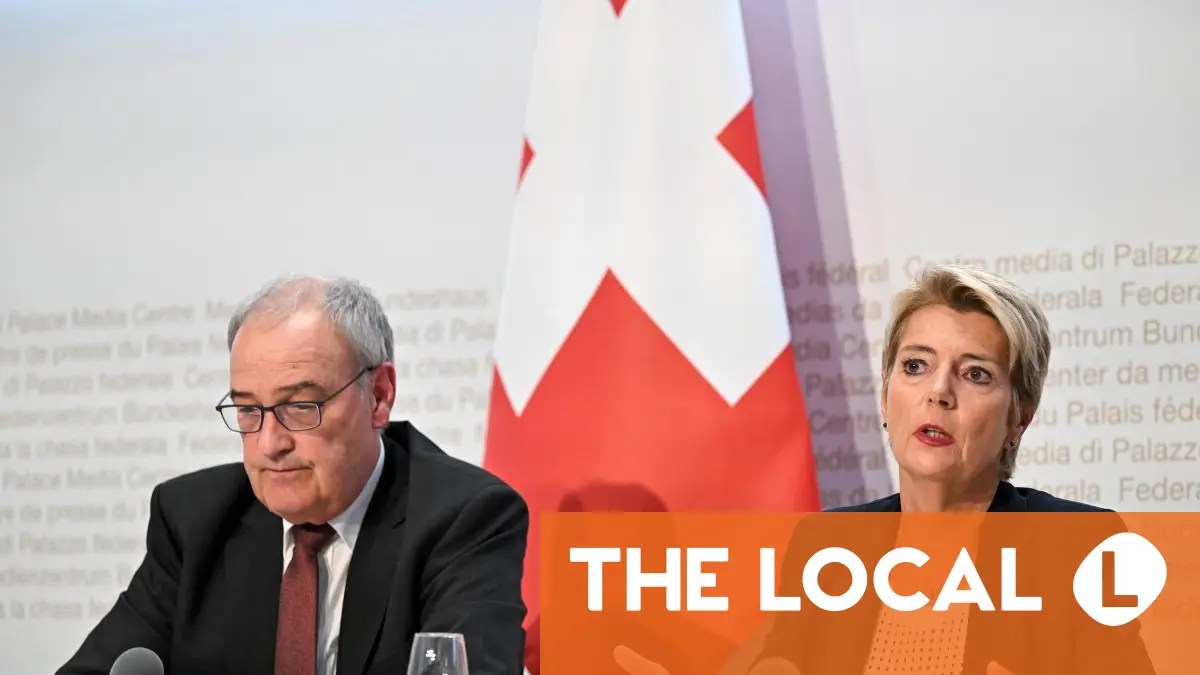
Just a few days after the tariffs were announced, President Karin Keller-Sutter and Economy Minister Guy Parmelin flew to Washington in a hope of renegotiating the customs duties.
This was a bold (even if a desperate) move: the day prior, in an interview with an American news outlet, Trump said that when Keller-Sutter called him a few days previously, he didn’t know who she was.
He referred to her as ‘Prime Minister’ — a post that doesn’t exist in Switzerland.
But when the Swiss delegation arrived in Washington, they did not meet Trump, as they had hoped; instead, they were directed to the Department of State, where they talked with the Secretary of State Marco Rubio, who has nothing to do with tariffs.
Keller-Sutter and Parmelin flew back to Switzerland the following day, having accomplished nothing except, as some media suggested “being humiliated by Trump.”
READ ALSO: Swiss reel from ‘horror scenario’ after US tariff blow
This means that the 39-percent customs duties on Swiss imports, which went into effect on August 7th, remain in place.
In the meantime, experts have suggested some reasons why the Swiss-US negotiations have failed.
According to Swiss negotiation expert Frédéric Mathier, “Trump wants a stage, not a lecture. If you don’t give him the feeling that he in the boss, the shutter goes down immediately.”
Furthermore, what the Swiss government considers as diplomacy, “apparently comes across as lecturing to Trump — and that is exactly what happened in the conversation with Keller-Sutter.”
Another negotiations expert, Daniel Ames from Columbia University, told Swiss media that Trump’s actions are not based on logic, reason, or facts.
Instead, “Trump conducts negotiations like a poker player, not like a statesman; he wants to win, not discuss,” Ames said. “What counts for Trump is who flatters him — and who delivers him the media victory.”
Advertisement
What is ahead for Switzerland now?
After Keller-Sutter and Parmelin returned from Washington, having failed to secure a better tariff deal for Switzerland, the Federal Council held an ’extraordinary’ meeting to discuss its options.
Even defeated, Switzerland “remains firmly committed to pursuing discussions with the US with the aim of reducing these tariffs as swiftly as possible,” the Federal Council said.
It added that the government “remains determined to find a solution that will lead to the prompt removal” of the hefty tariffs.
“Trade tensions are not in Switzerland’s interest,” the Federal Council added. “At present, countermeasures in response to the US tariff increases are not being considered, as they would impose additional costs on the Swiss economy.”
In the meantime, the government “will support sectors affected by additional tariffs, and generally ease the burden on companies.”


